Blog
Publish: 10 Nov 26Reading Time: 7 Min
Before a sustainability-linked loan (SLL) or bond (SLB) is signed, lenders and investors check five things: whether the KPIs are material, whether the targets are ambitious, how pricing moves with performance, how results will be reported and who will verify them. The LMA, APLMA and LSTA Sustainability-Linked Loan Principles (26 March 2025 edition) recommend confirming this before signing where appropriate, for example through a second-party opinion (SPO). Verification of results after signing is not optional: both the loan and bond principles treat it as a necessary element.
Last checked: 10 November 2026.
The difference is what the money is tied to. Use-of-proceeds instruments finance specific eligible projects. Sustainability-linked instruments finance the borrower in general and tie the cost of the debt to company-wide performance.
| Sustainability-linked loan (SLL) | Sustainability-linked bond (SLB) | Use-of-proceeds loan or bond (green, social, sustainability) | |
|---|---|---|---|
| Market standard | LMA/APLMA/LSTA Sustainability-Linked Loan Principles, 26 March 2025 | ICMA Sustainability-Linked Bond Principles, June 2024 | Green Loan Principles; ICMA Green Bond Principles (June 2025) and related guidelines |
| What the money funds | Usually general corporate purposes | General purposes | Eligible projects or activities only |
| What is tested | KPIs and sustainability performance targets (SPTs) | KPIs and SPTs | Project eligibility and how proceeds are managed |
| What changes if targets are missed | Financial and/or structural terms, most often the margin | Financial and/or structural terms, most often the coupon | Nothing in pricing; the test is allocation and reporting |
| Pre-signing external review | Recommended | Recommended | Set by the respective principles |
| Post-signing verification of target performance | Necessary element | Necessary element | No targets to verify; reporting covers allocation |
One practical consequence: in an SLL or SLB, the lender is not asking "what will you build?" but "how will we know you improved?" Every check below follows from that question.
Both sets of principles are built on the same five core components. The 2025 loan principles separate mandatory requirements ("shall") from recommendations ("should"), which tells a borrower where there is no room to negotiate.
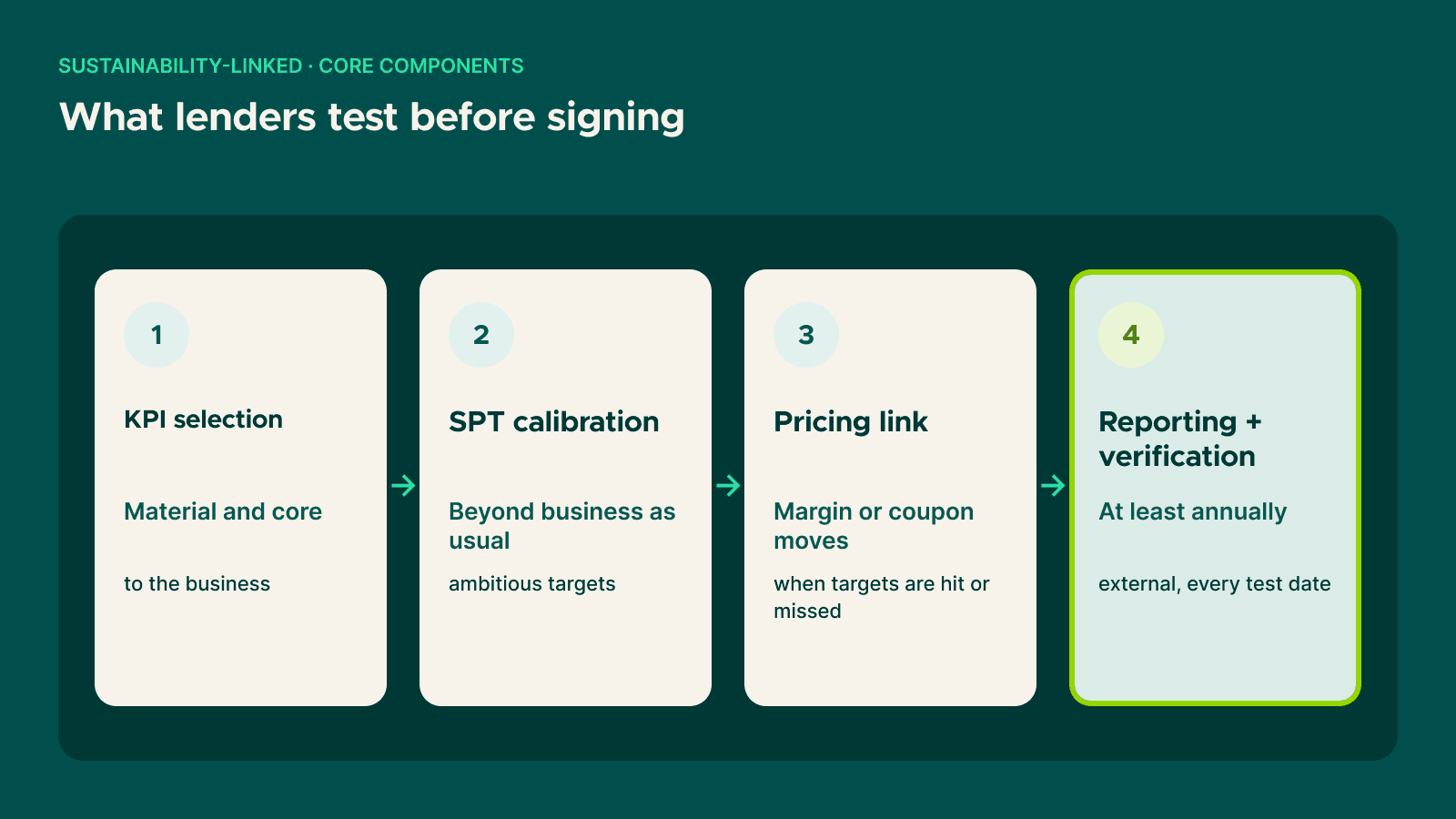
A pre-signing SPO is an external party's assessment of whether the instrument aligns with the five core components. The loan principles list what the reviewer should test:
The ICMA bond principles describe the same scope for a pre-issuance SPO. If no external review is sought, the loan principles expect the borrower to show, and document, the internal expertise to evidence alignment, and to share that documentation with lenders on request.
What an SPO does not do: it does not verify that targets were met. That is the post-signing verification, a separate engagement that recurs for every observation date. Mixing the two up is how borrowers end up with no verifier lined up when the first test date arrives.
The SPO is where a lender's question turns into evidence: which KPI, which baseline, which benchmark, and why the target is ambitious for this company in this sector. In our SPO for Çelebi's IFC-linked sustainability-linked loan, IFC being a member of the World Bank Group, the assessment went principle by principle against the Sustainability-Linked Loan Principles, with evidence requested and clarified before the opinion was finalised.
Semtrio is a World Bank accredited vendor and has delivered independent SPOs for projects financed by World Bank Group institutions, including IFC, and by J.P. Morgan. Our sustainable finance work has contributed to US$2.8 billion in sustainable financing.
Use this before the term sheet is final. Each item maps to a component lenders will test.
No. The Sustainability-Linked Loan Principles recommend pre-signing external review, such as an SPO, where appropriate. Without one, the borrower should demonstrate and document the internal expertise to evidence alignment with the five core components.
Yes. Under the 2025 loan principles, borrowers shall obtain independent external verification of performance against each SPT for every date relevant to a pricing adjustment. The ICMA bond principles also call post-issuance verification a necessary element.
Yes. Use of proceeds is not what defines an SLL, and in most cases SLLs are used for general corporate purposes. The test is performance against the SPTs, not where the money goes.
They must represent a material improvement in the KPI and go beyond both business as usual and any target already required by regulation. Lenders expect this to be shown through benchmarking against your own track record, your peers or science-based references.
An SPO is done before signing and assesses whether the KPIs, targets and structure align with the principles. Verification is done after signing, at each observation date, and confirms whether the targets were actually met.
For loans, the Sustainability-Linked Loan Principles of 26 March 2025. For bonds, the ICMA Sustainability-Linked Bond Principles of June 2024; ICMA's June 2025 update changed the Illustrative KPIs Registry, not the principles themselves.
Related reading: Corporate GHG accounting for verified baselines · SBTi advisory for science-based target references · How assurance works under IFRS S1 and S2 · Sustainable finance framework design
Before your term sheet is final, a pre-signing second-party opinion gives you a component-by-component assessment of your KPIs, SPTs and pricing structure against the Sustainability-Linked Loan or Bond Principles.
Get in touch
If something you've read here connects to a live project, a reporting deadline, or a decision you're weighing — we're happy to have a useful conversation.
Contact usLets talk about your sustainability goals.