Blog
Publish: 02 Sep 26Reading Time: 4 Min
Assurance under IFRS S1/S2 is the independent verification of a company's sustainability and climate disclosures by an external assurance provider, similar in concept to financial statement audits. The ISSB itself does not set assurance requirements — whether assurance is required, at what level, and on what timeline is determined by each jurisdiction's regulator, which means assurance obligations vary as much as the underlying disclosure mandate does.
Investors and other users of sustainability disclosures rely on the information being accurate and complete, much as they rely on audited financial statements. Assurance provides that independent check. As IFRS S1/S2 disclosures move from voluntary to mandatory in more jurisdictions, regulators are increasingly building assurance requirements into the compliance framework — recognizing that disclosure without verification carries less weight for investment decision-making.
Assurance engagements generally fall into two categories, both defined by international assurance standards rather than the ISSB itself:
Many jurisdictions phasing in assurance requirements start with limited assurance and move toward reasonable assurance over subsequent reporting cycles, mirroring the phased approach many took with the underlying disclosure mandate itself. The specific assurance level, phase-in timeline, and scope (for example, whether Scope 3 emissions are included) vary by jurisdiction and should be confirmed against the applicable local rule.
Jurisdictions differ on whether sustainability assurance must be provided by a traditional financial statement auditor, can be provided by another qualified independent assurance provider, or can be provided by either. This is an active area of regulatory development globally, and companies should confirm the applicable rule in each jurisdiction where they report rather than assuming their financial auditor is automatically permitted — or required — to provide sustainability assurance.
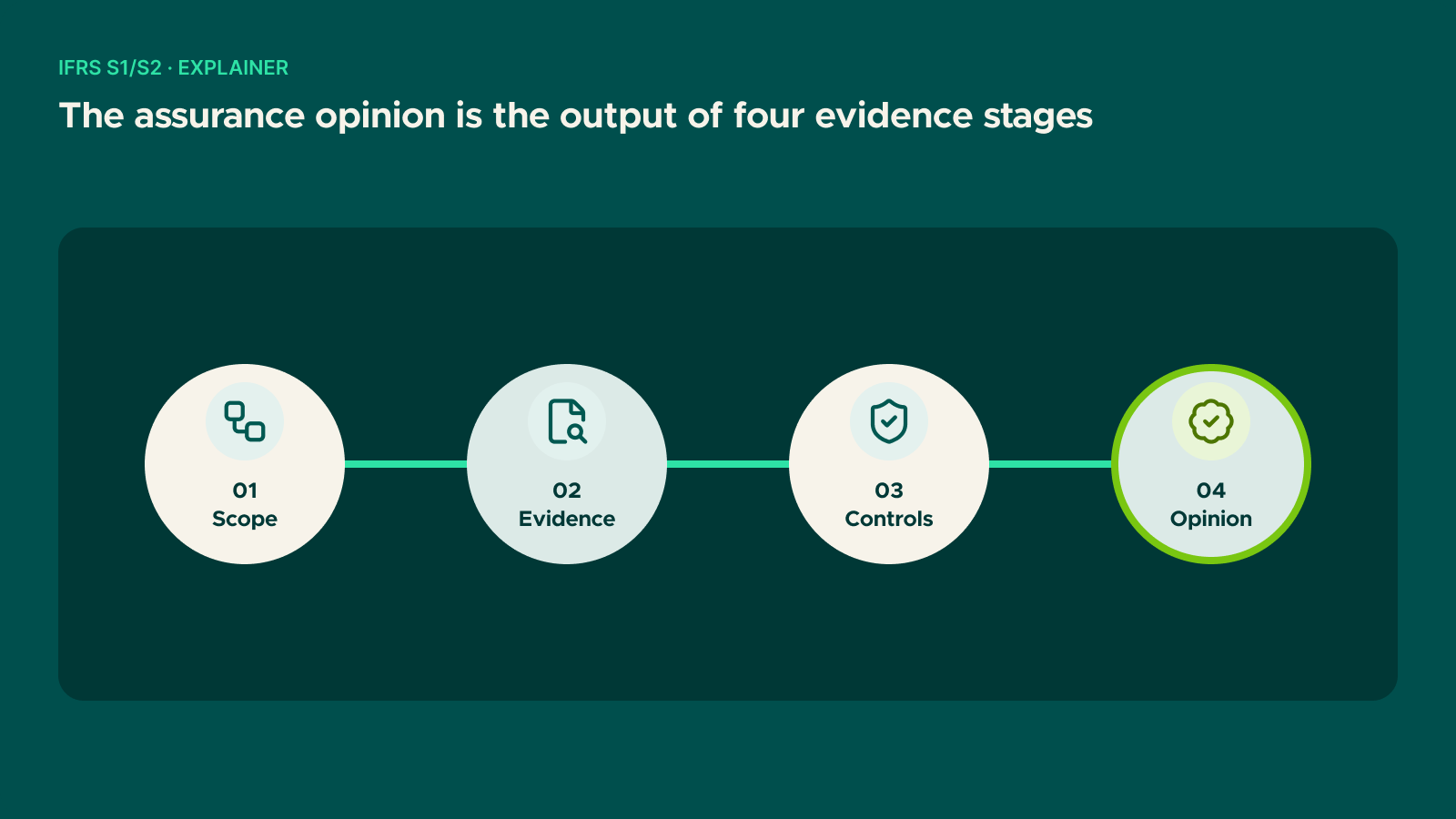
Being ready for assurance is different from simply producing a disclosure. Assurance providers need to test underlying data, processes, and controls, which means assurance-readiness typically requires:
Companies that build these elements into their reporting process from the outset — rather than retrofitting them once assurance becomes mandatory — generally face a smoother transition when assurance requirements phase in.
Assurance readiness should not be treated as a separate, later-stage project. It is most efficient when built into the disclosure design process from the start, following directly from the gap analysis described in How to Start Your IFRS S1/S2 Compliance Journey: A Gap Analysis Guide. A gap analysis that identifies data and control gaps early gives a company time to close them before assurance is mandatory, rather than scrambling once a regulator's assurance requirement takes effect.
Semtrio's IFRS S1/S2 advisory service includes assurance-readiness preparation as a core workstream — building the data architecture, documentation, and internal controls that an assurance provider will test, ahead of any mandatory assurance deadline.
Semtrio Note: As a CDP Accredited Solutions Provider, Semtrio works routinely with the data verification standards CDP applies to corporate emissions disclosures — discipline that transfers directly into preparing clients' GHG data for external assurance under IFRS S2.
No. The ISSB sets the disclosure standards themselves but does not set assurance requirements — those are determined independently by each jurisdiction's regulator.
Limited assurance results in a negative-form conclusion based on more limited procedures, while reasonable assurance involves more extensive testing and results in a positive-form opinion, comparable in rigor to a financial statement audit.
This depends on the jurisdiction — some permit only financial statement auditors, others permit a wider range of qualified independent assurance providers. The applicable rule should be confirmed jurisdiction by jurisdiction.
Ideally during the initial gap analysis and disclosure design phase, rather than waiting until an assurance mandate takes effect, since building data and control documentation retroactively is more difficult.
Assurance scope, including whether Scope 3 emissions are covered, varies by jurisdiction and phase-in stage; this should be confirmed against the applicable local rule.
If your organization needs to prepare its IFRS S1/S2 disclosures for external assurance, Semtrio can assess your current data and control environment and build a readiness plan. Contact Semtrio to discuss your assurance timeline.
Get in touch
If something you've read here connects to a live project, a reporting deadline, or a decision you're weighing — we're happy to have a useful conversation.
Contact us
Regulation & Compliance
Regulation & Compliance
Regulation & Compliance
Lets talk about your sustainability goals.