Blog
Publish: 17 Sep 26Reading Time: 5 Min
The difference between CBAM's transitional and definitive periods is usually summarised as "now you have to pay". That summary is incomplete. What changed on 1 January 2026 is also the legal standing of the reported data, who is permitted to import at all, and what happens when a figure is wrong. Taken together, these changes make most of the working practices built during the transitional period unusable.
From 1 October 2023 to 31 December 2025, CBAM was a data-collection regime rather than a compliance regime. EU importers reported quantities and embedded emissions each quarter. There was no payment, no certificate, and critically no requirement for the reported emissions to be independently verified.
For the Commission the period served two purposes: sizing the trade flows in scope, and testing whether the methodology worked in practice. For most exporters it was experienced as a spreadsheet exercise — a customer sent a template, production and environmental staff filled it in, the template went back.
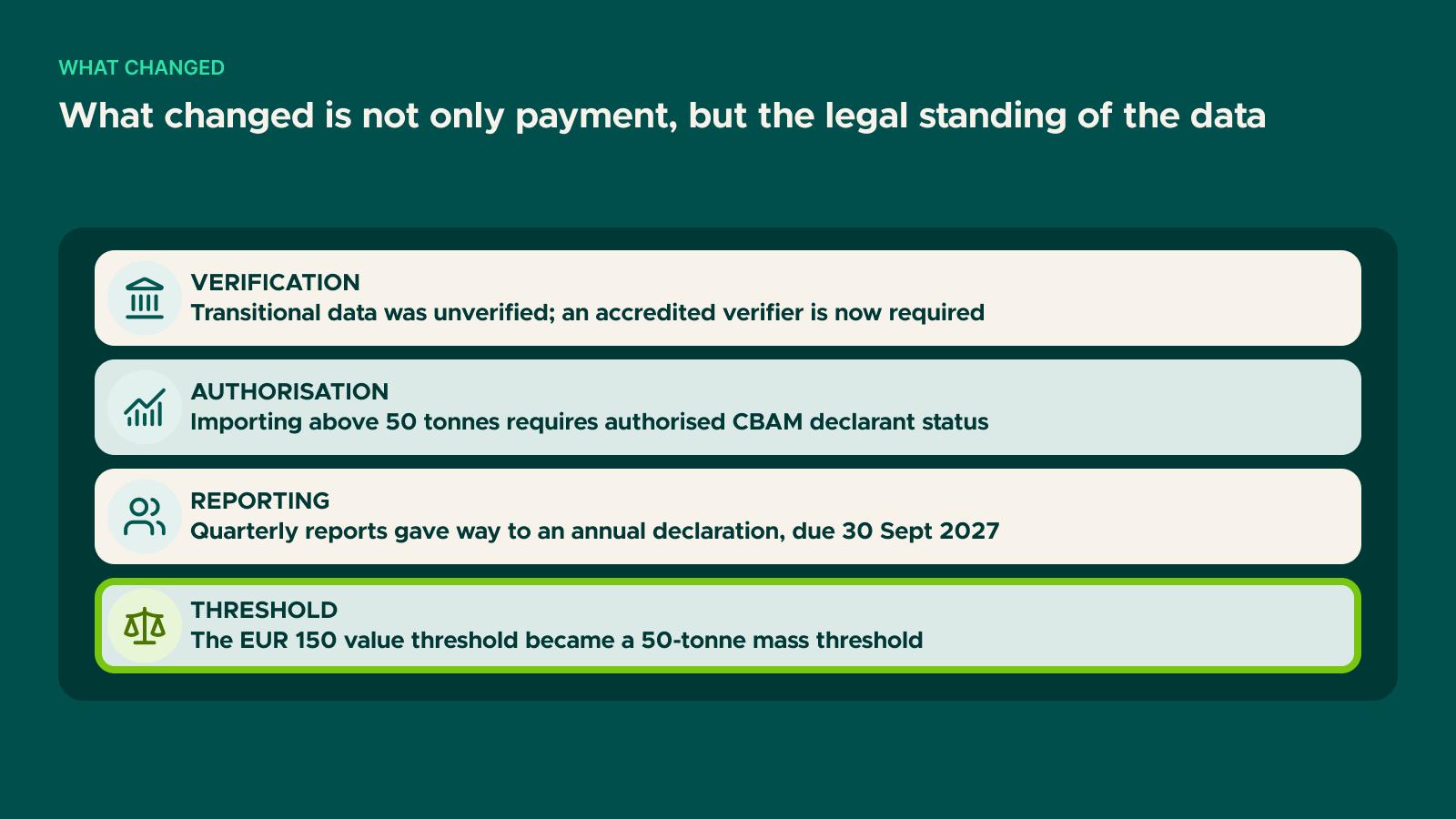
Reported emissions used to be a notification. They are now the tax base of a financial obligation, and the expectation attached to how they are produced has changed accordingly.
Actual emissions must now be verified by an independent verifier accredited under CBAM by an EU national accreditation body. The verifier applies a risk-based approach and must reach an opinion giving reasonable assurance that total emissions are not materially misstated. A physical site visit is mandatory in the first year, with flexibilities — virtual visits or exemptions — available subsequently; a site visit is expected at least every two years. For electricity emissions, one site visit covering five reporting periods is accepted.
In practice this means a completed template is no longer enough. Every figure must trace back to a source record: fuel consumption to invoices, raw material composition to laboratory analyses, production quantity to weighing records. The verifier audits the system that produces the number, not the number.
No particular status was required to import CBAM goods during the transitional period. Companies importing more than a cumulative 50 tonnes per year must now hold authorised CBAM declarant status before the goods can enter free circulation.
The Regulation softened the transition: importers who submitted an application by 31 March 2026 may continue importing throughout 2026 until their national competent authority decides, even above the threshold. That relief applies only to those who applied. For an importer above the threshold that did not apply, exceeding it becomes an import blockage — and a penalty in the range of €300 to €500 per tonne of embedded emissions, against the standard €100 per tonne for other non-compliance.
For suppliers this creates a commercial timing risk rather than a legal one: if the customer's status is missing or pending, the shipment sits at the border. Where the incoterm is DDP, that cost lands on the seller. We cover the status and the threshold in authorised CBAM declarant status and the 50-tonne threshold.
The Omnibus Regulation adopted in October 2025 simplified the mechanism on several points before the definitive regime began. The changes are mostly favourable to importers, but they also shape supplier preparation:
Work done during the transitional period is not wasted, but the directly transferable portion is narrower than most companies assume.
Having been able to fill in a template does not indicate an ability to pass verification. The distance between the two is the distance between an estimate and an audit.
2026 is the year in which data is generated but no financial consequence has yet crystallised. That dual position creates an unusual preparation window. The record-keeping regime the verifier will examine in 2027 is being established right now, and a mistake made while the free allocation factor stands at 97.5% costs a fraction of the same mistake in 2030, when the factor falls to 51.5%.
The full sequence of dates is set out in CBAM cost modelling 2026-2034, and the verification process in CBAM verification and accredited verifiers.
No. Declarations under the definitive regime must rest on data for a reporting period of 2026 or later.
The quarterly reporting obligation ended and was replaced by an annual declaration. From 2027, however, declarants must hold at least 50% of the certificates corresponding to year-to-date imports at the end of each quarter.
The Regulation does not assign it. In practice verification is performed once at installation level and the same report serves all customers, so producers commonly bear it — but this should be set out in the contract.
They are most likely below the 50-tonne threshold and therefore outside the mechanism entirely.
We work on restructuring transitional-period data practices to meet definitive-regime requirements under our CBAM accounting and reporting service. You can contact us with your questions.
Get in touch
If something you've read here connects to a live project, a reporting deadline, or a decision you're weighing — we're happy to have a useful conversation.
Contact us
Regulation & Compliance
Regulation & Compliance
Regulation & Compliance
Lets talk about your sustainability goals.