Blog
Publish: 17 Sep 26Reading Time: 7 Min
The Carbon Border Adjustment Mechanism (CBAM) puts a price on the greenhouse gas emissions embedded in carbon-intensive goods imported into the European Union, so that those goods carry a carbon cost comparable to the one EU producers pay under the EU Emissions Trading System. It began on 1 October 2023 as a reporting-only exercise. Since 1 January 2026 it has been a financial obligation. The obligation falls on the EU importer, but every figure that determines its size originates in the installation where the goods were made.
EU industrial installations have paid for their greenhouse gas emissions through the EU Emissions Trading System since 2005. That price is embedded in the cost structure of every EU cement kiln and steel plant. An identical product made in a jurisdiction without carbon pricing and then imported into the EU carries no such cost.
This asymmetry has two consequences. The first is competitive: EU producers are disadvantaged in their own market. The second matters more for climate policy: production migrates to jurisdictions without carbon pricing, which is known as carbon leakage. Emissions fall inside the EU but not globally, and may rise if the receiving installations are less efficient.
CBAM closes that gap. Stated in one sentence: goods imported into the EU are charged the carbon cost they would have borne had they been produced inside the EU. It is not a customs duty. It is an equivalence measure mirroring the EU ETS on the import side — a distinction that matters legally, because the mechanism's defensibility under World Trade Organization rules rests precisely on that equivalence claim.
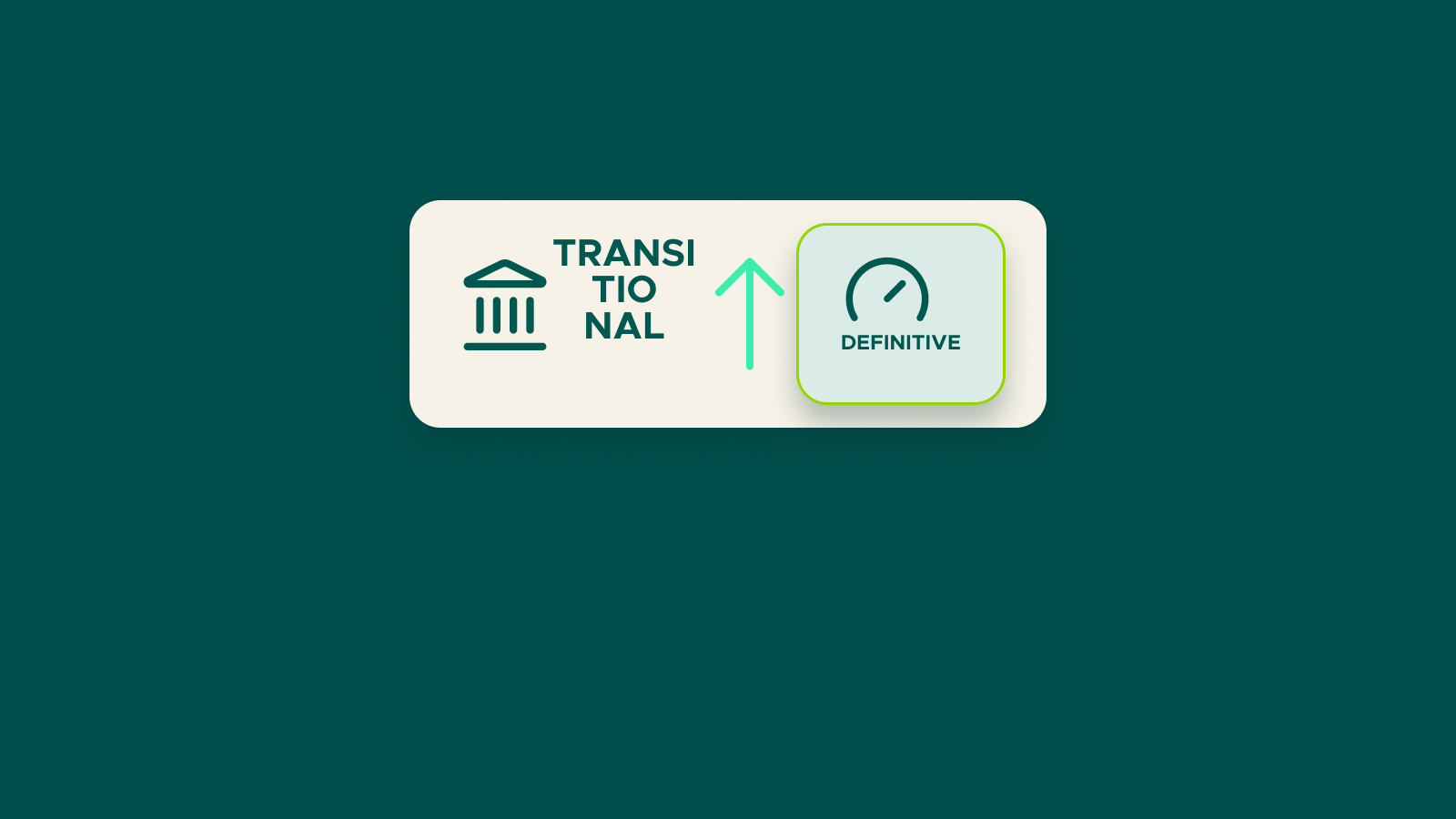
Between 1 October 2023 and 31 December 2025, importers only had to report the embedded emissions of the goods they imported, quarterly. There were no payments, no certificates and no verification requirement. The period existed to build the data infrastructure and give the Commission a picture of the trade flows involved.
Three structural changes took effect with the definitive regime:
2026 is the year in which all three changes apply but the bill has not yet arrived: imports happen throughout 2026, and payment falls due in 2027.
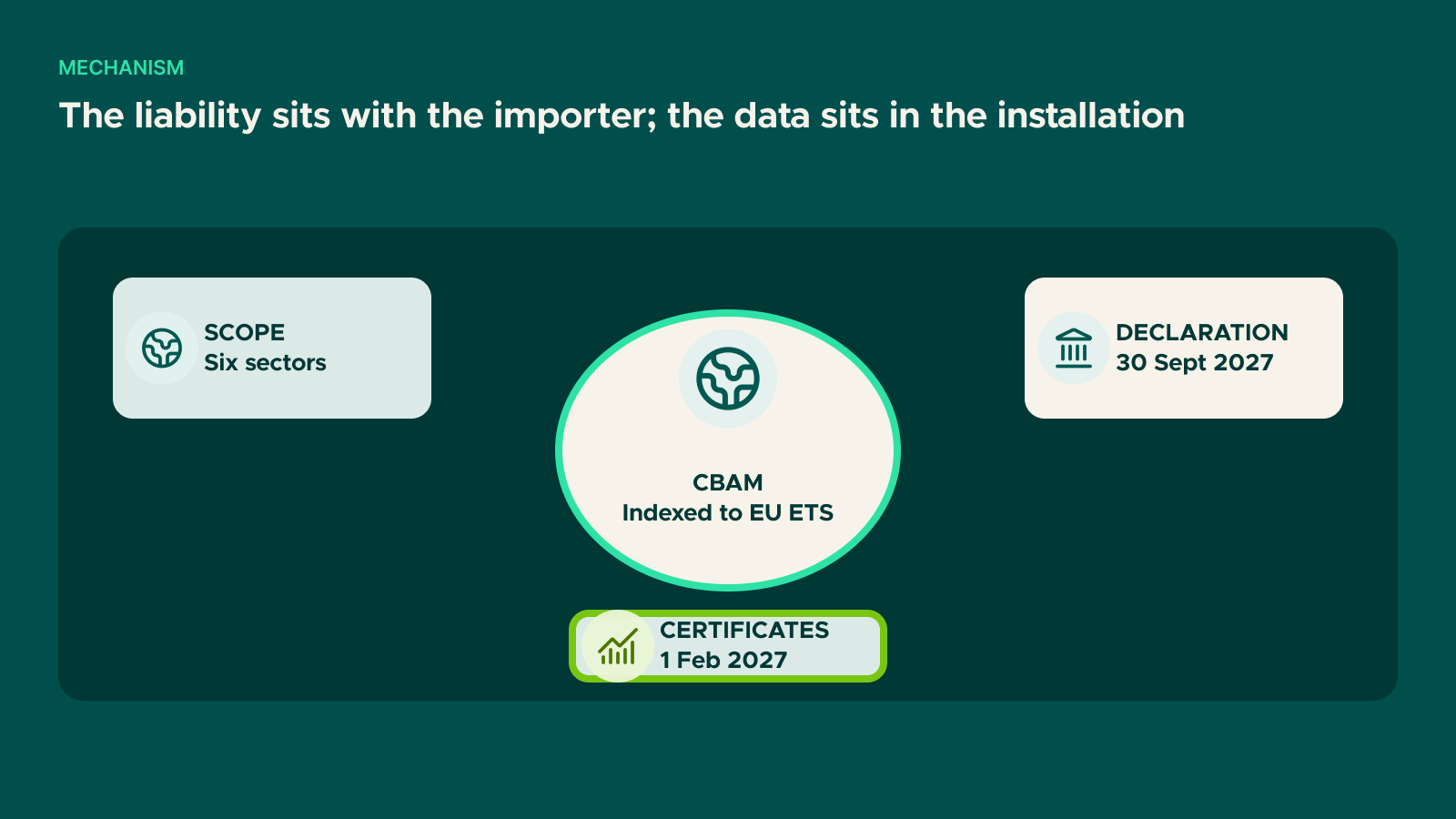
Scope is defined by Combined Nomenclature (CN) code, not by product name or sector. Only the CN codes listed in Annex I of the Regulation are covered; a good that is not listed is out of scope however carbon-intensive it may be. Six sectors are in scope:
Two points are commonly missed. Scrap is not in scope, which materially affects the position of electric arc furnace steel and secondary aluminium. And the Commission has proposed extending scope to 180 downstream goods from 1 January 2028 — vehicles, industrial machinery, metal articles and household appliances, whose inputs are on average 79% steel and aluminium by content. We set out how to run a scope check in CBAM goods and CN codes.
The legal obligation sits with the authorised CBAM declarant established in the EU. A non-EU producer has no declaration duty, no certificate obligation and no direct penalty exposure under EU law.
The content of the declaration, however, is entirely data from the production installation: system boundaries, production route, fuel and raw material consumption, electricity sourcing and the emissions embedded in precursors. The importer cannot generate any of it. The mechanism therefore splits legal liability from data responsibility, and the second half rests with the supplier.
A supplier that does not provide data does not escape the mechanism; its goods are simply calculated using default values. Default values are set by country and production route, and a mark-up is added on top — 10% for 2026, 20% for 2027, 30% from 2028, with fertilisers fixed at 1%. Not supplying data therefore has a measurable, quantifiable price, which we set out in default values and country mark-ups.
The obligation is not calculated on the full embedded emissions. Four components determine it: the embedded emissions of the goods, the CBAM benchmark, the free allocation factor, and any carbon price already paid in the country of production.
The benchmark represents the emissions intensity of the most efficient EU installations producing that good. EU producers continue to receive free allocation up to that benchmark, phased down to zero between 2026 and 2034. CBAM mirrors this: the benchmark multiplied by that year's free allocation factor is deducted from the importer's obligation.
The factor is 97.5% in 2026, falling to 51.5% in 2030, 14% in 2033 and zero on 1 January 2034. The decline is not linear; the sharpest single-year drop is between 2029 and 2030.
The critical point, and the one most often stated incorrectly: a 97.5% free allocation factor does not mean the obligation equals 2.5% of embedded emissions. That equivalence holds only where the installation's emissions intensity exactly equals the benchmark. Every unit above the benchmark enters the obligation in full, with no free allocation against it.
Using an illustrative benchmark of 1.50 tCO2 per tonne:
That is a fourteen-fold difference in the first year of the definitive regime. At the certificate prices published for 2026 — €75.36 for Q1 and €75.28 for Q2 — the gap translates into roughly €2.8 against €40.5 per tonne of product. We work through the arithmetic in the CBAM cost formula.
The calendar dictates the sequence. Emissions arising in 2026 will be verified in 2027 and declared by 30 September 2027. Emissions data cannot be reconstructed retrospectively, so 2026 is the only opportunity to generate verifiable records for that period.
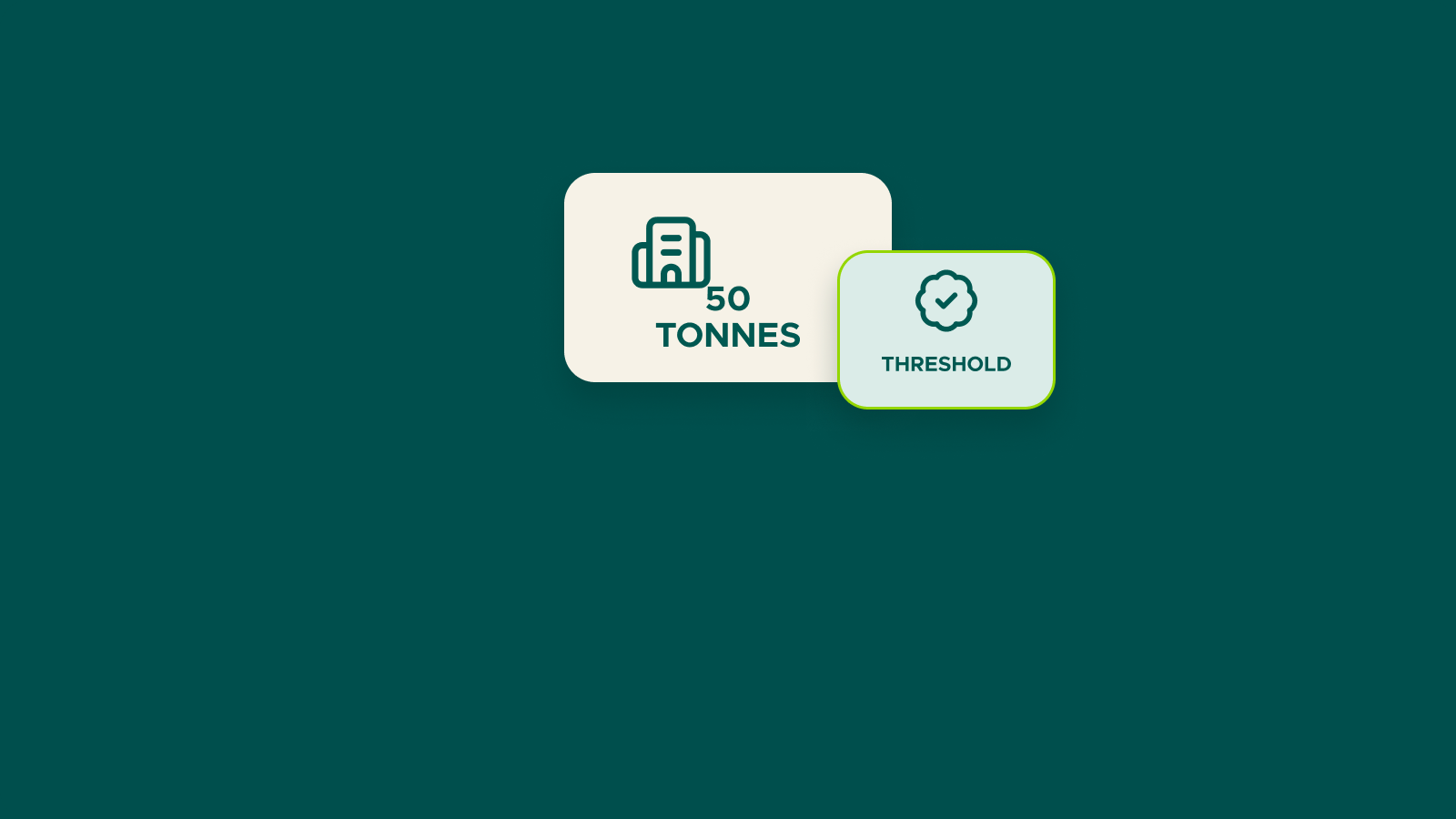
No. Importers below the cumulative annual threshold are exempt from CBAM obligations entirely, including the need to calculate emissions. Electricity and hydrogen are excluded from this exemption.
No. Default values apply where actual data is not available, with the mark-up added. For installations performing better than the country average, not supplying data is a direct commercial loss.
Beyond the proposed downstream extension, the 2025 review considered extending indirect emissions to steel, aluminium and hydrogen, adding transport emissions, and bringing in organic chemicals, polymers, refinery products, paper, glass and ceramics.
No. It is designed as an equivalence measure mirroring the EU ETS, and the certificate price is indexed to EU ETS allowance prices rather than set as a trade measure.
We work on embedded emissions calculation, monitoring methodology and verification readiness under our CBAM accounting and reporting service. You can contact us with your questions.
Get in touch
If something you've read here connects to a live project, a reporting deadline, or a decision you're weighing — we're happy to have a useful conversation.
Contact usLets talk about your sustainability goals.