Blog
Publish: 17 Sep 26Reading Time: 5 Min
The first question any company asks about CBAM is whether its goods are covered. The answer is not in the product's commercial name, its sector or its carbon intensity, but in the Combined Nomenclature code on the customs declaration. Because one code within a product family can be in scope while its neighbour is not, a scope check has to be run line by line rather than sector by sector.
The CBAM Regulation does not define scope through a product description or a sector test. Annex I lists Combined Nomenclature codes, and those codes are the scope. Two consequences follow.
First, scope is not arguable. If a line's code is listed, it is covered; if not, it is not. Second, and more inconveniently, two goods leaving the same production line can be treated differently. There are goods with high carbon intensity that are out of scope, and goods with low carbon intensity that are in.
This is why the assumption "we are a steel company, so all our exports are covered" produces both unnecessary data-collection work and gaps in preparation. The right starting point is a list of actual export lines with their codes, compared against Annex I.
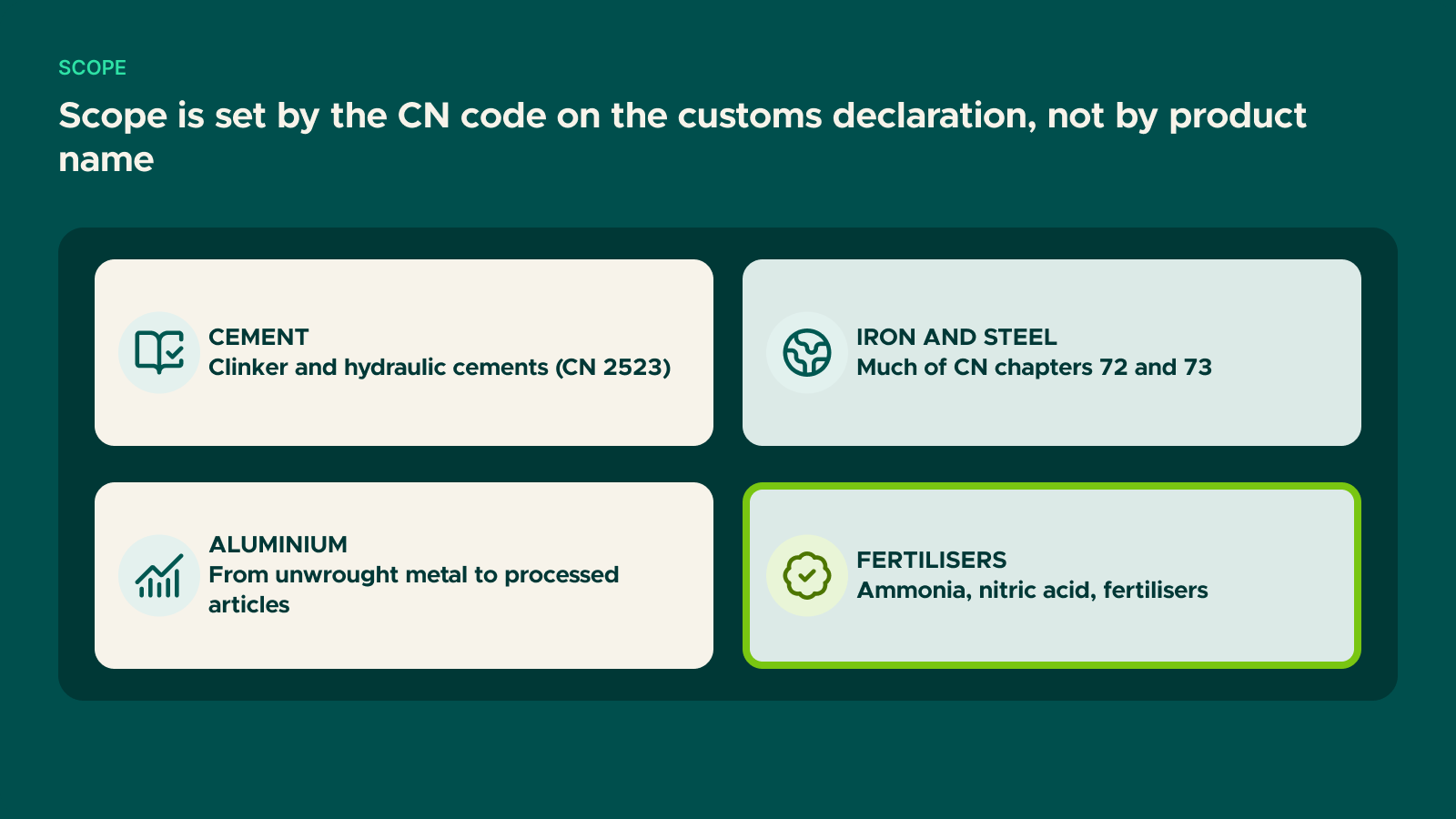
The core of scope is CN 2523: cement clinker, white Portland cement, other Portland cements, aluminous cement and other hydraulic cements. Calcined kaolinic clays are also listed. The critical structural point is that clinker is treated as a separate precursor; the embedded emissions of cement are built on the emissions of the clinker it contains.
The widest and most complex scope, drawing on a substantial part of CN chapters 72 and 73: pig iron and spiegeleisen, part of the ferro-alloys, products of direct reduction of iron ore, semi-finished products, flat-rolled products, bars, rods and profiles, wire, tubes, pipes and hollow profiles, structural components, reservoirs and tanks, stranded wire, and fasteners such as screws and bolts.
Two exclusions matter. Scrap is not in scope, which is material for electric arc furnace production, and only part of the ferro-alloys is listed.
From unwrought aluminium (CN 7601) through bars and profiles, wire, plates and sheets, foil, tubes and certain aluminium articles. Aluminium scrap is out of scope. Alumina and aluminium hydroxide are among the precursors under consideration for future inclusion.
Nitric acid and sulphonitric acids (CN 2808), ammonia (CN 2814), potassium nitrate, nitrogenous fertilisers (CN 3102) and compound fertilisers containing two or three nutrients (CN 3105). The functional unit is built on nitrate content, and the sector is unique in having its default-value mark-up fixed at 1%.
Electricity under CN 2716 and hydrogen under CN 2804 10 00. These two are the exceptions to the 50-tonne de minimis exemption and are in scope regardless of quantity.
Once scope is settled, the next step is building the emissions calculation for the covered lines, which we set out in calculating CBAM embedded emissions. The mechanism as a whole is covered in what is CBAM.
Not for current scope. If your product is steel- or aluminium-intensive, check it against the 180-code list proposed for 2028.
Scope is determined per code. For the emissions calculation, the functional unit is the tonnage produced under the same CN code, so the calculation is also built per code.
CBAM applies only to goods released for free circulation in the EU. If your non-EU buyer processes and sells into the EU, however, the data request can still reach you through the chain.
Code matching can be done on the customs side. Identifying precursors, system boundaries and functional units requires knowledge of the production process, so the two need to run together.
We work on scope determination and on building the embedded emissions calculation for covered lines, under our CBAM accounting and reporting service. You can contact us with your questions.
Get in touch
If something you've read here connects to a live project, a reporting deadline, or a decision you're weighing — we're happy to have a useful conversation.
Contact us
Regulation & Compliance
Regulation & Compliance
Regulation & Compliance
Lets talk about your sustainability goals.