Blog
Publish: 17 Sep 26Reading Time: 4 Min
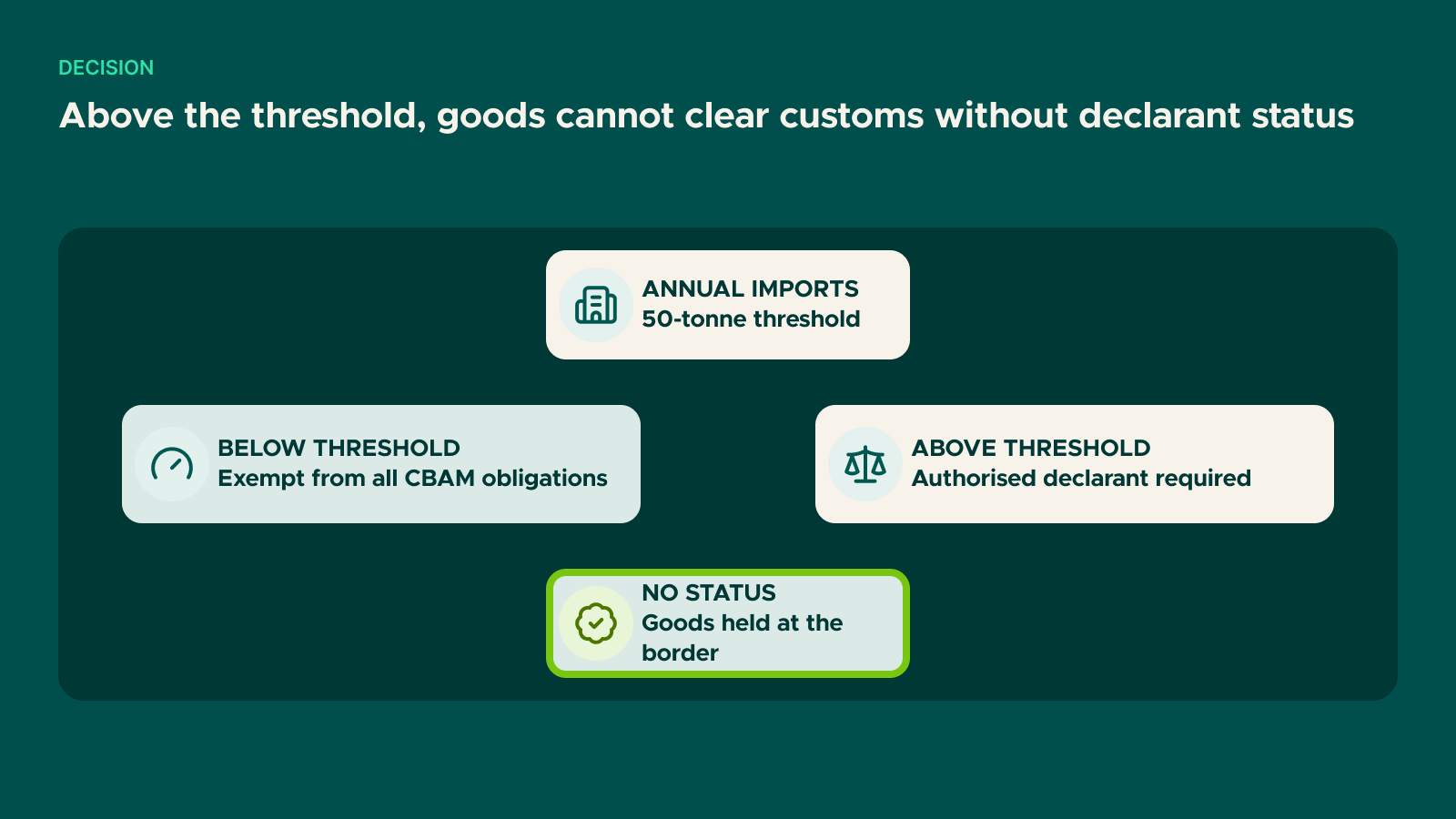
The hardest rule of the definitive regime on the import side is that importing CBAM goods has become conditional on holding a status. Companies importing more than a cumulative 50 tonnes per calendar year cannot release those goods for free circulation without authorised CBAM declarant status. The rule binds the EU importer, but its consequences reach the supplier one shipment at a time.
CBAM liability is settled roughly twenty months after the import takes place: goods imported in 2026 are covered by certificates bought from February 2027 and surrendered by 30 September 2027. That lag creates a collection risk.
Authorisation manages that risk up front. The national competent authority examines the applicant's financial standing, its record of compliance with customs and tax law, and its administrative capacity. The status is therefore not a registration formality but a fitness assessment.
The 50-tonne threshold introduced by the Omnibus Regulation replaced the previous €150 value threshold. Three features determine how it applies:
The exemption covers all CBAM goods except electricity and hydrogen, which are in scope regardless of quantity.
Because the threshold is set at importer level, an exporter's EU customer base effectively splits in two: customers above the threshold, who will need verified emissions data, and customers below it, who are outside the mechanism and will not ask for anything.
Applications are made to the national competent authority of the member state where the importer is established, through the authorisation module of the CBAM Registry. Decision times vary by member state.
The Regulation provided a transitional relief: importers who submitted an application by 31 March 2026 may continue to import throughout 2026 until their authority issues a decision, even if they exceed the threshold. That relief is conditional on having applied.
An importer above the threshold that did not apply faces two consequences. The goods cannot be released for free circulation, and a penalty in the range of €300 to €500 per tonne of embedded emissions applies — three to five times the standard €100 per tonne for other non-compliance. The difference is deliberate: failing to surrender enough certificates is a calculable shortfall that can be made good, whereas importing without authorisation bypasses the control gate entirely.
If the customer lacks the status, or its application is undecided outside the relief window, the shipment stops at the border. Where the incoterm is DDP, storage, demurrage and delay costs fall on the seller. Confirming the customer's authorisation status has accordingly become a routine commercial check for 2026 orders.
Data preparation effort should be allocated according to which customers cross the threshold. Preparing verified data for a customer who imports five tonnes a year produces nothing.
Selling the same total volume to many small importers rather than a few large ones changes CBAM exposure. A fragmented customer base leaves more buyers below the exemption; a concentrated one intensifies the data request but allows a single verified dataset to satisfy it.
The 50-tonne figure is not fixed. Alongside the proposal to extend scope to 180 downstream goods from 1 January 2028, the threshold is to be reviewed by 30 April 2027 in light of that extension. In downstream goods the CBAM-relevant metal accounts for only part of the product weight, so applying a mass threshold in the same way would produce a different effective cut-off. We cover the extension in the CBAM downstream extension, and the penalty regime in CBAM penalties and enforcement.
No. The status requires establishment in the EU. Groups with an EU subsidiary can apply through that entity, which also keeps the emissions data inside the group.
Indirect customs representatives can hold the status, and in practice this is becoming a common route for smaller importers.
No. Below the threshold the importer is exempt from CBAM obligations entirely, including any calculation against default or actual values.
Yes. A competent authority can suspend or revoke it where obligations are not met, which affects all subsequent imports.
We work on assessing EU customer portfolios against the CBAM threshold and preparing the data those customers will request, under our CBAM accounting and reporting service. You can contact us with your questions.
Get in touch
If something you've read here connects to a live project, a reporting deadline, or a decision you're weighing — we're happy to have a useful conversation.
Contact us
Regulation & Compliance
Regulation & Compliance
Regulation & Compliance
Lets talk about your sustainability goals.