Blog
Publish: 17 Sep 26Reading Time: 4 Min
In December 2025 the Commission proposed extending CBAM scope to sectors that use steel and aluminium rather than produce them. The proposal covers 180 goods and application is foreseen from 1 January 2028; the Council agreed its general approach in June 2026. The extension brings sectors that have so far treated CBAM as someone else's problem — automotive suppliers, machinery builders, appliance manufacturers — directly into the mechanism.
Current CBAM scope is limited to carbon-intensive raw and semi-finished goods, which leaves a structural gap. An EU manufacturer importing steel faces a CBAM cost; importing a machine made from the same steel does not.
That asymmetry encourages moving production one step down the chain: rather than importing steel and processing it in the EU, importing the processed product carries a cost advantage. The Commission describes this as residual carbon leakage risk and presents it as the principal justification for the extension.
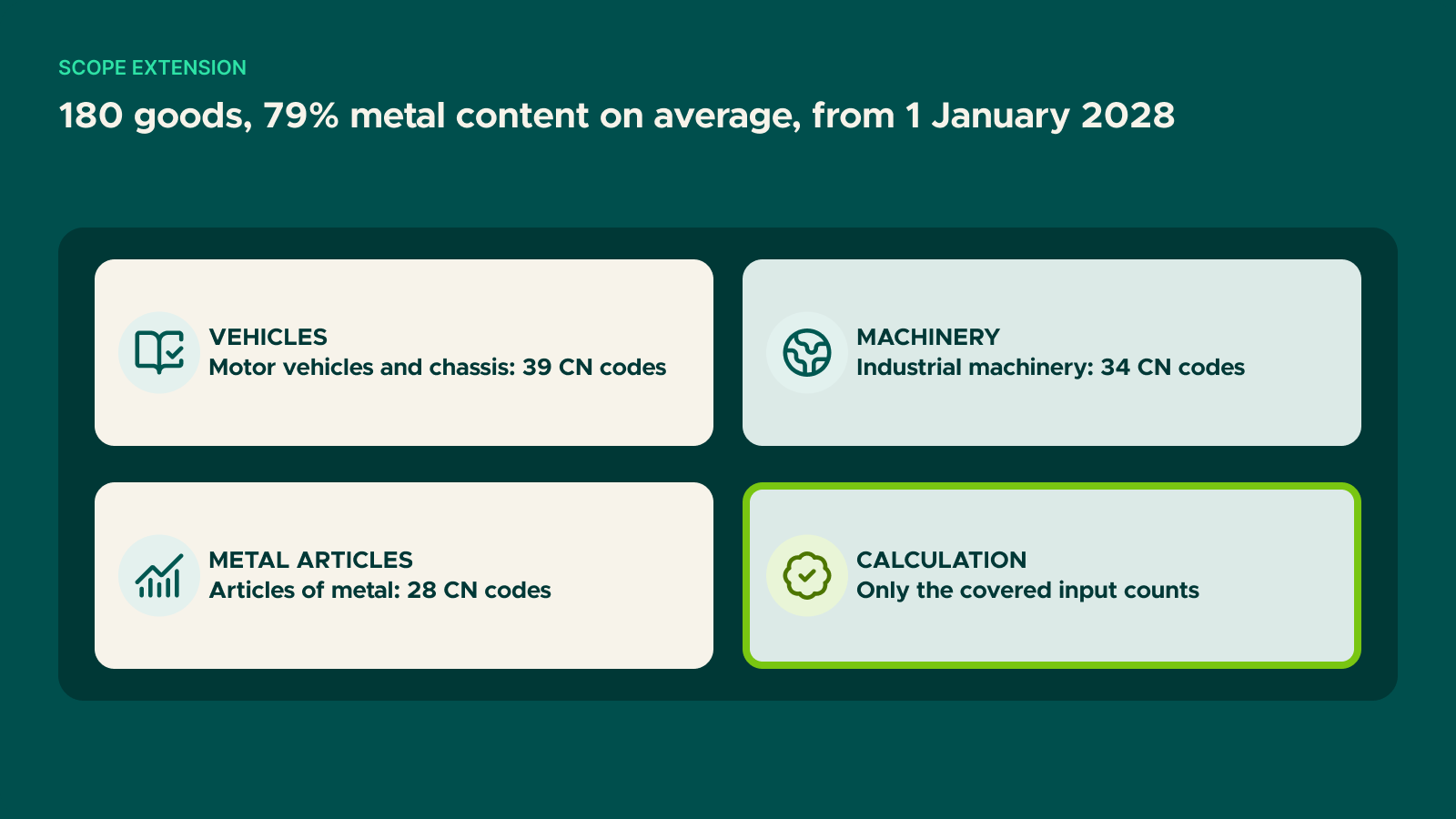
Goods were selected on two criteria: high carbon leakage risk, and a high share of steel and aluminium in their composition. Inputs on the list average 79% of these two metals by content.
| Product category | CN codes |
|---|---|
| Motor vehicles and chassis | 39 |
| Industrial machinery and equipment | 34 |
| Articles of metal | 28 |
| Motor vehicle parts and systems | 21 |
| Household appliances and consumer products | 18 |
| Construction and lifting equipment | 17 |
| Engines and power generation equipment | 7 |
| Electrical and electronic parts | 6 |
| Medical, laboratory and safety equipment | 5 |
| Agricultural and garden equipment | 5 |
| Total | 180 |
The distribution has a notable feature: more than 90% of the goods belong to industrial supply chains and only around 6% are consumer products. The extension is therefore aimed principally at intermediate goods trade.
The most important technical detail of the proposal is that for downstream goods, only the emissions of the CBAM-covered input enter the calculation. The embedded emissions of a washing machine are built on the steel and aluminium it contains, not on the total emissions of manufacturing it.
This makes the calculation both easier and harder for manufacturers. Easier, because there is no need to measure the assembly line's own emissions. Harder, because the manufacturer must document how much steel and aluminium its product contains and where those metals came from. The obligation shifts from measurement to material traceability.
The proposal also includes a relief: for certain specified goods, no additional mark-up would be applied where default values are used.
The current 50-tonne exemption threshold is calculated on total product weight. In downstream goods the covered metal accounts for only part of that weight, so applying the same threshold unchanged would produce a different effective cut-off.
The proposal foresees reviewing the threshold by 30 April 2027 in light of the extension. We cover how the threshold works in authorised CBAM declarant status and the 50-tonne threshold.
The extension does not only affect downstream manufacturers. For producers already in CBAM scope it creates a further effect: domestic customers will begin asking for emissions data as well.
Today a steel producer receives data requests only from customers exporting directly to the EU. From 2028, customers that process its steel and sell into the EU will need the same figures. That multiplies both the volume of requests and the number of counterparties, and makes central sharing of emissions data — through the CBAM Registry and O3CI portal — considerably more valuable.
The downstream extension is not the only scope item in play. The 2025 CBAM review considered the following for the end of 2027:
Taken together, this points to CBAM converging over time on the full set of industrial sectors covered by the EU ETS.
The legislative process is continuing. The Council agreed its general approach in June 2026; the final text and entry-into-force detail will be settled when the process concludes.
No. Only the emissions of the CBAM-covered input — the steel and aluminium — enter the calculation.
What matters is not the origin of the input but whether verified emissions data is available for it.
Not if you are outside current scope. But because building the data infrastructure takes time, preparation needs to begin in 2027.
We work on assessing product portfolios against the proposed scope and collecting emissions data for metal inputs, under our CBAM accounting and reporting service. You can contact us with your questions.
Get in touch
If something you've read here connects to a live project, a reporting deadline, or a decision you're weighing — we're happy to have a useful conversation.
Contact us
Regulation & Compliance
Regulation & Compliance
Regulation & Compliance
Lets talk about your sustainability goals.