Blog
Publish: 17 Sep 26Reading Time: 4 Min
Every non-EU producer selling into the EU faces one decision under CBAM: produce and verify actual emissions data, or let its goods be calculated on default values. The Regulation imposes no obligation either way. The right answer depends on where the installation's emissions intensity sits relative to the country and route average, and it is a number that can be worked out.
Embedded emissions can be established in one of two ways. Actual values are calculated from the producing installation's own data and verified by an accredited verifier. Default values are figures published by the Commission by country and production route, and they are not subject to verification.
Both routes cost something. The actual-data route costs money directly and up front: building the data infrastructure, writing the monitoring methodology, the verifier's fee and the site visit. The default-value route costs money indirectly and continuously: the installation is represented by a country average regardless of its real performance, and a mark-up is added to that average.
The decision is a comparison of those two costs, and it does not come out the same way for every installation.
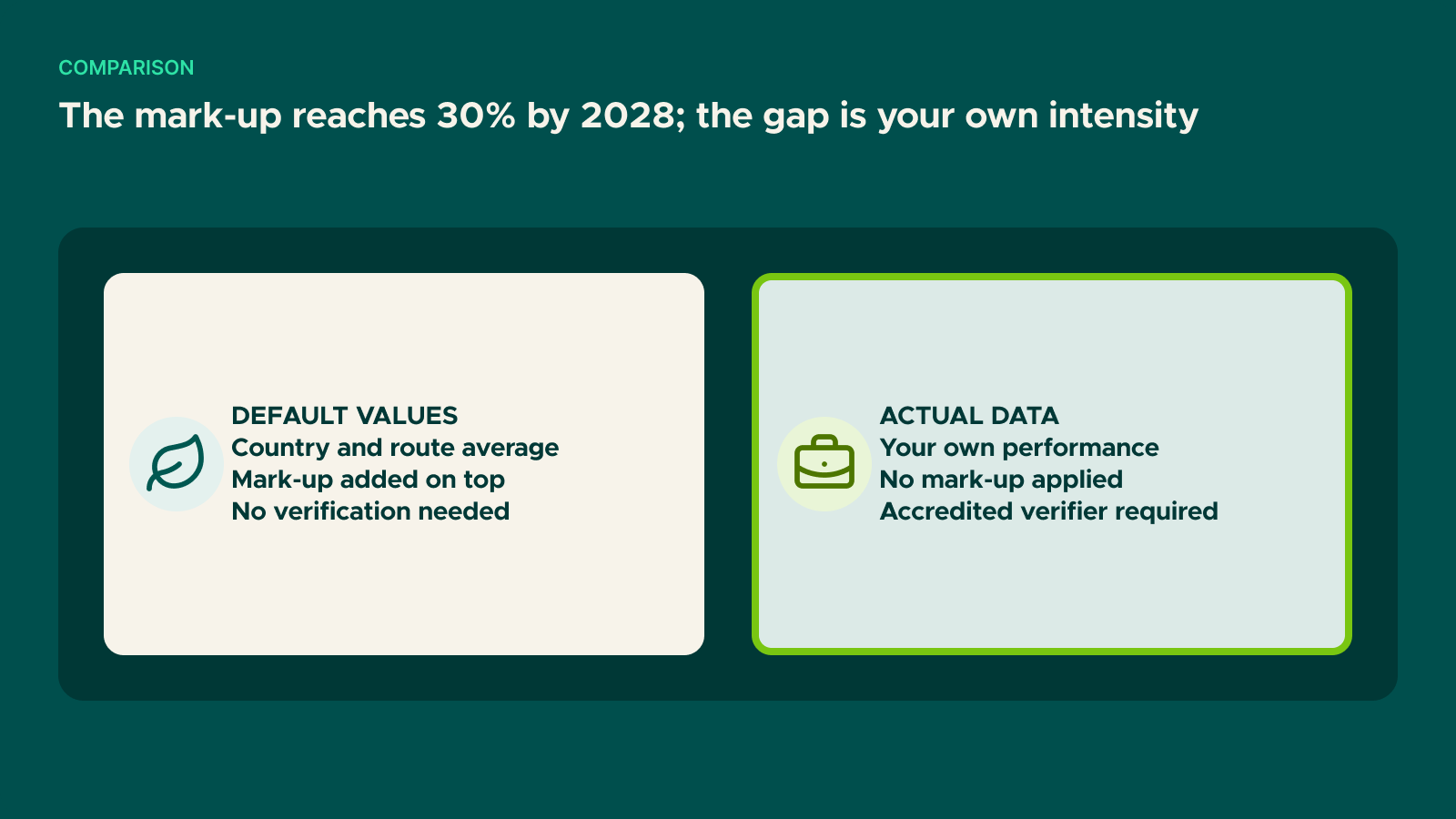
Default values are deliberately set above the level that would make not supplying data attractive. That adjustment is applied through a mark-up:
| Year | Mark-up | Fertilisers |
|---|---|---|
| 2026 | 10% | 1% |
| 2027 | 20% | 1% |
| 2028 onward | 30% | 1% |
The fertiliser exemption was set during the Omnibus negotiations on food security grounds. In every other sector the rise to 30% by 2028 means the default route becomes progressively more expensive.
A second rule applies where no default value has been set for a country: the average of the ten highest emission-intensity countries exporting to the EU is used. For producers in countries without a published default and without their own verified data, this is the least favourable outcome available.
Assume an illustrative benchmark of 1.50 tCO2/t, a country default value of 2.10 tCO2/t, a certificate price of €75.30 and the 2026 free allocation factor of 97.5%.
| Scenario | Emissions used | 2026 obligation | Cost per tonne |
|---|---|---|---|
| Default value with 10% mark-up | 2.31 | 0.8475 | ≈ €63.8 |
| Actual data, intensity 2.10 | 2.10 | 0.6375 | ≈ €48.0 |
| Actual data, intensity 1.70 | 1.70 | 0.2375 | ≈ €17.9 |
| Actual data, intensity 1.50 | 1.50 | 0.0375 | ≈ €2.8 |
The first two rows isolate the effect of the mark-up alone: even an installation performing exactly at the country average pays roughly €16 per tonne more simply because the mark-up applies. The lower rows show where the real value sits — for installations performing below the country average, actual data cuts the cost to a third or a twentieth.
This is the 2026 picture. As the free allocation factor falls, every row rises and the absolute gaps widen; by 2030 the difference between these scenarios is roughly twenty times larger in absolute terms.
There is a fourth dimension that does not appear in the arithmetic: commercial positioning. EU buyers increasingly treat embedded emissions as a differentiator in supplier selection. A supplier with verified low emissions reduces its customer's bill and makes its own performance visible. A supplier without data is represented by a country average and cannot show anything at all.
One of the Omnibus simplifications removed verification for default values. For the importer this removes verification cost entirely, which makes the default route rational in some low-volume trade.
This creates an asymmetry worth naming: the verification cost falls on the producer, while the saving accrues to the importer. How that cost is shared therefore belongs in the commercial conversation rather than being assumed. We cover the contractual side in supplier data collection.
Default values are due for review by December 2027, and a 30% reduction in electricity default values is among the revision proposals.
Building the calculation that replaces a default value is set out in calculating CBAM embedded emissions.
No. It is a legitimate route. The issue is cost, not compliance.
Yes. For complex goods, weighted averages or a combination of actual and default values are permitted — commonly used where a precursor supplier will not provide data.
The Commission publishes default values by country and production route and updates them periodically. Comparing your installation's intensity with that figure is the first step of the decision.
Each reporting period is assessed separately. Commercially, however, reverting after supplying verified data to a customer is difficult to explain.
We work on comparing installation intensity against country default values and modelling the actual-data business case, under our CBAM accounting and reporting service. You can contact us with your questions.
Get in touch
If something you've read here connects to a live project, a reporting deadline, or a decision you're weighing — we're happy to have a useful conversation.
Contact us
Regulation & Compliance
Regulation & Compliance
Regulation & Compliance
Lets talk about your sustainability goals.