Blog
Publish: 17 Sep 26Reading Time: 4 Min
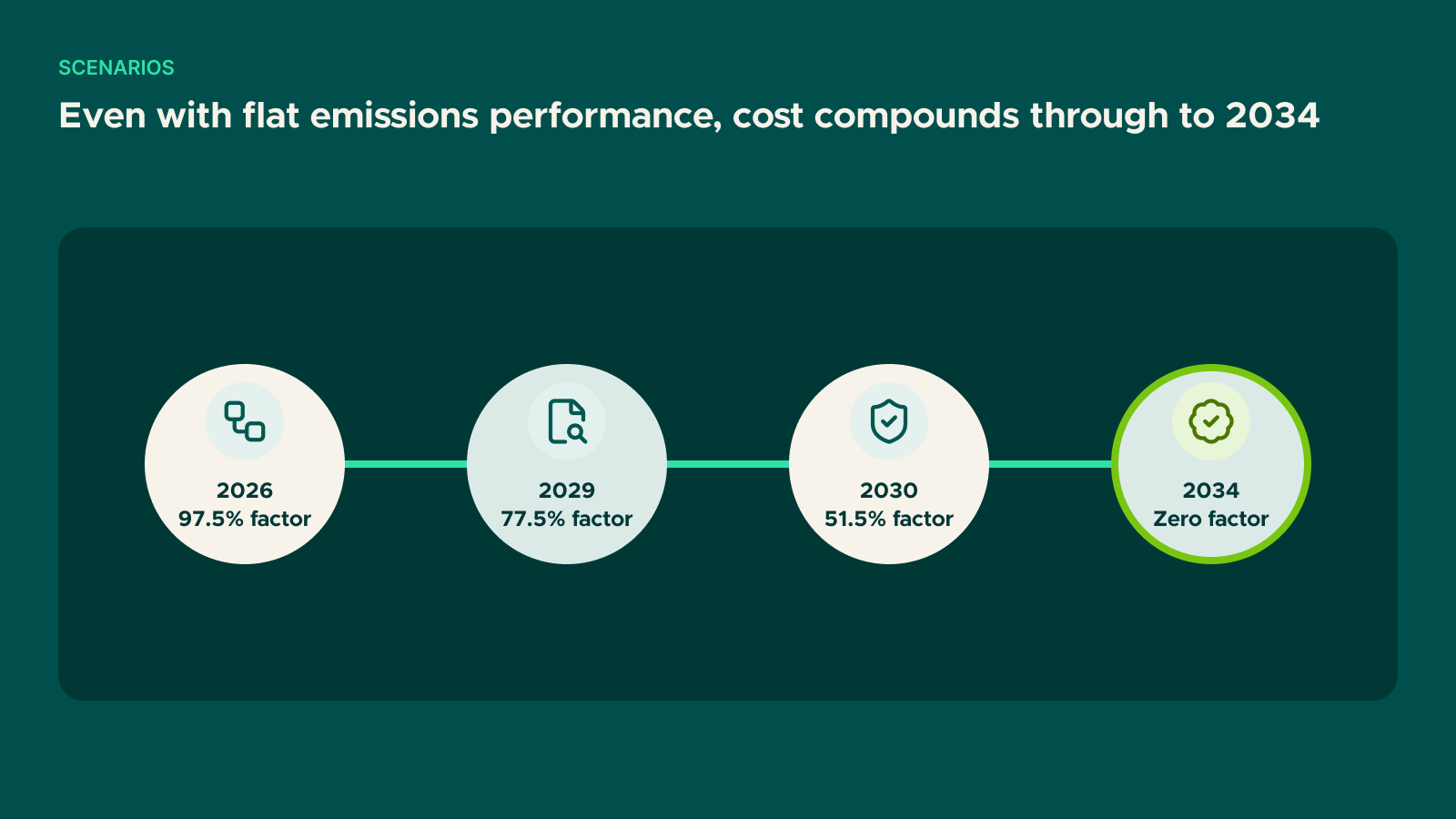
Today's CBAM cost looks small, and that is the most common reason given for deferring preparation. The mechanism, however, is built on the assumption that the cost will rise: the free allocation factor falls from 97.5% in 2026 to zero in 2034. This article models what happens to cost per tonne across that period on the assumption that emissions performance does not change at all.
The model rests on four assumptions:
The formula is obligation = embedded emissions − (benchmark × free allocation factor). Holding the certificate price constant is deliberate: the purpose is not to forecast the price but to isolate the effect of the free allocation factor alone. Since the EU ETS price is under upward medium-term pressure, the tables below should be read as conservative.
| Year | Factor | A: 1.50 tCO₂/t (at benchmark) | B: 1.90 tCO₂/t (27% above) | C: 2.50 tCO₂/t (67% above) |
|---|---|---|---|---|
| 2026 | 97.5% | €2.8 | €32.9 | €78.1 |
| 2027 | 95% | €5.6 | €35.8 | €80.9 |
| 2028 | 90% | €11.3 | €41.4 | €86.6 |
| 2029 | 77.5% | €25.4 | €55.5 | €100.7 |
| 2030 | 51.5% | €54.8 | €84.9 | €130.1 |
| 2031 | 39% | €68.9 | €99.0 | €144.2 |
| 2032 | 26.5% | €83.0 | €113.1 | €158.3 |
| 2033 | 14% | €97.1 | €127.2 | €172.4 |
| 2034 | 0% | €112.9 | €143.1 | €188.2 |
Figures are euro per tonne of product on the assumptions above.
In Scenario A the 2026 cost is €2.8 — negligible. In Scenario C, the same year, it is €78.1. The twenty-eight-fold gap explains why the generalisation that "2026 is barely payable" misleads. Because free allocation applies to the benchmark rather than to actual emissions, intensity above the benchmark generates a full obligation from the outset.
The factor falls only 7.5 points across 2026-2028, then 26 points in the single year from 2029 to 2030. In Scenario A cost rises from €25.4 to €54.8 — more than doubling in one year. For investment planning the date that matters is therefore before 2029, not 2034.
The difference between Scenarios A and C stays around €75 every year, because it derives from the difference in emissions intensity and is unaffected by the free allocation factor. The strategic implication is important: the CBAM return on abatement is the same in every year. Deferring abatement does not increase the return; it only accumulates the cost of the deferred years.
With free allocation at zero, even an installation operating exactly at benchmark faces €112.9 per tonne. After 2034 CBAM no longer prices the efficiency gap but the entire emissions footprint.
The commercial meaning of a euro-per-tonne figure depends on the product's unit price, so the same absolute cost lands very differently across sectors:
The table above is illustrative. Three inputs are needed to build your own projection:
The same three inputs are sufficient to price the CBAM side of an abatement investment: emissions avoided × certificate price × EU-bound volume. The formula is set out in the CBAM cost formula, and certificate pricing in CBAM certificates.
It is not expected to. The EU ETS price faces upward pressure from the phase-out of free allocation and supply-side mechanisms, so the figures above are conservative.
CBAM benchmarks are to be revised from 2027 in line with the EU ETS values for 2026-2030. Because ETS benchmarks tighten, such revisions generally raise the obligation.
An amount actually paid and not refunded is deducted from the obligation, shifting the whole table downward. The conditions are in carbon price paid in a third country.
The cost enters the importer's accounts but appears as a line item in supplier comparison. A supplier with higher emissions intensity becomes more expensive at the same quoted price.
We work on building CBAM cost projections by product and customer and on pricing the payback of abatement investments, under our CBAM accounting and reporting service. You can contact us with your questions.
Get in touch
If something you've read here connects to a live project, a reporting deadline, or a decision you're weighing — we're happy to have a useful conversation.
Contact us
Regulation & Compliance
Regulation & Compliance
Regulation & Compliance
Lets talk about your sustainability goals.