Blog
Publish: 17 Sep 26Reading Time: 4 Min
CBAM is designed to equalise carbon cost, not to raise revenue from imports. It therefore includes a rule preventing the same emissions being charged twice: where a carbon price has already been paid in the country where the goods were produced, that amount can be deducted. As more exporting countries introduce carbon pricing, the rule is moving from theory into routine practice.
CBAM is an equivalence measure mirroring the EU ETS on the import side. For that equivalence claim to hold, a carbon price already paid where the goods were produced has to be recognised; otherwise the same emissions are charged twice and the mechanism functions as a trade barrier rather than a levelling device.
The Regulation accordingly allows the importer to deduct a carbon price paid in the country of production, provided it can be documented. In the cost formula it appears as the fourth and final component.
The deduction is not automatic. It depends on several conditions:
The Commission foresees country-level default values for carbon prices and dedicated implementing rules during 2026, which will set out how the deduction is documented in practice.
Get in touch
If something you've read here connects to a live project, a reporting deadline, or a decision you're weighing — we're happy to have a useful conversation.
Contact us
Regulation & Compliance
Regulation & Compliance
Regulation & Compliance
Lets talk about your sustainability goals.
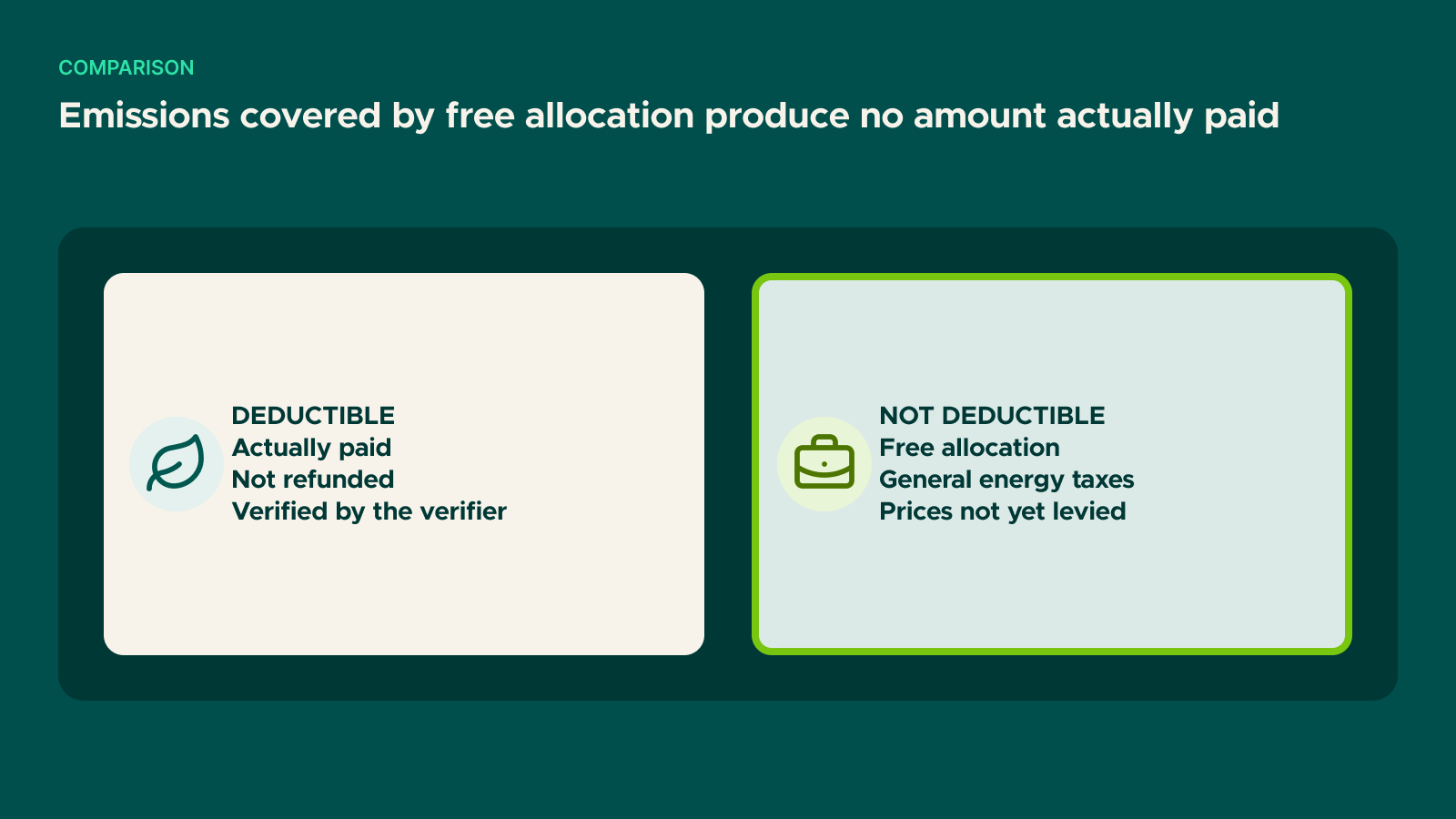
This is the point most often misread. Many emerging emissions trading systems begin with high or full free allocation. Where an installation's emissions are covered by free allocation, no amount is actually paid, and there is consequently nothing to deduct under CBAM.
A deduction arises only where the installation's emissions exceed its free allocation and it buys allowances on the market, actually paying for them.
There is a further subtlety. Free allocation in most systems, including the EU ETS, is calculated against a benchmark rather than against actual emissions. An installation whose intensity exceeds the benchmark can therefore be short even where the nominal free allocation rate is 100%. In other words, "full free allocation" does not mean zero cost — and it is exactly that shortfall which creates a deductible amount on the CBAM side.
The practical consequence is that a carbon price paid at home is not necessarily a sunk cost. To the extent the EU buyer can deduct it, the amount becomes an advantage in the supply relationship. Three things have to work together:
If any one of the three is missing, the amount paid at home is disregarded on the EU side and the same emissions are effectively charged twice.
Two further items appear in the Commission's revision proposals. The first is allowing credits falling under Article 6 of the Paris Agreement to be set against CBAM liability. The second is the possibility of an agreement recognising a third country's carbon pricing system.
The second would be the more consequential change. Recognition at system level would replace product-by-product documentation of the deduction with a systemic mechanism, cutting administrative burden substantially. Exporting countries with operating emissions trading systems have made this a priority in their engagement with the Commission, alongside the mutual recognition of national accreditation bodies.
The wider relationship between an exporting country's own system and CBAM is covered in CBAM and the EU ETS compared.
How the deduction sits within the wider calculation is set out in the CBAM cost formula.
No. The deduction is limited to charges specific to carbon pricing; general energy taxation is not treated as such.
The declarant makes the calculation, but it rests on documentation supplied and verified on the producer's side.
What matters is that a carbon price was actually paid, not the instrument's label.
The obligation cannot fall below zero; a carbon price higher than the CBAM liability does not create a credit.
We work on documenting carbon prices paid and preparing them for verification alongside the emissions report, under our CBAM accounting and reporting service. You can contact us with your questions.