Blog
Publish: 17 Sep 26Reading Time: 4 Min
CBAM is often described as the import side of the EU Emissions Trading System, and in policy terms that is accurate. Operationally the two systems are not alike. They measure the same physical emissions in different units, assign liability to different parties and operate on different calendars. For companies exposed to both — and increasingly to an emissions trading system in their own country as well — knowing where the two diverge prevents duplicated work and missed obligations.
The most useful starting point is what each system measures.
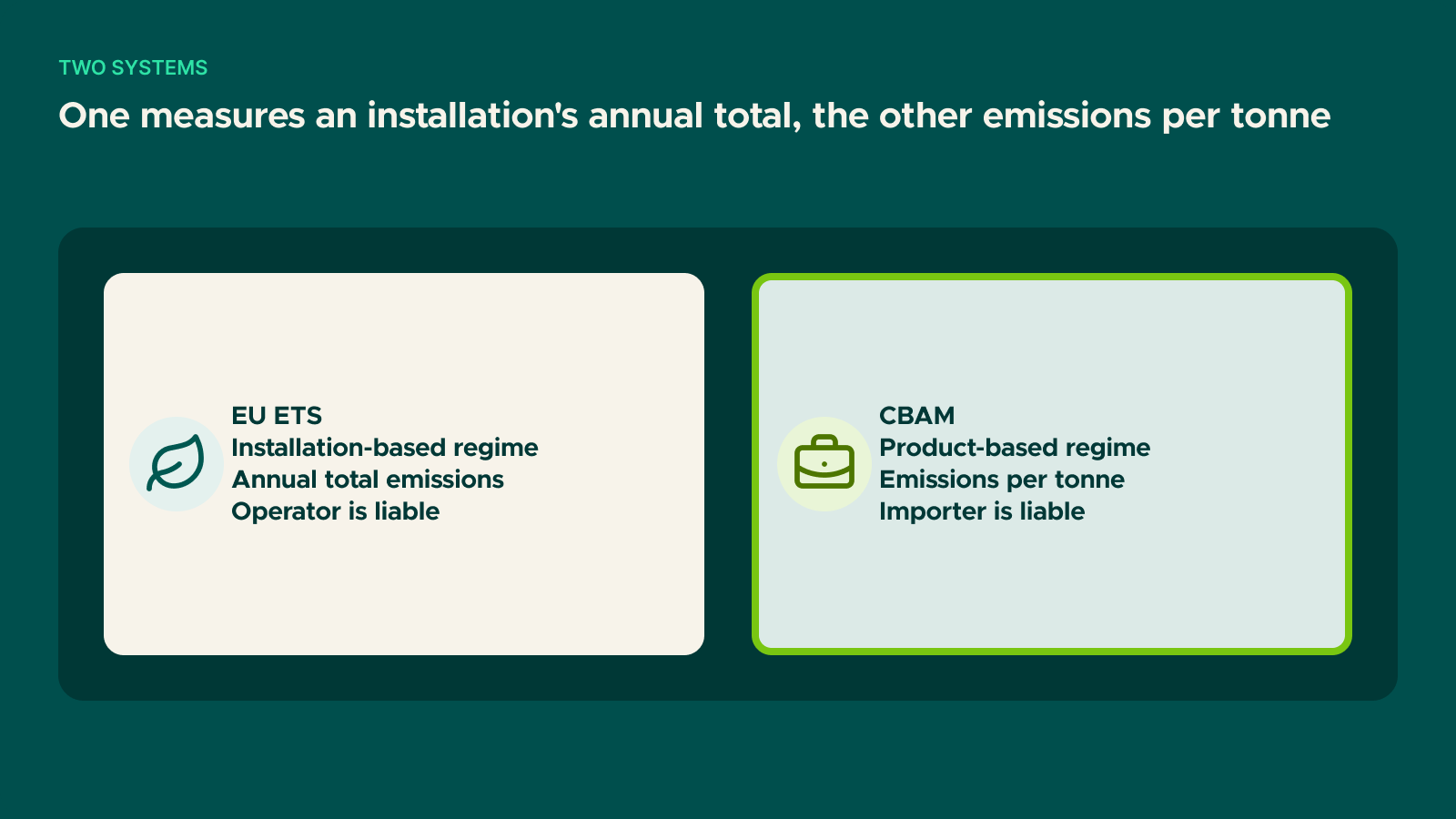
The EU ETS is an installation regime. It measures the total greenhouse gases an installation emits over a calendar year, requires the operator to surrender allowances covering that total, and provides part of those allowances free of charge. Its counterparty is the installation operator, and enforcement applies to that operator directly.
CBAM is a product regime. It is indifferent to an installation's annual total; it is concerned with how many tonnes of CO2 equivalent are embedded in a tonne of the good imported. Its counterparty is the importer established in the EU.
The same emissions therefore appear differently in each system. An installation with a modest annual total but high emissions per tonne of product can be comfortable under the ETS and exposed under CBAM. The reverse also holds.
| Dimension | EU ETS | CBAM |
|---|---|---|
| Liable party | Installation operator | Importer established in the EU |
| Unit of account | Installation, annual tCO2e | Product, tCO2e per tonne |
| Scope test | Activity type and capacity | The good's CN code |
| Geography | Production inside the EU | Goods imported into the EU |
| Permit regime | Greenhouse gas emissions permit | No permit; declarant authorisation instead |
| Instrument | Allowances, traded | Certificates, bought from authorities, not traded |
| Free allocation | Benchmark-based, phased down | Mirrored as the free allocation factor deduction |
| Enforcement | Penalties on the operator | Penalties on the importer; goods may be held at the border |
The systems connect at one structural point. EU producers receive free allocation up to the benchmark for their product, and that allocation is phased out between 2026 and 2034. CBAM mirrors it: the benchmark multiplied by the year's free allocation factor is deducted from the importer's obligation, so both sides are measured against the same reference.
The factor stands at 97.5% in 2026, 51.5% in 2030 and zero in 2034. The mirroring is what makes CBAM defensible as an equivalence measure rather than a trade barrier — and it is also why the mechanism becomes a full carbon cost only from 2034. We set out the arithmetic in the CBAM cost formula.
The most demanding practical difference is the level at which data must be collected. The ETS needs an annual total at installation level. CBAM needs emissions disaggregated to production processes and attributed to products.
The useful consequence is that the finer structure contains the coarser one: an installation-level total can be derived from process-level CBAM data, but not the other way round. Where a company faces both regimes, the correct sequence is to build the data infrastructure at CBAM granularity and generate the ETS report from it.
System boundaries still have to be defined separately, and an ETS monitoring plan is not the same document as a CBAM monitoring methodology. Verification differs too: CBAM requires a verifier accredited under CBAM by an EU accreditation body, which national ETS accreditation does not provide. See CBAM verification and accredited verifiers.
A growing number of exporting countries operate their own emissions trading systems, which introduces a third layer. The connection to CBAM runs through the deduction of a carbon price actually paid.
The point most often misread is that a high nominal free allocation rate does not create a deductible amount, because nothing is actually paid. Free allocation in these systems is generally calculated against a benchmark rather than against actual emissions, so an installation above the benchmark can still be short and buy allowances — and that payment is what may be deducted. See carbon price paid in a third country.
The Commission's revision proposals also contemplate agreements recognising third-country carbon pricing systems, which would move the deduction from product-level documentation to a systemic mechanism.
No. The scope tests are different. A producer exporting covered goods to the EU will face data requests regardless of its domestic ETS status.
Not directly. CBAM requires CBAM accreditation and CBAM methodology, although existing ETS and ISO capability is considered in accreditation assessments.
They address the same physical emissions, so consistency is expected. Differences arising from system boundaries must be explainable; unexplained differences generate findings.
No. CBAM certificates are bought from national competent authorities, are not traded on a secondary market, and cannot be used for ETS compliance.
We work on planning emissions trading and CBAM obligations from a single data infrastructure, under our CBAM accounting and reporting service. You can contact us with your questions.
Get in touch
If something you've read here connects to a live project, a reporting deadline, or a decision you're weighing — we're happy to have a useful conversation.
Contact us
Regulation & Compliance
Regulation & Compliance
Regulation & Compliance
Lets talk about your sustainability goals.