Blog
Publish: 02 Sep 26Reading Time: 4 Min
The starting point for IFRS S1/S2 compliance is a structured gap analysis: a systematic comparison of a company's existing sustainability governance, data, and disclosures against the specific requirements of IFRS S1 and IFRS S2, producing a clear map of what already exists, what needs to be built, and in what sequence.
Companies that skip directly to drafting disclosure language often discover mid-process that the underlying data doesn't exist, the governance oversight isn't documented, or the scenario analysis capability hasn't been built. A gap analysis surfaces these issues before drafting begins, so the disclosure design phase that follows is built on a realistic foundation rather than assumptions about what data is available.
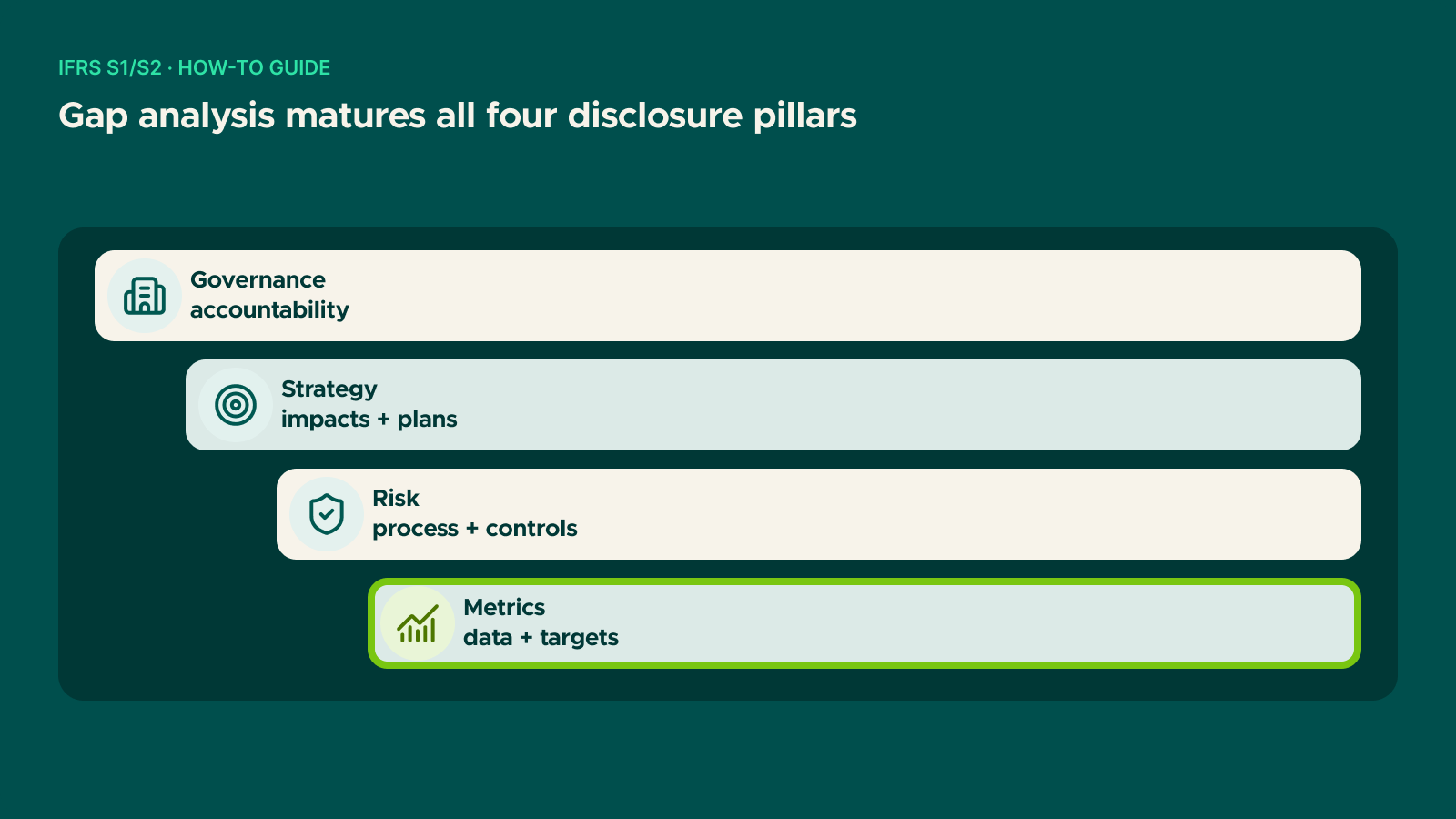
A thorough IFRS S1/S2 gap analysis typically works through each of the four pillars shared by both standards:
Governance. Does the board or a designated committee have documented oversight of sustainability and climate-related risks and opportunities? Is management's role in assessing and managing these risks clearly defined and evidenced?
Strategy. Has the company identified its material sustainability and climate-related risks and opportunities? Has it assessed how these affect its business model and financial planning? For IFRS S2 specifically, has any climate scenario analysis been performed to test strategic resilience?
Risk Management. Are sustainability and climate risks integrated into the company's existing risk management processes, or managed separately? Is the process for identifying, assessing, and prioritizing these risks documented and consistently applied?
Metrics and Targets. What GHG emissions data exists today — Scope 1, Scope 2, and Scope 3 — and at what level of assurance? Are climate-related targets set, tracked, and reported? What industry-specific metrics (often drawn from SASB) are relevant to the company's sector?
Before assessing gaps, a company needs clarity on which entities, in which jurisdictions, are actually in scope for IFRS S1/S2 — since requirements and timing vary by market, as covered in Who Must Comply with IFRS S1/S2? Scope and Adoption Timeline by Jurisdiction. A gap analysis performed without this scoping step risks either overbuilding disclosure infrastructure the company doesn't yet need, or missing an obligation in a jurisdiction that has already adopted the standards.
The gap analysis output feeds directly into disclosure design: building the reporting content, data collection processes, and internal controls needed to close identified gaps. It also informs assurance readiness planning, since many jurisdictions phase in assurance requirements over time — a topic covered in How Does Assurance Work Under IFRS S1/S2 Sustainability Reporting?. Once the disclosure content itself is being drafted, our reporting checklist sets out what a complete IFRS S1/S2 disclosure needs to include.
Semtrio's IFRS S1/S2 advisory service begins every client engagement with a structured gap analysis covering jurisdictional scope, the four disclosure pillars, and existing data maturity, before any disclosure drafting begins. This sequencing avoids the common failure mode of building disclosure language around data and governance processes that don't yet exist.
Semtrio Note: Semtrio's gap analysis methodology draws on the firm's own practitioner experience — Semtrio holds the same CDP Accredited Solutions Provider and EcoVadis Accredited Consulting Partner accreditations it advises clients toward, giving the assessment process a working, not theoretical, understanding of what closing each gap actually requires.
It is a structured assessment comparing a company's existing sustainability governance, data, and disclosures against IFRS S1 and IFRS S2 requirements, identifying what is already in place and what still needs to be built.
Timelines vary depending on the size and complexity of the organization and how many jurisdictions are in scope — no fixed duration applies universally, as scope and existing data maturity vary significantly between companies.
Prior TCFD reports, CDP disclosures, existing GHG inventories, and any existing sustainability reports typically serve as the baseline against which IFRS S1/S2 requirements are assessed.
It should cover every jurisdiction where the company has an actual or likely IFRS S1/S2 obligation, which requires first confirming jurisdictional scope before assessing gaps in detail.
The output feeds into disclosure design, data architecture build-out, and assurance readiness planning, sequenced according to the remediation roadmap the gap analysis produces.
If your organization is ready to start its IFRS S1/S2 compliance journey, Semtrio can conduct a structured gap analysis to identify exactly where your reporting program stands today. Contact Semtrio to begin.
Get in touch
If something you've read here connects to a live project, a reporting deadline, or a decision you're weighing — we're happy to have a useful conversation.
Contact us
Regulation & Compliance
Regulation & Compliance
Regulation & Compliance
Lets talk about your sustainability goals.