Blog
Publish: 07 Aug 26Reading Time: 4 Min
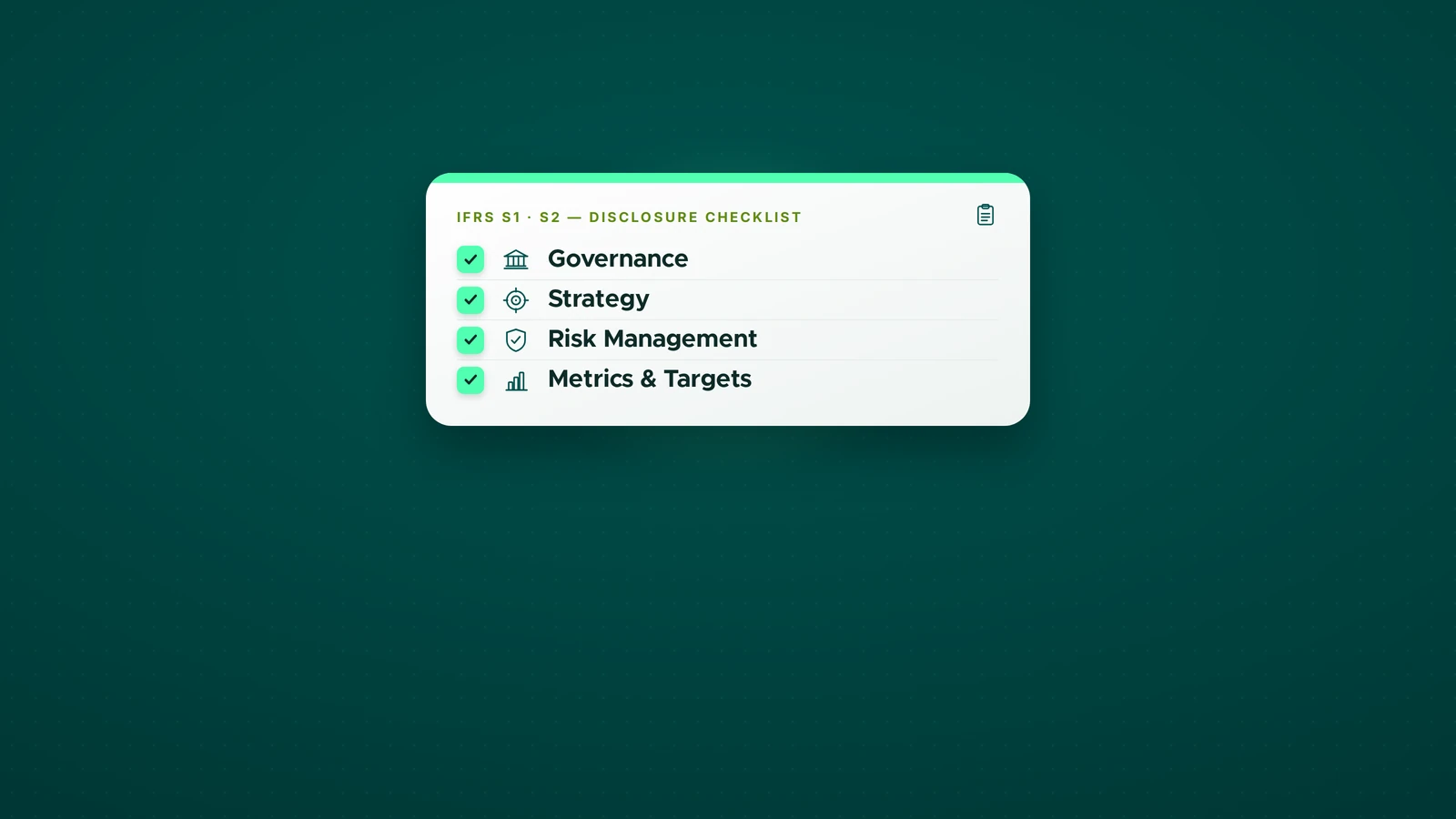
A complete IFRS S1/S2 disclosure must address four pillars — governance, strategy, risk management, and metrics and targets — for both general sustainability-related risks and opportunities under IFRS S1 and climate-specific risks under IFRS S2, connected to the company's financial statements and covering the same reporting period. This checklist walks through what each pillar requires in practice.IFRS S1/S2ChecklistDisclosureIFRS S1/S2IFRS S1/S2
The governance body or individual(s) responsible for oversight of sustainability-related and climate-related risks and opportunities.
How that oversight body is informed about these risks and opportunities, and how often.
How the oversight body considers these risks and opportunities when reviewing strategy, major transactions, and risk management policies.
Management's role in assessing and managing sustainability-related and climate-related risks and opportunities, including which management-level position or committee holds this responsibility.
The sustainability-related and climate-related risks and opportunities the company has identified as reasonably likely to affect its prospects.
The current and anticipated effects of these risks and opportunities on the company's business model and value chain.
The effects on the company's strategy and decision-making, including how the company plans to respond.
The effects on the company's financial position, financial performance, and cash flows for the reporting period, and the anticipated effects over the short, medium, and long term.
For IFRS S2 specifically: the resilience of the company's strategy to climate-related changes, developments, and uncertainties, assessed using climate scenario analysis.
The processes and policies used to identify, assess, prioritize, and monitor sustainability-related and climate-related risks and opportunities.
How these processes are integrated into the company's overall risk management process.
Whether and how risk management processes for climate-related risks specifically differ from, or align with, the company's broader sustainability risk management approach.
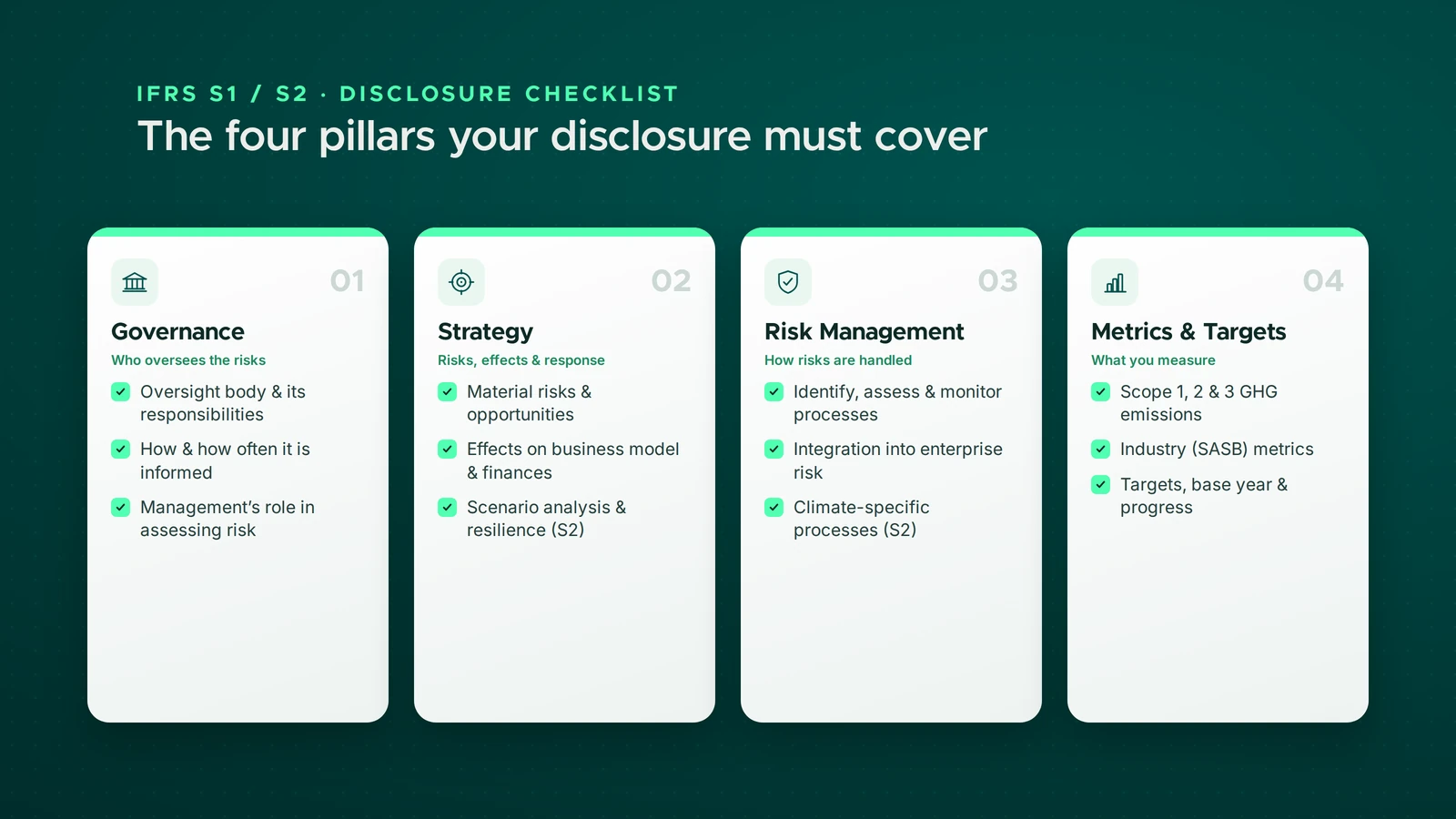
Metrics required by IFRS S2, including Scope 1 and Scope 2 GHG emissions, and Scope 3 emissions where material.
Industry-specific metrics relevant to the company's business model, typically informed by SASB standards.
Climate-related targets the company has set, including the metric used, the base period, and progress against the target.
For IFRS S1 topics beyond climate: any additional metrics and targets the company has determined are material to its sustainability-related risks and opportunities.
IFRS S1 requires that sustainability disclosures be provided alongside — not separately from — the company's general purpose financial statements, covering the same reporting period, and demonstrating clear connectivity between the sustainability information and the financial statements it relates to. This connectivity requirement is one of the more operationally demanding aspects of IFRS S1/S2 compliance.
Companies producing their first IFRS S1/S2 disclosure commonly underweight:
Scenario analysis documentation — many companies disclose a scenario analysis conclusion without adequately documenting the inputs, assumptions, and methodology behind it.
Scope 3 materiality assessment — rather than simply excluding Scope 3, IFRS S2 expects a documented materiality assessment explaining why Scope 3 is or is not material to the company.
Explicit connectivity to financial statements — treating the sustainability disclosure and financial statements as two separate documents rather than demonstrating the required linkage between them.
Governance detail beyond a general statement — naming the specific committee or role responsible, and describing the frequency and nature of its oversight, rather than a generic reference to "board oversight."
This checklist describes the content of a compliant disclosure — it assumes the underlying gap analysis has already identified what data and governance processes need to be built. Once the disclosure is drafted against this checklist, assurance readiness becomes the next consideration, particularly for companies in jurisdictions phasing in assurance requirements.
Semtrio's IFRS S1/S2 advisory service includes disclosure design support structured directly around this four-pillar checklist, helping reporting teams verify completeness before external review or assurance.
Semtrio Note: Semtrio's B Corp status reflects the firm's own experience being assessed against a rigorous, externally verified disclosure standard — a perspective the advisory team brings directly to reviewing the completeness and defensibility of client disclosures.
What are the four required disclosure pillars under IFRS S1/S2?
Governance, strategy, risk management, and metrics and targets — applied to general sustainability-related risks and opportunities under IFRS S1 and specifically to climate under IFRS S2.
Is Scope 3 emissions disclosure always required?
Scope 3 disclosure is required where it is material to the company. A documented materiality assessment explaining the determination is expected rather than a blanket exclusion.
Where should IFRS S1/S2 disclosures be located in a company's reporting?
IFRS S1 requires them to be provided alongside the company's general purpose financial statements, covering the same reporting period, with clear connectivity between the two.
What is commonly missing from first-time IFRS S1/S2 disclosures?
Scenario analysis documentation, a documented Scope 3 materiality assessment, explicit connectivity to financial statements, and specific (rather than generic) governance detail are common gaps.
Does the checklist differ for a company applying only IFRS S1 versus both IFRS S1 and IFRS S2?
Yes. A company applying only IFRS S1 for non-climate topics follows the same four-pillar structure but without the climate-specific metrics, scenario analysis, and GHG disclosures that IFRS S2 requires.
If your team is drafting its first IFRS S1/S2 disclosure and wants a second review against the full requirements, Semtrio can help verify completeness before submission or assurance.
Get in touch
If something you've read here connects to a live project, a reporting deadline, or a decision you're weighing — we're happy to have a useful conversation.
Contact us
Regulation & Compliance
Regulation & Compliance
Regulation & Compliance
Lets talk about your sustainability goals.