Blog
Publish: 02 Sep 26Reading Time: 4 Min
No company is automatically required to comply with IFRS S1 and IFRS S2 simply because the ISSB issued them. Compliance becomes mandatory only when a jurisdiction's securities regulator, stock exchange, or government formally endorses the standards and writes them into local law or listing rules — which means scope and timing differ by country, and multinational companies may face different obligations in different markets where they operate or list.
The ISSB is a standard-setter, not a regulator. It issues the standards and recommends an effective date — annual reporting periods beginning on or after 1 January 2024 — but it has no authority to compel any government or exchange to require them. Each jurisdiction decides independently whether, when, and how to adopt IFRS S1/S2, whether through direct endorsement, incorporation into a local sustainability reporting law, or adaptation into a jurisdiction-specific standard built on the ISSB baseline. This is the same "endorsement" model long used for IFRS Accounting Standards, where jurisdictions individually decide whether to require, permit, or ignore the global baseline.
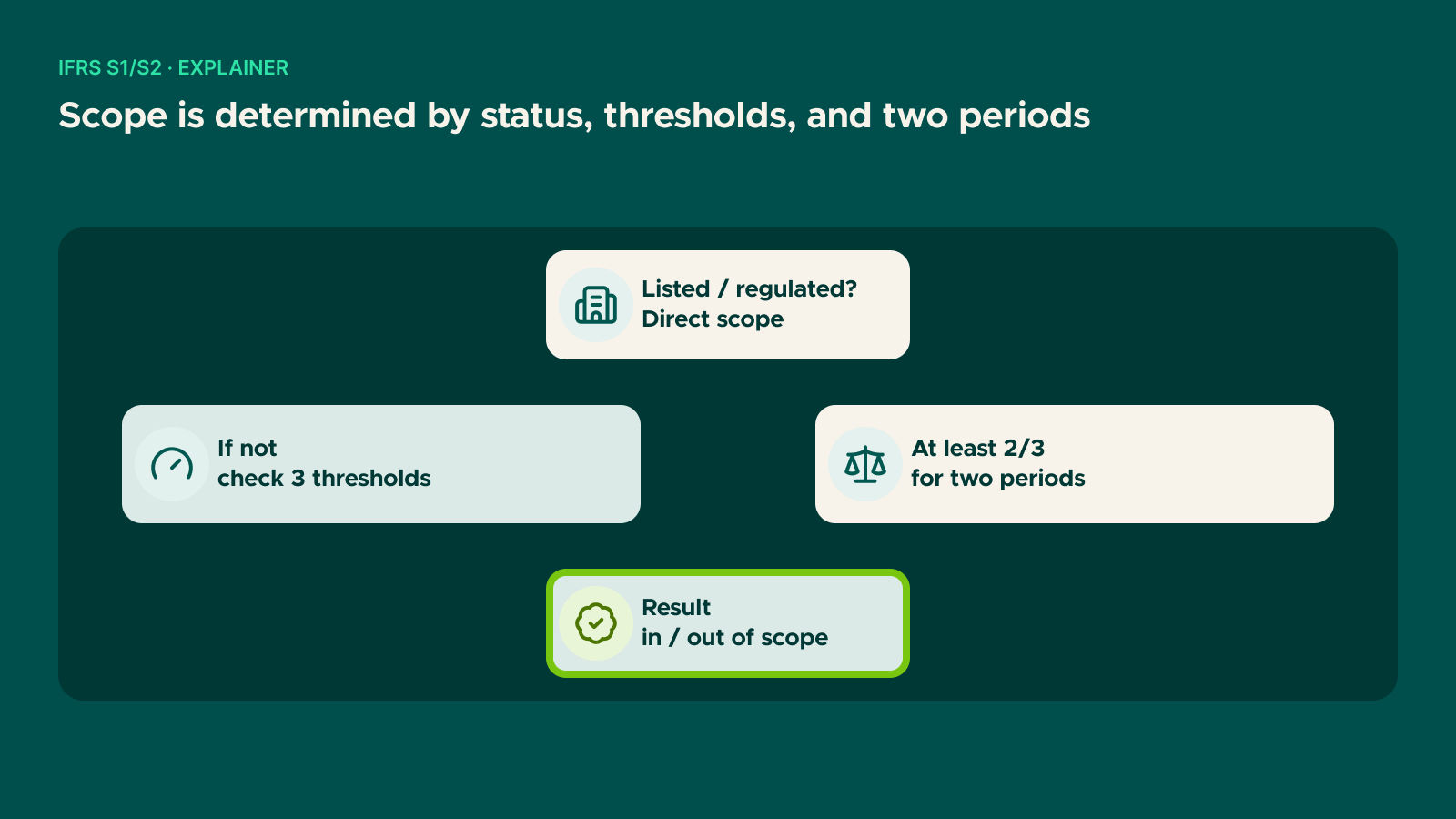
Across jurisdictions that have moved to adopt IFRS S1/S2 (or close local equivalents), the pattern of early scope tends to follow a similar logic:
Because adoption is jurisdiction-specific, a multinational group's compliance obligations are rarely determined by its headquarters location alone. A group may need to comply because:
This means scope assessment has to be done market by market rather than assumed from a single corporate domicile. For the country-level detail on which jurisdictions have moved on adoption, see ISSB Adoption Timeline: Which Countries Have Mandated IFRS S1/S2 Reporting?.
Adoption is not binary. A jurisdiction may:
A growing number of jurisdictions across Asia-Pacific, the Middle East, Africa, and Latin America have begun endorsing or phasing in IFRS S1/S2, or standards closely modeled on it, through their local regulators as part of this broader global trend toward ISSB convergence.
Given the jurisdiction-by-jurisdiction nature of adoption, the reliable approach is a formal scope assessment: identifying every jurisdiction where the company is incorporated, listed, or has a reporting subsidiary, then checking the current adoption status and applicable thresholds in each. This scope assessment is typically the first deliverable in a broader gap analysis, and it directly informs the design of the disclosure program that follows. Semtrio's IFRS S1/S2 advisory service begins every engagement with this jurisdictional scoping step before any disclosure design work starts.
Semtrio Note: Semtrio's advisory work spans clients reporting across multiple jurisdictions, giving our team direct, current visibility into how different regulators are sequencing IFRS S1/S2 adoption — visibility we apply when scoping a client's specific obligations rather than relying on general assumptions.
No. Compliance is mandatory only where a jurisdiction's regulator has formally adopted the standards; elsewhere, application is voluntary.
Each jurisdiction's own securities regulator, stock exchange, or government — the ISSB itself has no enforcement authority.
Yes. A subsidiary operating or listed in a jurisdiction that has adopted IFRS S1/S2 can create reporting obligations that flow up into the parent group's disclosures.
Yes, banks, insurers, and asset managers are frequently among the first entities brought into scope given their systemic exposure to climate-related financial risk.
A formal, jurisdiction-by-jurisdiction scope assessment covering every market where the company is incorporated, listed, or has a reporting subsidiary.
If your organization needs a clear answer on where and when IFRS S1/S2 compliance applies to your group, Semtrio can conduct a jurisdictional scope assessment as a first step. Contact Semtrio to get started.
Get in touch
If something you've read here connects to a live project, a reporting deadline, or a decision you're weighing — we're happy to have a useful conversation.
Contact us
Regulation & Compliance
Regulation & Compliance
Regulation & Compliance
Lets talk about your sustainability goals.