Blog
Publish: 02 Sep 26Reading Time: 4 Min
There is no single global date on which IFRS S1/S2 became mandatory, because the ISSB sets the standards but each jurisdiction decides independently whether and when to adopt them. The ISSB's recommended effective date — annual reporting periods beginning on or after 1 January 2024 — is a starting point for voluntary or endorsed application, not a worldwide legal deadline.
The ISSB operates on an endorsement model, the same approach long used for IFRS Accounting Standards. The ISSB publishes the standard; individual jurisdictions then choose whether to require it, permit voluntary use, adapt it into a local equivalent, or take no action. This is why the global picture reads as a patchwork of progress rather than a single rollout date, and why the pace of adoption differs by region, by type of entity (listed vs. private, financial vs. non-financial), and by whether a jurisdiction already had an established climate disclosure regime to build on.
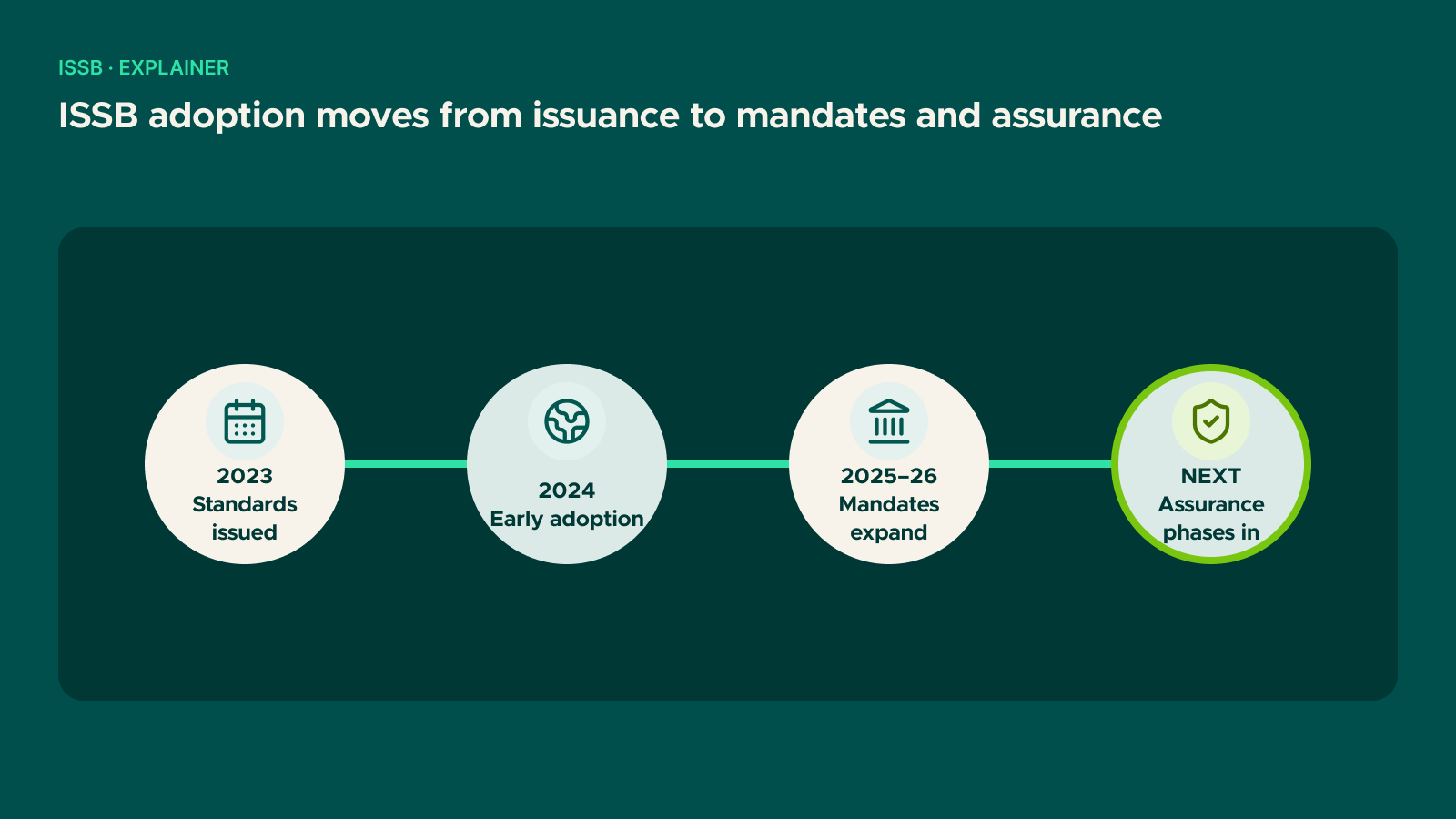
Since the standards were issued in 2023, a growing number of jurisdictions across Asia-Pacific, the Middle East, Africa, and Latin America have begun endorsing or phasing in IFRS S1/S2 — or sustainability disclosure standards closely modeled on the ISSB baseline — through their own securities regulators, central banks, or stock exchanges. This reflects the broader intent behind the ISSB's creation: to give jurisdictions that lacked an established sustainability disclosure regime a ready-made, investor-grade baseline they can adopt rather than building one from scratch.
Some jurisdictions are adopting IFRS S1/S2 as part of a phased rollout — starting with the largest listed companies and financial institutions, then extending to smaller entities over subsequent reporting cycles. The specific phase-in years, thresholds, and entity categories vary materially by jurisdiction and should always be confirmed against the current rule in force before a company relies on any particular date.
Adoption speed tends to track a few structural factors:
Rather than trying to memorize a static list of country dates — which will shift as more regulators act — reporting teams benefit from a standing process that:
This tracking process is a natural companion to the scope assessment described in Who Must Comply with IFRS S1/S2? Scope and Adoption Timeline by Jurisdiction, and both feed directly into the broader picture of what is changing across the ISSB landscape covered in ISSB Standards in 2026: What's Changing in Global Sustainability Disclosure.
Semtrio's IFRS S1/S2 advisory service maintains ongoing visibility into adoption developments across the jurisdictions our clients operate in, so that scope assessments and disclosure programs are built against current rules rather than outdated assumptions.
Semtrio Note: Semtrio's IFRS Sustainability Alliance membership provides direct access to ISSB jurisdictional adoption updates as they are published, which our advisory team incorporates into client scope assessments on an ongoing basis.
No. That date is the ISSB's recommended effective date, not a global legal mandate. Actual mandatory dates depend entirely on when each jurisdiction's own regulator adopts the standards.
Differences stem from each jurisdiction's existing disclosure infrastructure, regulatory capacity, capital markets priorities, and whether it already has an established climate reporting regime such as TCFD-aligned rules or a regional framework like CSRD/ESRS.
Some adopt the ISSB standards directly; others adapt them into a jurisdiction-specific standard closely modeled on the ISSB baseline. The precise approach depends on the individual regulator.
By maintaining an ongoing jurisdictional tracking process that checks adoption status regularly across every relevant jurisdiction, rather than relying on a one-time assessment.
Adoption is an active, ongoing process. Additional jurisdictions continue to move toward endorsement or phase-in, which is why standing monitoring is more reliable than a fixed list.
If you need an accurate, current read on IFRS S1/S2 adoption status across the jurisdictions relevant to your organization, Semtrio's advisory team can prepare a jurisdictional tracking brief specific to your group. Contact Semtrio to begin.
Get in touch
If something you've read here connects to a live project, a reporting deadline, or a decision you're weighing — we're happy to have a useful conversation.
Contact us
Regulation & Compliance
Regulation & Compliance
Regulation & Compliance
Lets talk about your sustainability goals.