Blog
Publish: 02 Sep 26Reading Time: 5 Min
Heading into 2026, the defining development in ISSB standards is the continued expansion of jurisdictional adoption: more regulators are moving from proposal to mandate, assurance requirements are beginning to phase in alongside disclosure mandates, and the interoperability work between IFRS S1/S2 and other frameworks such as CSRD/ESRS continues to mature. There is still no single global mandatory date — the picture remains one of jurisdiction-by-jurisdiction progress.
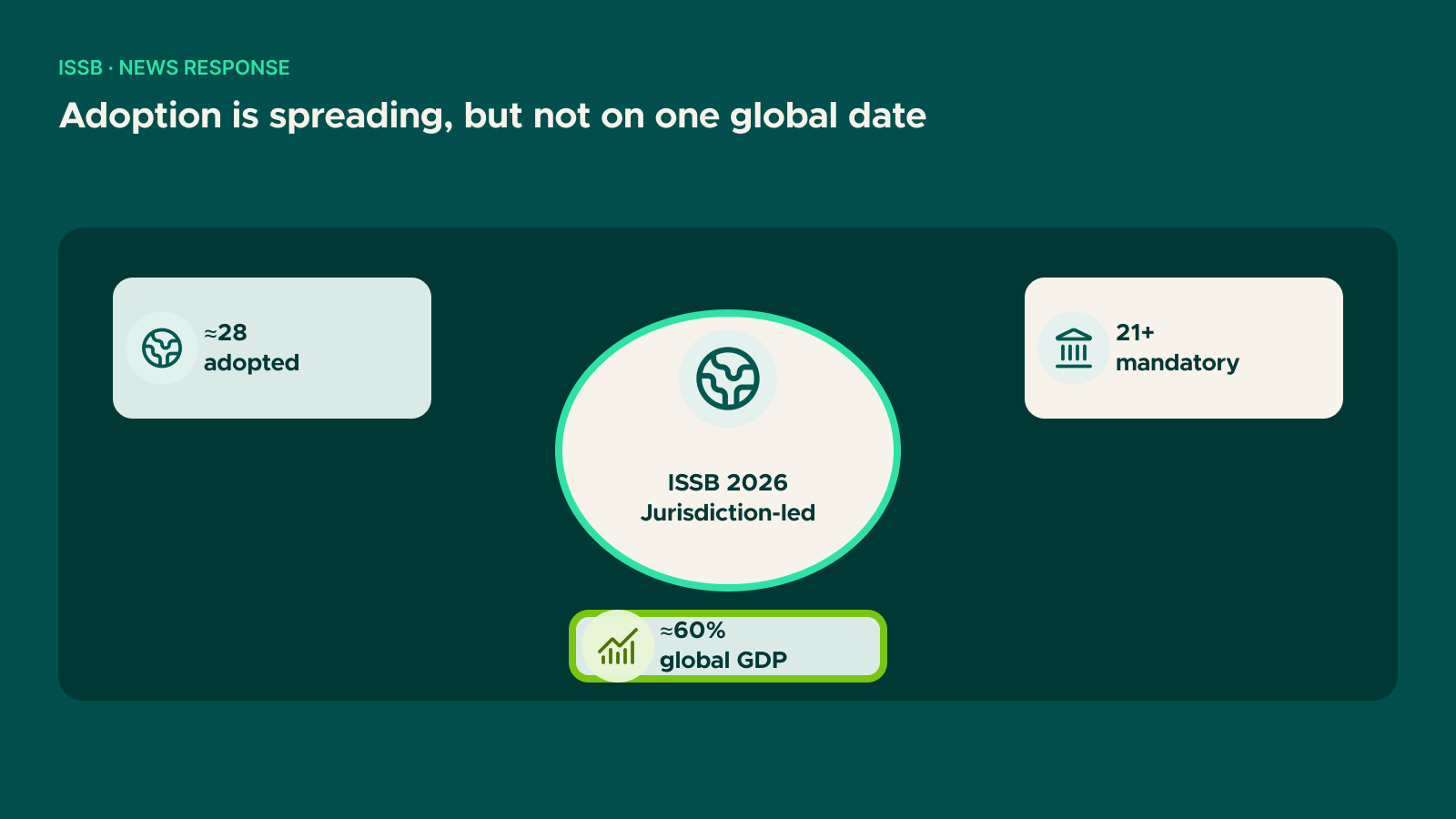
When the ISSB issued IFRS S1 and IFRS S2 in June 2023, the standards existed as a global baseline with a recommended effective date but limited actual mandatory application. In the period since, adoption has broadened materially: as of early-to-mid 2026, roughly 28 jurisdictions have adopted the standards on a voluntary or mandatory basis, with more than 21 having made them mandatory, representing an estimated 60% of global GDP. Early and 2026 mandatory adopters include Nigeria, Australia, Japan, Singapore, Hong Kong, South Korea, Canada, the UK, and Brazil, with Chile, Qatar, and Mexico among the jurisdictions where mandatory rules took effect at the start of 2026, and Costa Rica, Malaysia, Sri Lanka, Tanzania, and Pakistan implementing ISSB-aligned reporting on their own timelines.
As more jurisdictions move from voluntary to mandatory IFRS S1/S2 reporting, a parallel trend is the phase-in of assurance requirements — following the same pattern financial reporting has long used, where disclosure mandates precede assurance mandates. Companies operating in jurisdictions further along in this process are more likely to face assurance requirements in the near term, while companies in jurisdictions earlier in the adoption curve may still be in a disclosure-only phase. For a detailed look at how assurance requirements work once they apply, see How Does Assurance Work Under IFRS S1/S2 Sustainability Reporting?.
Interoperability work between the ISSB and EFRAG continues to develop, aimed at reducing duplication for companies reporting climate information under both IFRS S2 and ESRS. This work has not made the two frameworks identical — CSRD/ESRS remains a broader, double-materiality-based framework, while IFRS S1/S2 remains investor-focused and financially material — but the alignment of underlying climate concepts continues to make dual reporting more efficient than treating the two frameworks as entirely separate exercises. It is also worth noting that CSRD's own scope was substantially narrowed in early 2026 through the EU's "Omnibus I" simplification package, which raised CSRD's thresholds and pushed back its timeline — a separate but related development multinational reporters should track alongside ISSB adoption. See IFRS S1/S2 vs CSRD/ESRS: Key Differences for Multinational Reporters for the current state of that comparison.
Given the continued pace of jurisdictional change, reporting teams are best served by:
Yes. The ISSB has an active work programme of targeted amendments rather than a wholesale rewrite. In 2025, it proposed targeted relief amendments to IFRS S2 aimed at easing application and reducing the risk of duplicated reporting effort for preparers, informed by feedback from its Transition Implementation Group. Separately, the ISSB has been running a multi-phase project to update the SASB Standards it inherited: an exposure draft covering amendments to nine SASB Standards was issued in July 2025 (comment period closed 30 November 2025), followed by a further exposure draft in March 2026 proposing amendments to three additional SASB Standards and to the Industry-based Guidance on Implementing IFRS S2. As of mid-2026, the ISSB is still considering feedback and has not finalized these amendments — companies should check the ISSB's current work plan before assuming any specific change is final.
Companies that treat IFRS S1/S2 compliance as a fixed, one-time project risk falling behind as jurisdictions continue to adopt, phase in assurance, and refine interoperability guidance. A more resilient approach treats ISSB compliance as an ongoing program — one that started with a gap analysis (see How to Start Your IFRS S1/S2 Compliance Journey: A Gap Analysis Guide) and continues to adapt as the regulatory landscape develops.
Semtrio's IFRS S1/S2 advisory service is structured as an ongoing advisory relationship rather than a one-time project, precisely because the jurisdictional and regulatory landscape continues to evolve.
Semtrio Note: Semtrio's IFRS Sustainability Alliance membership keeps our advisory team current on ISSB developments as they are published, which we apply directly when advising clients on how their compliance programs should adapt through 2026 and beyond.
No. Adoption remains jurisdiction-specific. As of mid-2026, roughly 28 jurisdictions have adopted the standards voluntarily or mandatorily, with more than 21 making them mandatory — but there is no single worldwide date.
Assurance requirements are generally phasing in as jurisdictions mature their disclosure mandates, following the pattern seen in financial reporting, though the specific pace varies by jurisdiction.
No. The two frameworks remain distinct, with ESRS retaining its double-materiality approach and IFRS S1/S2 remaining investor-focused. Interoperability guidance reduces duplication but does not make the frameworks identical — and CSRD's own scope was narrowed by the EU's 2026 Omnibus I package, which is a separate development from this interoperability work.
Active jurisdictional tracking, assurance readiness ahead of mandates, continued investment in Scope 3 data capability, and treating IFRS S1/S2 and CSRD/ESRS as a coordinated reporting program while accounting for CSRD's narrower current scope.
Yes — the ISSB has active exposure drafts (as of March 2026) proposing targeted amendments to several SASB Standards and to the Industry-based Guidance on Implementing IFRS S2, alongside earlier 2025 proposals for targeted IFRS S2 relief. These are still under deliberation and not yet finalized.
If your organization wants to make sure its IFRS S1/S2 compliance program keeps pace with ongoing regulatory developments, Semtrio's advisory team can help you build a forward-looking, adaptable reporting strategy. Contact Semtrio to discuss your program.
Get in touch
If something you've read here connects to a live project, a reporting deadline, or a decision you're weighing — we're happy to have a useful conversation.
Contact us
Regulation & Compliance
Regulation & Compliance
Regulation & Compliance
Lets talk about your sustainability goals.