Blog
Publish: 07 Aug 26Reading Time: 4 Min
IFRS S1/S2 and the EU's CSRD/ESRS framework are both major sustainability disclosure regimes, but they are built on different materiality concepts: IFRS S1/S2 uses single (financial) materiality, focused on what matters to investors, while ESRS uses double materiality, requiring companies to also disclose their impacts on people and the environment. The two frameworks are not identical, though the ISSB and EFRAG have developed interoperability guidance to reduce duplication for companies reporting under both.
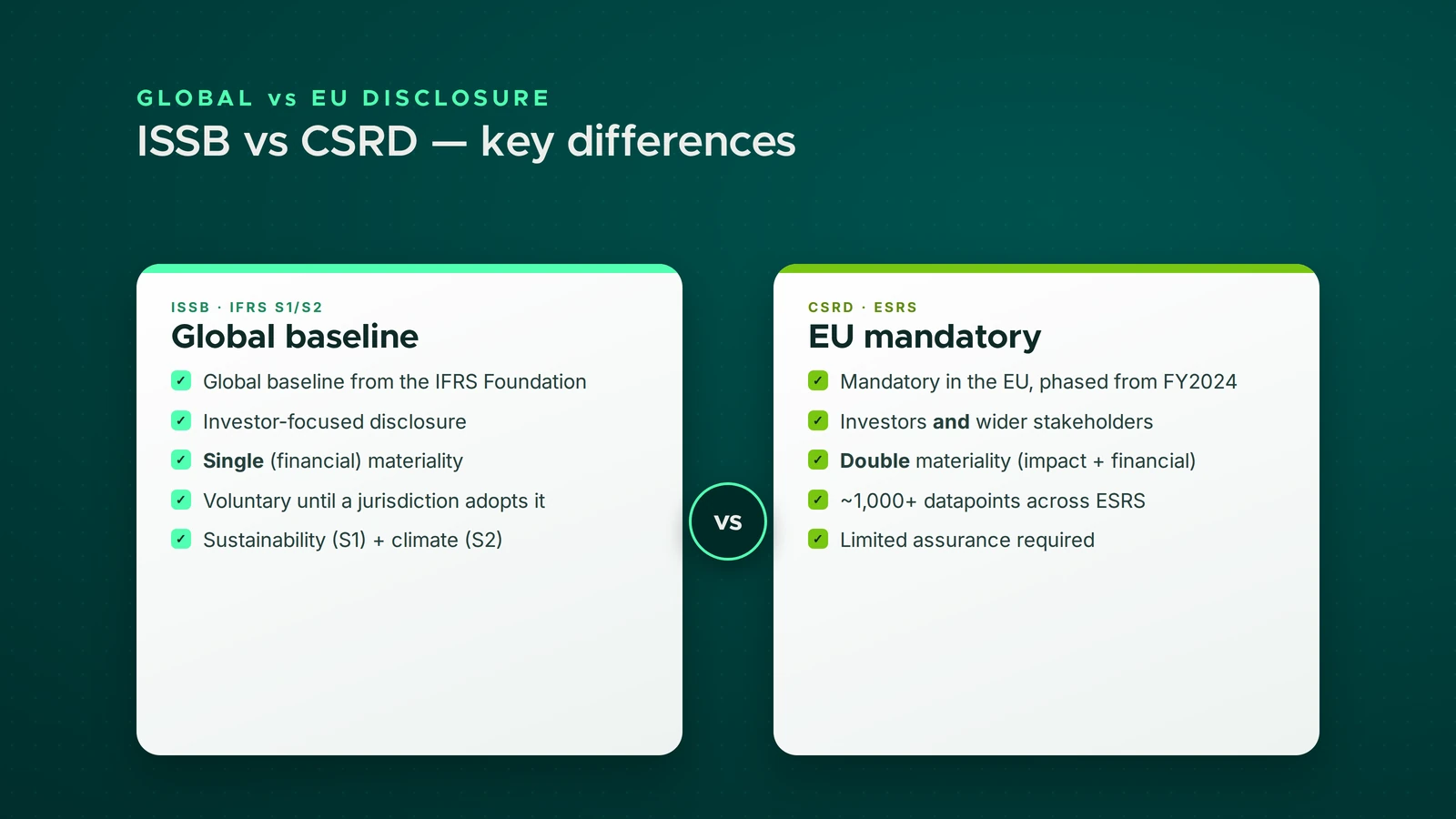
IFRS S1/S2 and the EU's CSRD/ESRS framework are both major sustainability disclosure regimes, but they are built on different materiality concepts: IFRS S1/S2 uses single (financial) materiality, focused on what matters to investors, while ESRS uses double materiality, requiring companies to also disclose their impacts on people and the environment. The two frameworks are not identical, though the ISSB and EFRAG have developed interoperability guidance to reduce duplication for companies reporting under both.
The starting point for understanding this comparison is materiality:
IFRS S1/S2 (single/financial materiality): A topic is disclosed if it could reasonably affect the company's cash flows, access to finance, or cost of capital.
CSRD/ESRS (double materiality): A topic is disclosed if it is financially material to the company OR if the company has a material impact on people or the environment — even where that impact does not currently affect the company's own financial position.
This means a company applying ESRS may need to disclose sustainability information that would not meet the financial-materiality threshold under IFRS S1/S2, and vice versa.
CSRD/ESRS covers a considerably broader set of sustainability topics beyond climate — including biodiversity, water, workforce, affected communities, and business conduct — each governed by its own detailed ESRS standard. IFRS S2 is climate-specific, while IFRS S1 leaves topic selection to the company's own materiality judgment, often informed by SASB industry standards.
The ISSB and EFRAG (the body that develops ESRS) have worked together on interoperability guidance, particularly on climate disclosures, so that a company reporting under both frameworks does not need to build entirely separate climate disclosure processes from the ground up. It is important to be precise about what this interoperability guidance does and does not achieve: it reduces duplication of effort and supports a more efficient reporting process, but it does not make the two frameworks fully identical or interchangeable.
For companies subject to both CSRD/ESRS (through EU operations or listings) and IFRS S1/S2 (through other jurisdictions or investor expectations), a coordinated approach typically involves:
Building one integrated climate data architecture — GHG inventory, scenario analysis inputs, transition plan data — that can feed both disclosures, using the interoperability guidance as a reference point.
Running separate materiality assessments for each framework, since the underlying tests differ (financial materiality vs. double materiality), rather than assuming one assessment covers both.
Mapping disclosure requirements side by side to identify where content can be shared directly, where it needs to be adapted, and where entirely separate disclosures are required.
Maintaining jurisdiction-specific compliance tracking, since which framework applies — one, both, or neither — depends on the company's specific footprint.
Semtrio's IFRS S1/S2 advisory service works with multinational clients to design data architecture and disclosure processes that serve both IFRS S1/S2 and CSRD/ESRS obligations efficiently, without treating either framework as a lesser priority.
Semtrio Note: As an EcoVadis Accredited Consulting Partner, Semtrio maintains close working familiarity with double-materiality assessment methodology — directly relevant to helping clients run rigorous, separate materiality processes for ESRS alongside their IFRS S1/S2 work.
What is the main difference between IFRS S1/S2 and CSRD/ESRS?
IFRS S1/S2 uses single (financial) materiality, focused on investor decision-making, while CSRD/ESRS uses double materiality, requiring disclosure of both financial impacts and the company's impacts on people and the environment.
Can one report satisfy both IFRS S1/S2 and CSRD/ESRS requirements?
Not fully. Interoperability guidance developed by the ISSB and EFRAG reduces duplication, particularly in climate data, but the two frameworks have different materiality processes and disclosure requirements that each need to be satisfied on their own terms.
Does CSRD/ESRS cover more topics than IFRS S1/S2?
Yes. ESRS covers a broader range of sustainability topics — including biodiversity, workforce, and business conduct — while IFRS S2 is climate-specific and IFRS S1's topic scope depends on the company's own financial-materiality assessment.
Do companies need separate materiality assessments for each framework?
Yes. Because the materiality tests differ — financial materiality under IFRS S1/S2 versus double materiality under ESRS — a single materiality assessment generally cannot serve both frameworks.
Is a company required to report under both frameworks?
That depends on the company's specific jurisdictional footprint — EU operations or listings may trigger CSRD/ESRS obligations, while other jurisdictions may separately require or encourage IFRS S1/S2 alignment.
If your organization needs to reconcile IFRS S1/S2 and CSRD/ESRS reporting obligations, Semtrio can help you design a data architecture and disclosure process that serves both without duplicating effort.
Get in touch
If something you've read here connects to a live project, a reporting deadline, or a decision you're weighing — we're happy to have a useful conversation.
Contact us
Regulation & Compliance

Regulation & Compliance
Regulation & Compliance
Lets talk about your sustainability goals.