Blog
Publish: 10 Nov 26Reading Time: 7 Min
Greenwashing is presenting a product or company as better for the environment than the evidence supports. In the EU, Directive (EU) 2024/825 on empowering consumers for the green transition has applied since 27 September 2026: it bans generic claims such as "eco-friendly" without recognised proof, and product claims of "climate neutral" or "reduced impact" based on carbon offsetting. The separate Green Claims Directive was never adopted; in its 2027 work programme of 4 November 2026, the Commission listed it among proposals it intends to withdraw.
Last checked: 10 November 2026. This article explains the rules; it is not legal advice.
Directive (EU) 2024/825, adopted on 28 February 2024, amends the Unfair Commercial Practices Directive (UCPD). Member States had to transpose it by 27 March 2026, and its rules apply from 27 September 2026, including to products and packaging already on the market ("old stock"), according to the Commission's September 2026 Questions & Answers.
It adds practices to the UCPD's blacklist, which are banned in all circumstances, and new grounds for case-by-case assessment:
| Practice | Rule | Status |
|---|---|---|
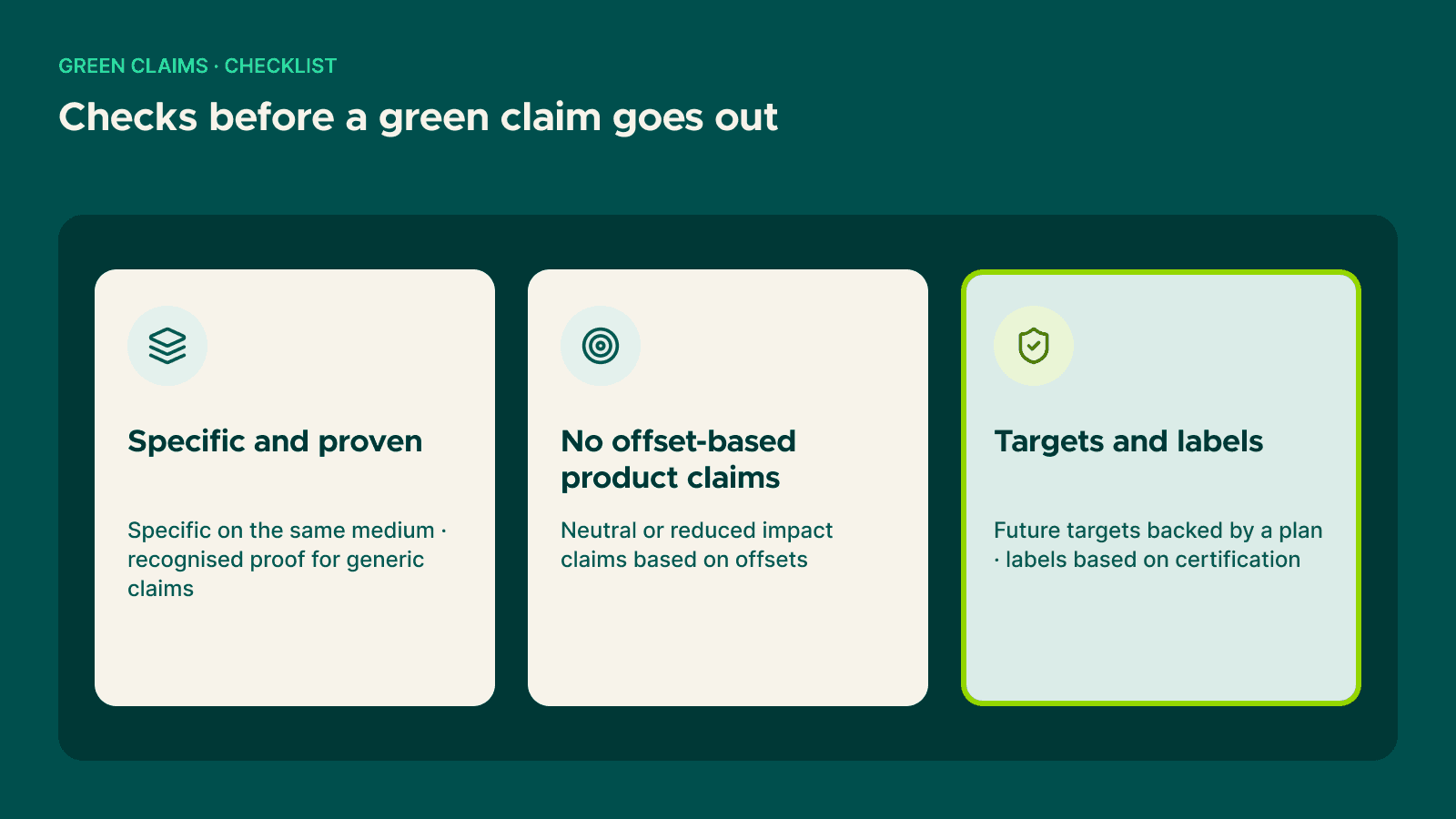
| Generic environmental claim ("eco-friendly", "green", "climate friendly") without recognised excellent environmental performance | Annex I, point 4a | Banned in all circumstances |
| Product claim of neutral, reduced or positive greenhouse gas impact based on offsetting | Annex I, point 4c | Banned in all circumstances |
| Sustainability label not based on a certification scheme or not established by public authorities | Annex I, point 2a | Banned in all circumstances |
| Future environmental performance claim (for example "net zero by 2040") without a detailed, realistic implementation plan regularly verified by an independent third-party expert | Article 6(2)(d) UCPD | Misleading, assessed case by case |
What "generic" means. A claim is generic when its specification is not given in clear and prominent terms on the same medium, such as the same advert, pack or product page. "Recognised excellent environmental performance" can be shown in three ways: the EU Ecolabel, an officially recognised EN ISO 14024 type I ecolabel (the Commission names Nordic Swan and Blue Angel, among others), or top performance under other EU law, such as the Energy Labelling Regulation. The proof has to be relevant to the claim.
What the offset ban covers. Recital 12 gives examples: "climate neutral", "CO2 neutral certified", "carbon positive", "climate net zero", "climate compensated", "reduced climate impact" and "limited CO2 footprint". Claims based on the product's actual lifecycle impact within its own value chain remain possible, and companies can still describe their investment in carbon credit projects if they do so transparently and without misleading.
It is a proposal, not law. The Commission proposed it in March 2023 to set rules on how environmental claims are substantiated and verified. On 20 June 2025, the Commission announced that it intended to withdraw the proposal, and the trilogue planned for 23 June 2025 was cancelled. A Commission spokesperson later said it had not yet been withdrawn.
On 4 November 2026, the Commission published its 2027 work programme. Annex III lists the Green Claims proposal among pending proposals it intends to withdraw, on the grounds that it is unlikely to win sufficient support in the Council within a reasonable time. Until the withdrawal procedure is complete, the file remains formally pending.
For companies, the practical point is simpler than the procedure: the rules that bind marketing today are the ones in Directive (EU) 2024/825 and the national laws that transpose it.
The directive covers business-to-consumer marketing. The Commission's Q&A states that it is strictly limited to B2C practices; B2B communication falls under other instruments, such as the Misleading and Comparative Advertising Directive, and some Member States extend protection nationally.
It applies wherever EU consumers see the claim. A Turkish manufacturer selling online to EU consumers, or whose brand appears on shelves in the EU, is making claims to EU consumers. Brand and product names can count as environmental claims if they create an environmental association for the average consumer.
Your EU customers' claims rest on your data. If an EU retailer or brand makes a consumer-facing claim about your product, such as "reduced CO2 impact", that claim has to be specified clearly and backed by real reductions across the product's lifecycle. The evidence usually starts with supplier data: a product carbon footprint, a life cycle assessment or an environmental product declaration.
Enforcement is national. Enforcement lies with national authorities and courts, and transposition has been uneven: law firm Mayer Brown counted eight Member States that had notified no transposing measures as of late October 2026. The rules' application date does not move because of that, so the safer reading is to comply from 27 September 2026 in every market.
Turkish companies selling at home face a parallel standard: the Ministry of Trade Advertising Board's guide on environmental claims in advertising, in force since 13 December 2022, asks claims to say which part of the product or process they refer to and backs future targets only with a public, verifiable strategy.
Run every consumer-facing claim through these five checks:
Get in touch
If something you've read here connects to a live project, a reporting deadline, or a decision you're weighing — we're happy to have a useful conversation.
Contact usLets talk about your sustainability goals.
They answer different questions. A science-based target describes how a company will cut its own emissions; a carbon credit funds a reduction or removal somewhere else. The SBTi describes action on ongoing emissions as "a complement to—not a substitute for—companies reducing their carbon footprints". The SBTi published Version 2.0 of its Corporate Net-Zero Standard in 2026; companies can submit targets under it from the first quarter of 2027, and Version 1 stays open until the end of 2027.
EU consumer law draws a similar line. Offsetting cannot support a product claim of reduced impact, but a validated target and a verified implementation plan can support a factual statement about where the company is heading.
Most risky claims are not invented; they come from a sustainability report written for investors and reused on a product page. The fix is usually to rebuild the claim from the evidence up: what was measured, for which product, against which baseline. Sustainability strategy advisory turns targets into a plan that supports public commitments, and product carbon footprint work produces the product-level evidence that specific claims require.
Greenwashing is presenting a product, service or company as more environmentally friendly than the evidence supports. EU law does not use the word as a legal term; it bans specific practices, such as unsubstantiated generic claims and offset-based neutrality claims, in consumer marketing.
No. It was proposed in March 2023 and never adopted. The Commission announced its intention to withdraw it in June 2025 and listed it for withdrawal in its 2027 work programme on 4 November 2026.
The offset ban in Annex I point 4c applies to product claims, not company-level claims. Company-level claims remain subject to the general UCPD rules on misleading practices, and a generic "climate neutral" claim still needs recognised proof or a clear specification.
Not under the harmonised EU framework, which is limited to business-to-consumer practices. B2B claims fall under other rules, and some Member States extend protection to businesses nationally.
It should set who approves public environmental claims, what evidence each type of claim needs, and how future targets are linked to an implementation plan and independent verification. Check the policy against the directive's rules for every market where you sell to consumers.
Related reading: Life cycle assessment · How to get an EPD certification · GRI vs ESRS/CSRD: which framework · SBTi advisory
Before your next product launch or report, a sustainability strategy scoping call maps your public targets and claims against the evidence and the implementation plan they need.