Blog
Publish: 07 Aug 26Reading Time: 5 Min
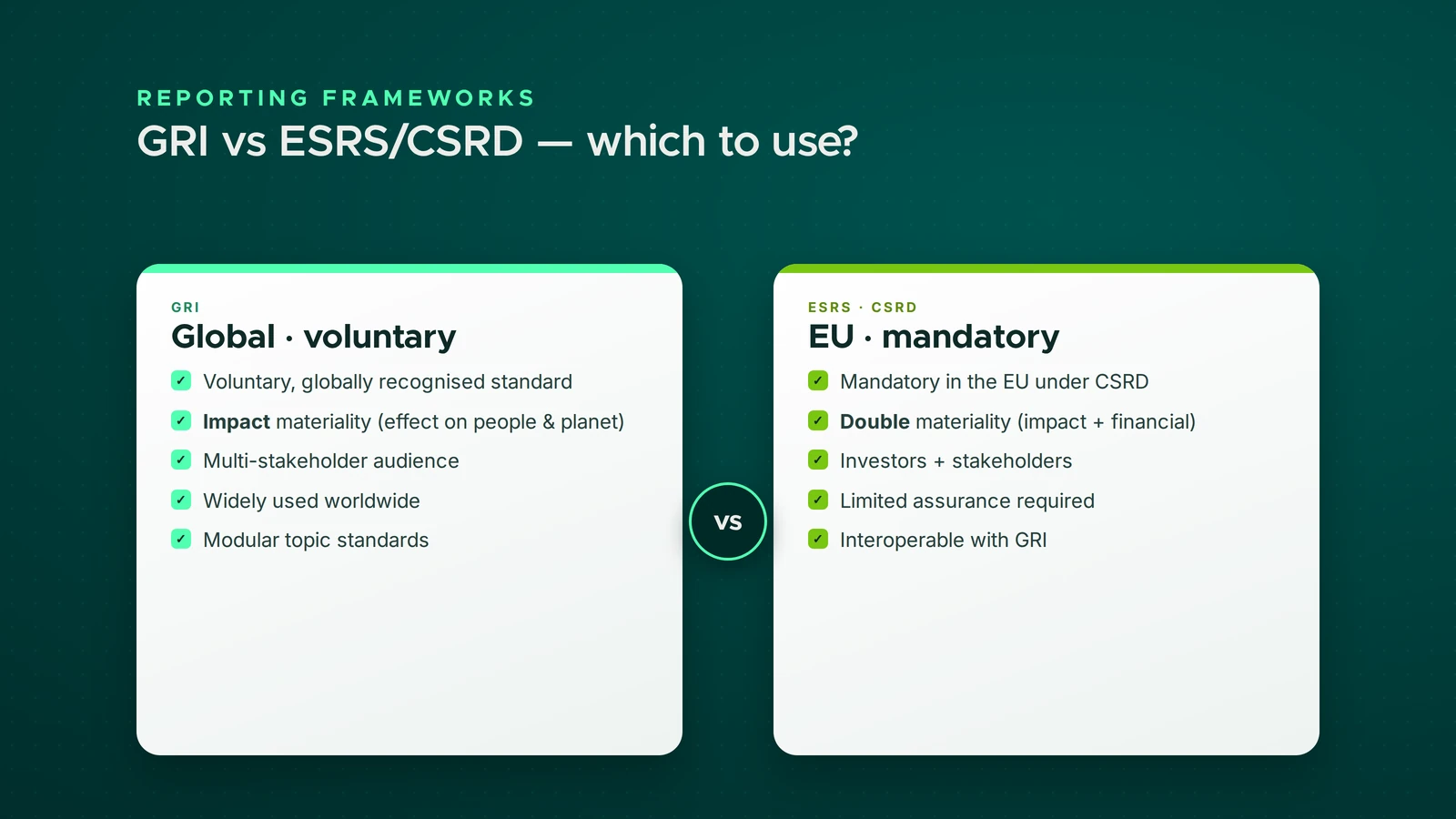
GRI and ESRS (the European Sustainability Reporting Standards, applied under the EU's Corporate Sustainability Reporting Directive, or CSRD) are not interchangeable, and choosing between them is usually the wrong question — most companies in scope of CSRD need ESRS for legal compliance and may still choose GRI for broader stakeholder reporting. The two differ chiefly in mandate status and materiality approach.
GRI and ESRS (the European Sustainability Reporting Standards, applied under the EU's Corporate Sustainability Reporting Directive, or CSRD) are not interchangeable, and choosing between them is usually the wrong question — most companies in scope of CSRD need ESRS for legal compliance and may still choose GRI for broader stakeholder reporting. The two differ chiefly in mandate status and materiality approach.
CSRD is EU legislation requiring a defined population of companies operating in the EU to report sustainability information according to ESRS, a detailed set of disclosure standards developed for this purpose. Unlike GRI, ESRS reporting under CSRD is a legal requirement for in-scope companies.
The EU Council approved the "Omnibus I" simplification package — covering both CSRD and CSDDD — on 24 February 2026; the revised rules were published in the Official Journal on 26 February 2026 and entered into force on 18 March 2026. This substantially narrowed CSRD's scope compared to its original implementation, as summarized below:
Criterion / Current threshold (post-Omnibus I):
Employees: More than 1,000
Net annual turnover: More than €450 million
Listed SMEs: Fully exempt
Non-EU parent undertakings: More than €450 million in EU-generated turnover
Non-EU subsidiaries/branches: More than €200 million in turnover
These thresholds are considerably higher than CSRD's original scope (roughly 250 employees / €50 million), and reporting for the second and third waves of companies has been delayed by two years — from financial years starting 2026 to financial years starting 2028. For financial years beginning between 1 January 2024 and 31 December 2026, large public-interest entities with more than 500 employees remain subject to CSRD reporting (absent a Member State exemption).
This means CSRD's scope narrowed rather than expanded in 2026, and its timeline was pushed back — a pattern also seen in the CSDDD's parallel Omnibus I update, and in Türkiye's TSRS threshold revision around the same period.
GRI is a voluntary, globally-used reporting framework not tied to EU legislation or any other single jurisdiction's regulatory regime. A company can use GRI regardless of whether it is in scope of CSRD.
This is the distinction reporting teams most often get wrong, so it is worth stating precisely.
GRI's materiality approach is fundamentally impact materiality — it asks which of the organization's impacts on the economy, environment, and people are significant, regardless of whether those impacts affect the company's own financial position.
ESRS applies double materiality, which combines impact materiality with financial materiality — a topic is material under ESRS if it is significant from an impact perspective, a financial perspective, or both.
It's worth noting that GRI 3 has moved closer to double-materiality-adjacent thinking in its more recent guidance, and organizations already running a rigorous GRI 3 process will find real overlap with ESRS's impact-materiality half. But GRI's foundational orientation remains impact-first, while ESRS's is explicitly dual by legal design.
ESRS reports a topic if it is material from an impact perspective, a financial perspective, or both; GRI is fundamentally impact-first.
EFRAG and GRI have a formal Memorandum of Understanding, and have jointly published the GRI-ESRS Interoperability Index (30 November 2023) and the GRI-ESRS Standards Data Point Mapping (November 2024). EFRAG's 2026 work programme continues this effort, prioritizing interoperability with ISSB, GRI, and the GHG Protocol, and developing a shared XBRL taxonomy with GRI. This work reduces duplication of effort but does not make the two frameworks fully identical or interchangeable — a company reporting under both still needs to satisfy each framework's own specific requirements.
Many companies map their existing GRI disclosure processes against ESRS data points to reduce duplication of data collection, since a number of underlying data sources — energy consumption, emissions, workforce data — feed both frameworks. This is a practical efficiency measure, not a claim that GRI reporting satisfies ESRS compliance; a company legally in scope of CSRD still needs to complete ESRS-specific disclosures, including the double-materiality assessment ESRS requires as a matter of law.
If your company is in scope of CSRD under the current (post-Omnibus I) thresholds — more than 1,000 employees and more than €450 million in turnover — ESRS compliance is not optional. Given that these thresholds are considerably higher than before, it is worth explicitly reconfirming whether your company (or an EU subsidiary) is still in scope, since some previously-in-scope mid-sized entities may now fall outside it. The separate question is whether to also maintain GRI reporting for stakeholders CSRD's scope does not fully address, or for international operations outside the EU where CSRD does not apply.
Semtrio Note: Semtrio has been a GRI Community Member since 2020, and supports clients in distinguishing GRI's impact-materiality process from the double-materiality requirements of ESRS, so the two workstreams are planned coherently rather than duplicated.
Does reporting under GRI satisfy CSRD compliance?
No. CSRD requires reporting under ESRS specifically, including its double-materiality assessment. GRI reporting can inform and complement this work but does not substitute for it legally.
Is double materiality the same as GRI's approach?
No. GRI's core approach is impact materiality — assessing significance to the economy, environment, and people. ESRS's double materiality explicitly combines this with financial materiality.
What are the current CSRD scope thresholds after the 2026 Omnibus I update?
More than 1,000 employees and more than €450 million in net annual turnover for EU companies (listed SMEs are fully exempt); non-EU parent undertakings with more than €450 million in EU-generated turnover, or non-EU subsidiaries/branches with more than €200 million in turnover.
Can our GRI materiality assessment be reused for ESRS?
Portions of the underlying data and stakeholder engagement work can inform both, and the published GRI-ESRS interoperability guidance makes this mapping more concrete, but ESRS's double-materiality assessment has its own formal requirements that a GRI-only process will not automatically satisfy.
If your organization needs to reconcile GRI and ESRS reporting requirements, Semtrio's sustainability reporting team can help design a data collection process that serves both frameworks efficiently.
Get in touch
If something you've read here connects to a live project, a reporting deadline, or a decision you're weighing — we're happy to have a useful conversation.
Contact us
Regulation & Compliance

Regulation & Compliance

Regulation & Compliance
Lets talk about your sustainability goals.