Semtrio
ACADEMY
Partner Login
Contact

By subscribing you agree to receive marketing communications from Semtrio. You can unsubscribe at any time.

Be the first to know what’s changing.

Semtrio
Follow us on

Services

Compliance and RegulatoryClimate AccountingSustainability ReportingClimate and Sustainability StrategySupply Chain Sustainability
ESG RatingsSustainable FinanceCapacity Building and TrainingCarbon Markets and Climate Projects

Industries

ManufacturingEnergyAviationFinance and Banking
TelecomsRetail and ConsumerConstruction MaterialsGroup Companies and Holdings

Works

All Clients & ProjectsKey ProjectsAccreditations

Insights

Case StudiesBlogsGlossaryResources

About

Who We AreWhy SemtrioWork With Us

Contact

Contact Us

Our Partners

B Corp Certified
CDP
UN Global Compact
Ecovadis CoreEcovadis Platinum
GRI Community Member

Copyright © 2026 All Rights Reserved.

Legal
Policies
Peerless Ventures

Designed by

Fameus
Home
Insights
Blog
ISO 14001:2026: What Changes and What Certified Companies Do Now

Blog

ISO 14001:2026: What Changes and What Certified Companies Do Now

ISO 14001ISO 14001:2026ISO 14001:2015environmental management systemEMStransitionEcoVadisCBAM

Publish: 10 Nov 26Reading Time: 7 Min

ISO 14001:2026, the fourth edition of the international standard for environmental management systems (EMS), was published on 15 April 2026 and replaces ISO 14001:2015 together with its 2024 climate amendment. Under the transition timeline that accreditation bodies are applying, ISO 14001:2015 certificates stop being valid on 30 April 2029, and no new 2015 certificates can be issued after 30 October 2027.

Has ISO 14001:2026 been published?

Yes. ISO's own record shows the International Standard reached publication on 15 April 2026 as Edition 4, and lists ISO 14001:2015 and ISO 14001:2015/Amd 1:2024 as withdrawn.
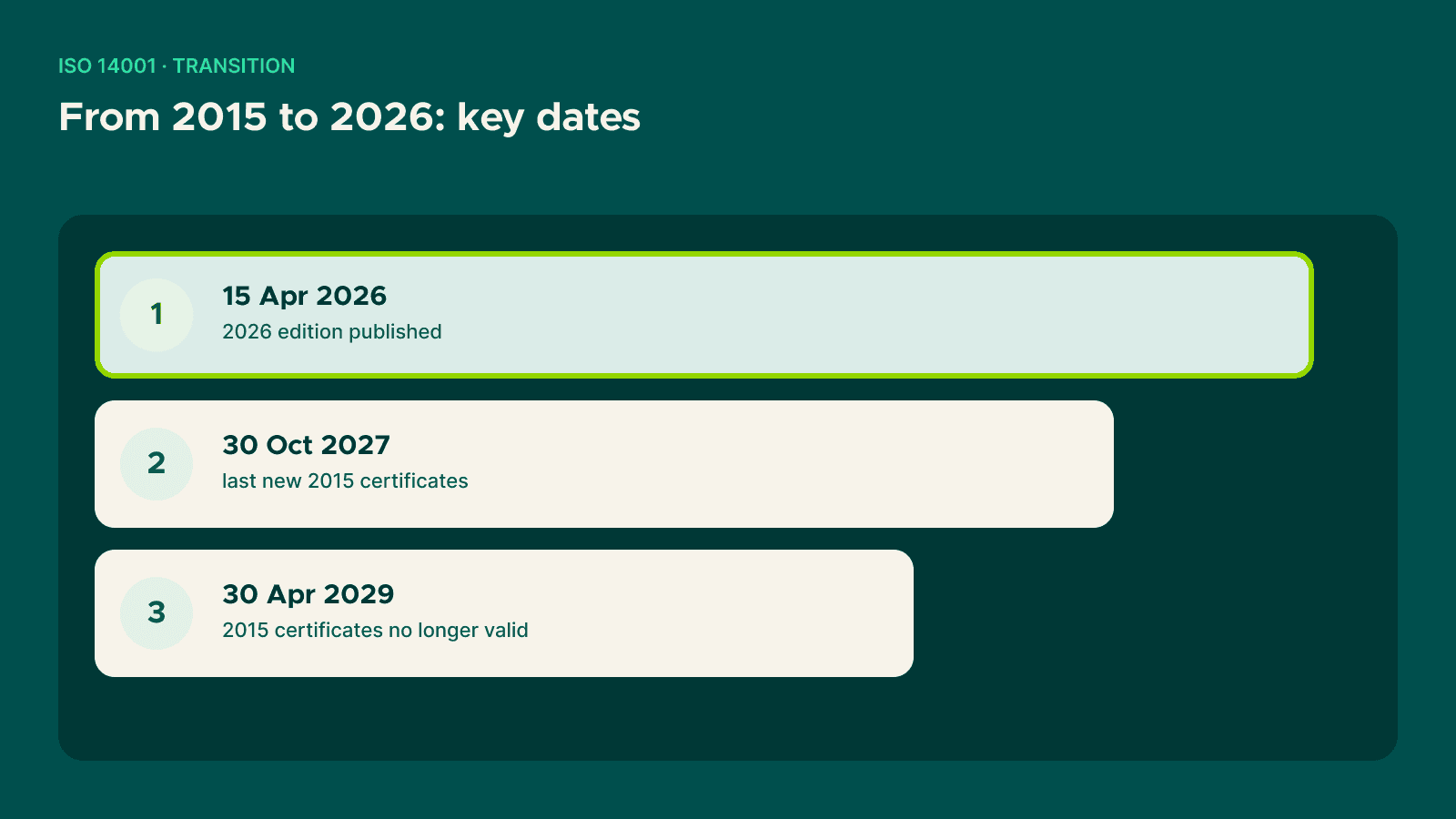
Timeline of the ISO 14001:2026 transition from publication on 15 April 2026 to the 30 April 2029 deadline

The transition rules come from Global Accreditation Cooperation Incorporated (Global ACI), the organisation formed from the merger of the International Accreditation Forum (IAF) and the International Laboratory Accreditation Cooperation (ILAC). Italy's accreditation body Accredia set out the timeline in April 2026, based on Global ACI's draft transition document:

Milestone Date
ISO 14001:2026 published 15 April 2026
Accreditation bodies ready to accredit to the new edition by 30 October 2026
Certification bodies declare they can manage the transition by 30 January 2027
Certification bodies' own transition completed by 30 April 2027
No new ISO 14001:2015 certificates issued after 30 October 2027
All certified organisations transitioned; 2015 certificates invalid 30 April 2029

Accredia noted it would adjust these rules if the final Global ACI document differs. Confirm the dates your certification body applies; Ireland's NSAI, for example, gave an indicative deadline of 15 April 2029.

What changes compared with ISO 14001:2015?

The 2026 edition keeps the 2015 framework. ISO describes it as a clearer structure that reflects current environmental challenges. Certification bodies DNV and BSI summarise the main changes as follows:

Area ISO 14001:2015 (with Amd 1:2024) ISO 14001:2026
Context of the organisation Since the 2024 amendment, organisations determine whether climate change is a relevant issue A broader set of environmental conditions to consider alongside climate change, including pollution, biodiversity and natural resource availability
Environmental aspects Life cycle perspective required Life cycle perspective strengthened, with attention to upstream and downstream impacts
Risks and opportunities Combined clause on actions to address risks and opportunities Requirements restructured and clarified
Planning of changes No dedicated clause; changes handled within other clauses New requirement to plan and manage changes to the EMS (clause 6.3)
Operational control "Outsourced processes" "Externally provided processes, products and services"
Guidance (Annex A) Existing guidance Substantially extended guidance across several clauses

In practice, these changes push your EMS records outward: more attention to what happens in your supply chain and products, and documented reasoning when you change the system.

What should certified companies do now?

  1. Get the standard and read the changed clauses. Start with context (4.1), risks and opportunities, the new planning-of-changes requirement and operational control. Buy the official text from ISO or your national standards body; summaries vary on clause detail.
  2. Run a gap check against your current EMS. For each change, write down what evidence exists today: the context analysis, the aspects register, the procedure for changes, the controls on suppliers and contractors.
  3. Update the context analysis. Add a documented view of relevant environmental conditions, including pollution, biodiversity and resource availability, on top of the climate change assessment introduced in 2024.
  4. Extend the aspects register across the life cycle. Record upstream and downstream aspects you can influence, such as purchased materials, transport and end-of-life of products.
  5. Write a change-planning procedure. Define how EMS changes are proposed, assessed, approved and recorded.
  6. Review controls on externally provided processes, products and services. Include suppliers whose products, not only outsourced processes, affect your environmental aspects.
  7. Book the transition audit with your certification body. Accredia's rules say the transition audit can run with a surveillance or recertification audit, or as a special audit. If you decline it, the certificate is withdrawn at the end of the transition period.

How does an EMS support CBAM, ESRS and EcoVadis evidence?

ISO 14001 certification isn't required by CBAM, ESRS or EcoVadis. What an EMS gives you is a controlled system for environmental data and documents, and that is what each of these asks you to produce.

  • EcoVadis. EcoVadis says its method draws on company documentation and relevant third-party endorsements such as certifications. A valid ISO 14001 certificate, the environmental policy and the monitoring records behind it are the documents an Environment theme assessment looks at. See our EcoVadis document checklist.
  • ESRS. The ESRS adopted in 2023 build each environmental topic around policies, actions, targets and metrics. An EMS already holds the environmental policy, objectives and performance records. The Commission has since published revised ESRS that apply to financial years from 1 January 2027, so check which set applies to your report.
  • CBAM. An EMS doesn't replace a CBAM monitoring methodology or verification by a CBAM-accredited verifier. But the EMS disciplines of documented information, calibration and monitoring records give installation data a home before the verifier asks for it. More in CBAM verification and accredited verifiers.

What we see in practice

Companies that already hold ISO 14001 often keep EMS records, EcoVadis evidence and sustainability report data in three separate places, and collect the same figures three times. At Turkish Technic, one data collection fed both the GRI disclosures and the EcoVadis evidence base. The 2026 transition is a good moment to do the same with EMS records. Our sustainability strategy advisory designs the KPI framework and data architecture that connect these outputs, and our EcoVadis advisory and CSRD and ESRS advisory cover the reporting side.

Frequently asked questions

When was ISO 14001:2026 published?

On 15 April 2026. It is the fourth edition of ISO 14001 and replaces ISO 14001:2015 and its 2024 climate amendment, both of which ISO lists as withdrawn.

Is my ISO 14001:2015 certificate still valid?

Yes, during the transition period. Under the timeline accreditation bodies are applying, 2015 certificates stop being valid on 30 April 2029, so the transition audit has to be completed before then.

Who sets the ISO 14001:2026 transition period?

Global ACI, the body formed from the merger of IAF and ILAC, sets the transition rules for accreditation bodies and certification bodies. Accreditation bodies such as Accredia published the timeline in April 2026 based on Global ACI's draft document.

Is ISO 14001:2026 a major revision?

No. The 2026 edition keeps the existing framework and adds targeted changes: a broader view of environmental conditions, a stronger life cycle perspective, a new requirement for planning changes, and wider control of externally provided processes, products and services.

What was the 2024 climate amendment?

ISO 14001:2015/Amd 1:2024, "Climate action changes", was published in February 2024. It required organisations to determine whether climate change is a relevant issue when setting the context of their EMS, and it is now folded into the 2026 edition.

Does ISO 14001 help with EcoVadis?

It can. EcoVadis draws on company documentation and third-party endorsements such as certifications, so a valid certificate and its supporting records feed the Environment theme. It doesn't replace the policies, measures and results the assessment asks for.

Book a scoping call and get a map of which of your EMS records can serve as evidence for your EcoVadis, ESRS and CBAM work.

Sources

  • ISO, ISO 14001 standard record (Edition 4, published 2026-04-15) – https://committee.iso.org/ru/standard/14001 (checked 2026-11-10)
  • ISO, ISO 14001:2015/Amd 1:2024 record (withdrawn 2026-04-15, replaced by ISO 14001:2026) – https://committee.iso.org/standard/88209.html (checked 2026-11-10)
  • Accredia, Circolare informativa DC N°14/2026, transition to ISO 14001:2026 (16 April 2026) – https://www.accredia.it/wp-content/uploads/2026/04/Circolare_informativa_DC_14-2026_ITA-Nuova-ISO-14001.pdf (checked 2026-11-10)
  • NSAI, Transitioning your EMS certification to I.S. EN ISO 14001:2026 – https://www.nsai.ie/about/news/transitioning-your-environmental-management-system-certification-to-i.s-en-iso-140012026/ (checked 2026-11-10)
  • DNV, New edition of ISO 14001 published – https://www.dnv.com/news/2026/new-edition-of-iso-14001-published/ (checked 2026-11-10)
  • BSI, ISO 14001 revision: shaping the future of environmental management – https://www.bsigroup.com/en-SE/insights-and-media/insights/blogs/iso-14001-revision-shaping-the-future-of-environmental-management/ (checked 2026-11-10)
  • EcoVadis, CSR methodology overview and principles – https://resources.ecovadis.com/ecovadis-solution-materials/ecovadis-csr-methodology-overview-and-principles (checked 2026-11-10)
  • EFRAG, Commission publishes delegated act on revised ESRS (3 July 2026) – https://www.efrag.org/en/news-and-calendar/news/european-commission-publishes-delegated-act-on-revised-esrs-and-voluntary-sustainability-reporting (checked 2026-11-10)

Get in touch

Let's talk about what you're working on.

If something you've read here connects to a live project, a reporting deadline, or a decision you're weighing — we're happy to have a useful conversation.

Contact us

Related reading

CDP disclosure explained: scoring levels and the 2027 scoring deadline in the week of 26 July

Sustainability Reporting

7 Min10 Nov 26

CDP disclosure explained: how scores work and the 2027 timeline

Read
EU greenwashing rules: Directive (EU) 2024/825 applies from 27 September 2026

Regulation & Compliance

7 Min10 Nov 26

EU greenwashing rules in 2026: what changed for green claims

Read
Carbon credits label with a leaf icon and the date the EU ban on offset-based product claims applies, 27 September 2026

Regulation & Compliance

8 Min10 Nov 26

Voluntary carbon market explained: carbon credits, integrity and claims

Read

Get in Touch With Our Experts

Lets talk about your sustainability goals.