Blog
Publish: 02 Sep 26Reading Time: 4 Min
An EcoVadis assessment relies on documentary evidence across four themes, so preparation means assembling written policies, implementation records, and outcome data before submission — not describing intentions. Gathering and organizing this evidence early is the single biggest factor in a smooth, well-scored first assessment.
Evidence generally expected includes a written environmental policy, GHG emissions data or tracking methodology, energy consumption and efficiency records, water usage data, waste management procedures, and any biodiversity-related policies or assessments relevant to the company's operations. Where available, third-party environmental certifications and monitoring reports strengthen this evidence set, but they supplement rather than replace the underlying policy and data documentation.
This theme typically requires a written labor and human rights policy, health and safety procedures and incident records, evidence of working conditions monitoring, anti-child-labor and anti-forced-labor policies (particularly for companies with extended or international supply chains), and documentation supporting freedom of association, such as records of employee representation or collective bargaining agreements where applicable. Training records tied to these policies — showing that staff have actually been trained, not just that a policy exists — are frequently a missing piece in first-time submissions.
Expected evidence includes a written anti-corruption and anti-bribery policy, a whistleblowing mechanism with evidence it is operational (not just a policy stating one exists), data security and information protection policies, and records of ethics training completion. Where a company has faced any ethics-related incidents, documented corrective action tends to be viewed more favorably than no record of any incident having occurred, since it demonstrates the mechanism is genuinely in use.
This theme requires evidence that the company extends its own sustainability expectations into its supply base: a supplier code of conduct, evidence of supplier sustainability screening or assessment, records of supplier engagement on responsible sourcing topics, and any monitoring or audit activity conducted on key suppliers. This is often the weakest-documented theme for companies that have strong internal policies but have not yet formalized expectations for their own vendors — a common pattern discussed in Common Reasons Companies Score Low on EcoVadis.
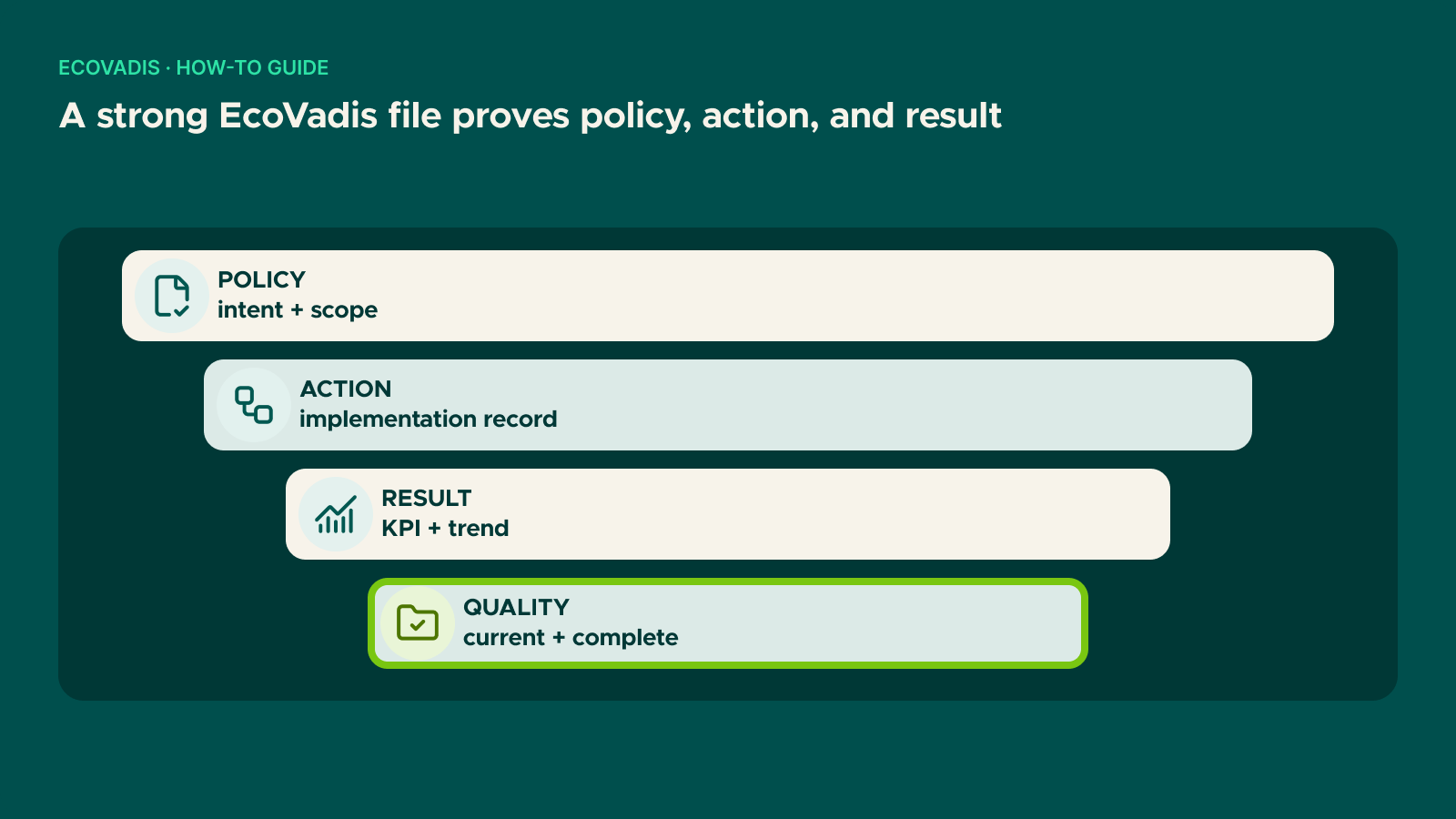
A practical approach is to build a document inventory mapped directly to the four themes before starting the EcoVadis platform submission itself. For each theme, three columns are useful: the policy document itself, the implementation evidence (training logs, monitoring reports, assigned ownership), and the outcome evidence (audit results, incident records, corrective actions). Gaps become visible quickly once documents are organized this way — a theme with a policy but no implementation or outcome evidence is a clear priority area, since EcoVadis analysts score depth of evidence, not just existence of a policy. The scoring logic behind this evidence weighting is explained in How Does the EcoVadis Scoring System Work?.
Because much of this evidence — training records, monitoring data, audit results — accumulates over time rather than being producible on demand, preparation is most effective when it starts well ahead of a submission deadline. A company beginning preparation only weeks before a required submission date is often limited to whatever documentation already exists, whereas earlier preparation allows genuine gaps (such as a missing supplier code of conduct or unrecorded training) to be closed rather than merely documented as absent.
Semtrio Note: Organizations Semtrio supports achieve an average first-year improvement of 25.6 points, reaching an average client score of 73.2 against a global first-year average of 48.4, with a 100% medal-earning rate — a result driven primarily by structured document preparation across all four themes rather than last-minute submissions.
Semtrio's EcoVadis consulting team runs structured document audits ahead of submission, mapping existing evidence against all four EcoVadis themes and flagging exactly which gaps to close before the assessment window opens.
A formalized supplier code of conduct or documented supplier sustainability screening process, since Sustainable Procurement is often the least mature theme for companies newly preparing for EcoVadis.
Certifications are useful supporting evidence but are generally reviewed alongside, not instead of, the underlying policy and implementation documentation EcoVadis expects.
Recent records demonstrating ongoing implementation are generally more useful than a single historical record, since EcoVadis evaluates whether a policy is actively in use rather than a one-time event.
EcoVadis accepts documentation in multiple languages, though clear, well-organized evidence — regardless of language — is easier for analysts to review and score accurately.
To have your existing documentation reviewed against EcoVadis's evidence requirements before your next submission, talk to Semtrio's team.
Get in touch
If something you've read here connects to a live project, a reporting deadline, or a decision you're weighing — we're happy to have a useful conversation.
Contact us
Regulation & Compliance
Regulation & Compliance
Regulation & Compliance
Lets talk about your sustainability goals.