Blog
Publish: 02 Sep 26Reading Time: 4 Min
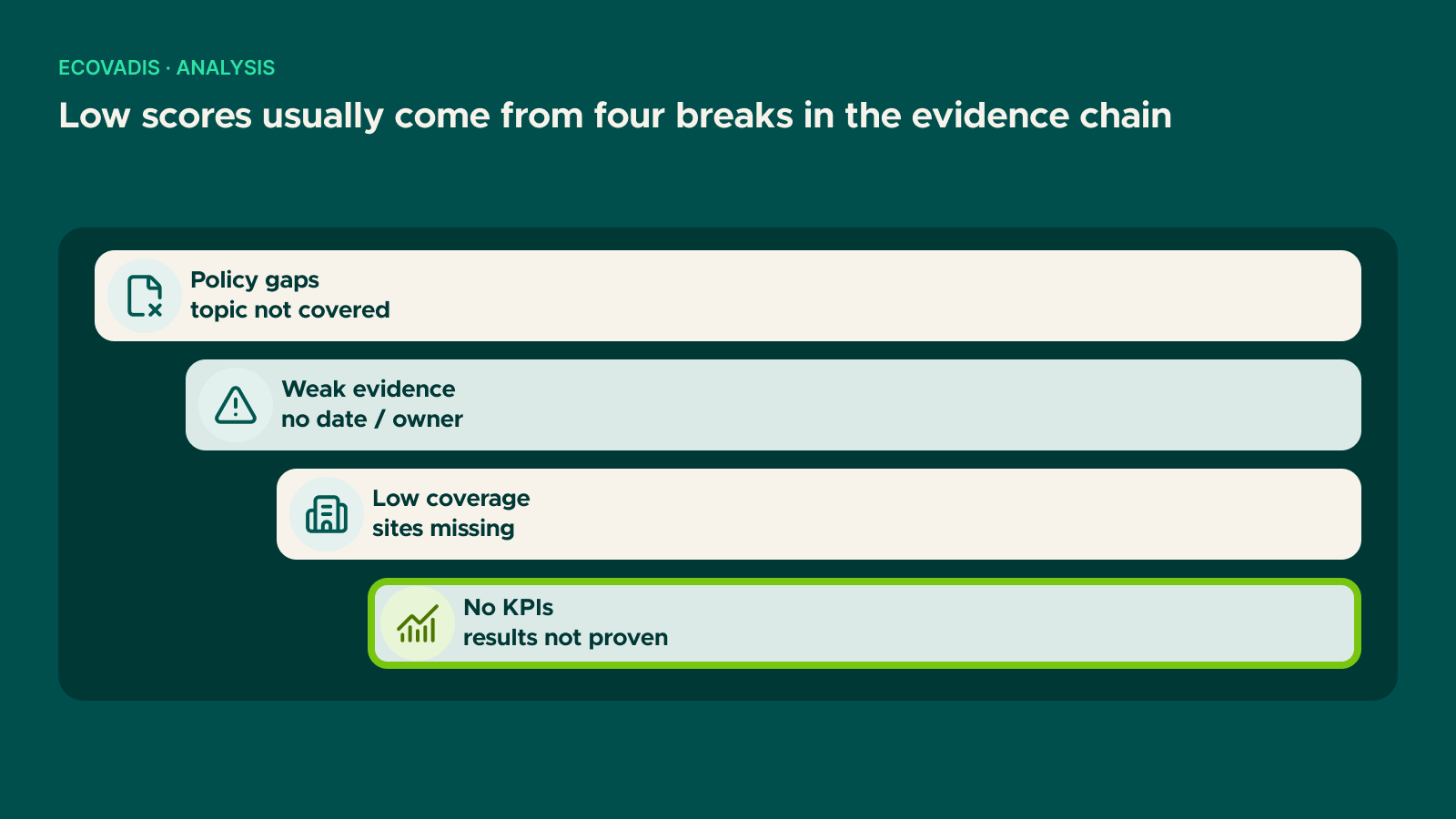
Companies typically score low on EcoVadis because of missing documentary evidence — policies without implementation records, no supplier-facing sustainability requirements, or gaps in a single weak theme that caps the overall score — rather than because of poor underlying sustainability performance. Most low scores are a documentation problem, not a performance problem.
The most frequent gap is a policy that exists on paper but has no supporting implementation record. A written environmental or labor policy with no training logs, no monitoring data, and no assigned ownership reads to an EcoVadis analyst as an untested or inactive policy, regardless of whether the underlying practice is genuinely followed day to day. EcoVadis scores documented evidence, not internal reputation, so undocumented good practice does not register in the score. This dynamic is explained further in How Does the EcoVadis Scoring System Work?.
Across many first-time assessments, Sustainable Procurement is the weakest of the four themes, because companies naturally focus first on formalizing their own internal policies before extending sustainability expectations into their supplier base. A company may have strong internal labor and ethics policies but no supplier code of conduct, no supplier sustainability screening, and no record of engaging suppliers on responsible sourcing. Because medals require a minimum score of 30 in every theme, a weak Sustainable Procurement score alone can block a medal even when the other three themes are strong.
Some companies attempt to offset thin documentation with strong forward-looking commitments — net-zero targets, diversity goals, supplier engagement ambitions. EcoVadis analysts assess documented evidence and verifiable action, not stated ambition. A commitment with no supporting monitoring plan, baseline data, or interim milestones does not substitute for a modest, fully documented program already in place. This is one of the most consistent misunderstandings first-time applicants bring to the process, and it is addressed directly in How to Improve Your EcoVadis Score: A Practical Guide.
Because EcoVadis medals are awarded by percentile rank rather than fixed score bands, a company's absolute score can stay flat while its medal standing declines, if the broader pool of assessed companies improves faster. Third-party trackers report the Silver threshold rising from roughly 68 to roughly 72 (and to roughly 73 by mid-2026) and Gold from roughly 77 to roughly 78 between mid-2025 and early 2026. A company that does not actively strengthen its evidence between cycles risks falling behind this moving bar even without any internal decline in practice.
Beyond missing evidence and weak procurement documentation, recurring issues include:
A structured pre-submission document review, covered in Preparing for Your EcoVadis Assessment: Document Checklist, is the most direct way to catch these gaps before they affect a live assessment.
Semtrio Note: Global first-year EcoVadis scores average 48.4. Organizations Semtrio supports average 73.2 in their first year — a 25.6-point improvement — with a 100% medal-earning rate, driven by closing exactly these documentation and evidence gaps rather than by improving underlying sustainability performance alone.
Semtrio's EcoVadis consulting team specializes in identifying the specific evidence gaps behind a low or stagnant score, theme by theme, and building the documentation needed to close them ahead of the next assessment cycle.
Not necessarily. Many low scores reflect missing or poorly organized documentation rather than genuinely weak underlying practices — EcoVadis can only score what is evidenced.
Sustainable Procurement is frequently the weakest theme in first-time assessments, since companies tend to formalize internal policies before extending requirements to suppliers.
Not in the form of a general appeal. EcoVadis offers a free "Scorecard Inquiry" process, through which a company can ask up to 15 precise questions challenging how an analyst interpreted specific evidence already submitted. The inquiry cannot be used to submit new documents or reopen the overall score — it is strictly a clarification mechanism on the existing evidence set. This makes getting the original submission right the far more reliable path than counting on a post-hoc inquiry.
Because medals are percentile-based, a static score can fall in relative standing if the broader pool of assessed companies improves faster during the same period.
If your last EcoVadis score fell short of target, talk to Semtrio's team about a gap analysis before your next submission.
Get in touch
If something you've read here connects to a live project, a reporting deadline, or a decision you're weighing — we're happy to have a useful conversation.
Contact us
Regulation & Compliance
Regulation & Compliance
Regulation & Compliance
Lets talk about your sustainability goals.