Blog
Publish: 18 Nov 26Reading Time: 7 Min
To choose a CBAM consultant, ask six questions: which side of CBAM the firm works on, whether it calculates embedded emissions per installation and CN code, how it replaces default values with actual data, what it hands over, whether it is independent of your verifier, and how it proves its results. The answers show whether you are buying a declaration-ready dataset or a report. The timing matters: the first annual CBAM declaration, for goods imported in 2026, is due by 30 September 2027.
Last checked: 18 November 2026.
Since 1 January 2026 CBAM is in its definitive regime, and it now has a price. An authorised CBAM declarant declares the embedded emissions in the previous year's imports and surrenders the matching number of CBAM certificates, after the deduction for a carbon price paid abroad and the free allocation adjustment. Certificates go on sale from 1 February 2027, and from 2027 declarants must hold at least 50% of the year-to-date requirement at the end of each quarter.
That changes what a consultant is for. In the transitional period, the job was a complete quarterly report. Now every tonne declared on a default value, or a figure that cannot be defended in a review, costs money. The consultant you want works on the data that sets that cost, not only on the form that reports it.
CBAM has two sides. The declarant is the EU importer, or an indirect customs representative acting as authorised CBAM declarant, and it files the declaration. The installation operator outside the EU produces the goods and holds the data. A consultant who only knows the declarant side will chase suppliers for numbers; one who only knows the installation side will produce numbers your declaration process cannot use.
If you import from several suppliers, ask how the firm handles a supplier who sends nothing usable. Our guide to requesting CBAM data from suppliers shows what that request should contain.
A consultant cannot file for you unless it is your indirect customs representative with authorised declarant status. Under the CBAM Regulation, only the authorised declarant submits the declaration in the CBAM Registry.
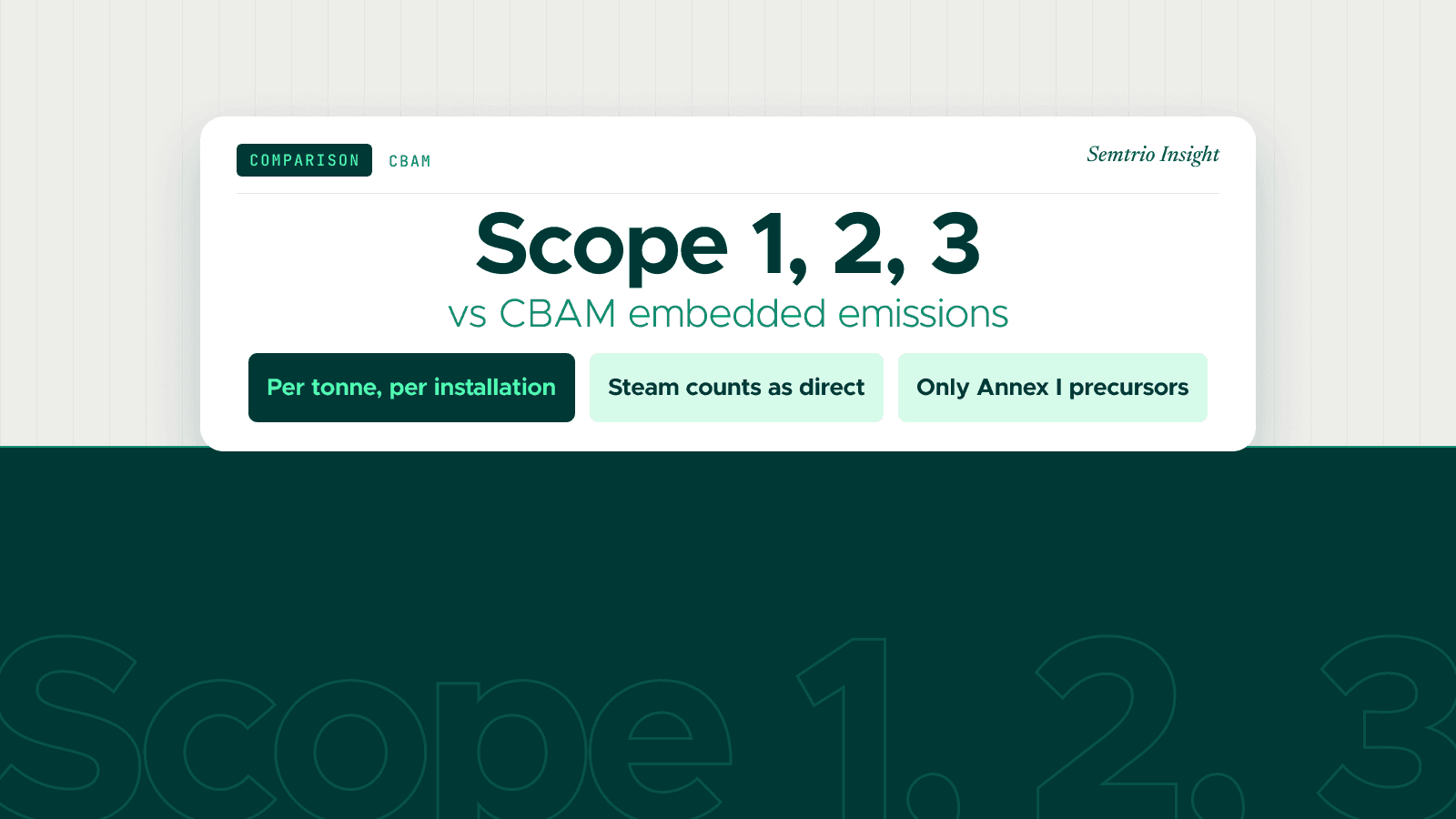
Embedded emissions are calculated per type of goods, with system boundaries aligned with the EU ETS and relevant precursors included (Article 7 and Implementing Regulation (EU) 2025/2547). For most iron and steel goods and for aluminium only direct emissions count; for cement and fertilisers, indirect emissions count too. Ask to see one worked calculation for a good like yours, with the precursor chain visible.
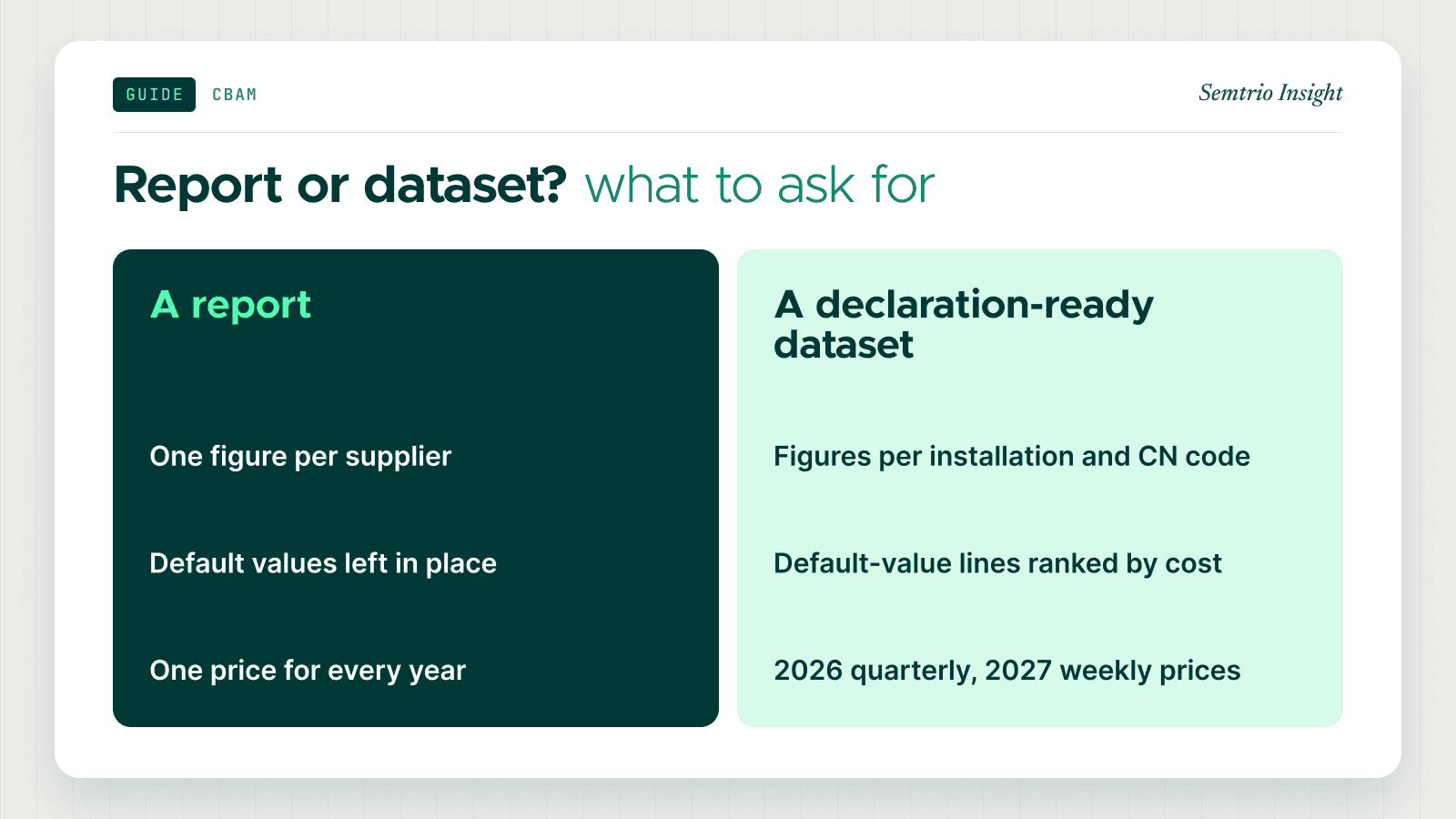
Default values set by the Commission are the fallback when actual data is missing, and they include a mark-up; our post on CBAM cost modelling for 2026 to 2034 shows how the gap grows. A useful first deliverable is a list of every import line on default values, ranked by the certificates it would add. Ask whether the cost model uses the right price basis: the quarterly average of EU ETS auction prices for 2026 imports, and a weekly average from 2027.
"A CBAM report" is not a deliverable. Ask for a list that matches what the declaration needs under Article 6(2): quantities per type of goods, embedded emissions per tonne, the certificate number after both adjustments, and the evidence behind each figure. Ask how the evidence file is organised: the declarant must keep these records until the end of the fourth year after the year the declaration was due, and the Commission can review declarations within that period.
For installation operators, the handover should also include the monitoring record behind the calculation and, where you choose it, registration in the Registry's O3CI portal so that buyers can access your data there.
Where embedded emissions are based on actual emissions, they must be verified by an accredited verifier. Verification is one step in the cycle, and the CBAM rules keep it separate from advice. Under Delegated Regulation (EU) 2025/2551, a verifier that develops part of an operator's monitoring and reporting process, such as the monitoring methodology, the monitoring plan or the emissions report, faces an unacceptable risk to its impartiality. Impartiality is also compromised where the consultant and the verifier share ownership, management or finances. Ask both firms to confirm they have no such link.
Look for CBAM results you can check: which sectors, which period, which reporting cycles, and a case you can read. Then ask what your team holds when the engagement ends: the calculation files, the evidence file, and someone in-house who can explain each figure. If only the consultant can explain your numbers, next year starts from zero.
| Red flag | Why it matters |
|---|---|
| "We will submit your declaration" from a firm that is not your representative | Only the authorised CBAM declarant submits in the CBAM Registry |
| One emissions figure per supplier | Declarations work per type of goods and installation, not per supplier |
| No view of which lines sit on default values | That list is where most of the avoidable cost is |
| Cost estimates with one price for every year | 2026 imports use quarterly averages, 2027 imports onwards weekly averages |
| The same group offers to prepare and verify your data | Verifier impartiality is compromised by such a link |
| Results with no sector, period or way to check them | You cannot compare a claim with nothing behind it |
The same logic applies to other frameworks; compare it with our checklist for choosing an IFRS S1 and S2 reporting advisor.
The cost of CBAM is decided in the installation data, long before the declaration. At Tosyalı Holding, scope was set for each production entity first: export volumes and processes needing calculation. Embedded emissions were then quantified from production-level data and sector-specific emission factors, every calculation and cost estimate went through an internal technical review, and quarterly submission packages were prepared for each site across nearly twenty production entities. The same cycle was extended to wire rod, rolling mill, structural steel and spiral pipe operations, including sites in Algeria.
Our CBAM work so far: every quarterly submission deadline met in the transitional period. Past results, not a guarantee of future outcomes.
Only if it is your indirect customs representative and holds the status of authorised CBAM declarant. Otherwise the consultant prepares the figures and evidence, and the declarant submits the declaration in the CBAM Registry.
No. Under the CBAM accreditation and verification rules, a verifier that has developed part of an operator's monitoring and reporting process faces an unacceptable risk to its impartiality, and a verifier linked to the consultancy that did has a conflict of interest. Keep the two roles with separate firms.
The legal obligation to declare sits with the EU declarant. Exporters are asked for installation data, and without it their buyers fall back on default values. Whether you need outside help depends on how many installations and goods you supply; our post on CBAM supplier readiness in Türkiye covers the exporter's side.
Early enough to have 2026 actual data calculated and verified before the declaration is due on 30 September 2027. Importers also need a certificate plan for the 50% quarterly holding requirement that applies from 2027.
A scope by installation and CN code, a list of the deliverables matched to the declaration's content, a cost view based on default versus actual values, a timeline to 30 September 2027 and a statement of independence from your verifier.
Related reading: Requesting CBAM data from suppliers · CBAM cost modelling 2026–2034 · Authorised CBAM declarant and the 50-tonne threshold
Before you sign, ask for the list of your import lines on default values with the certificates each one adds; CBAM accounting and reporting starts there, line by line, with the installation data needed to replace them.
Get in touch
If something you've read here connects to a live project, a reporting deadline, or a decision you're weighing — we're happy to have a useful conversation.
Contact usLets talk about your sustainability goals.