Blog
Publish: 18 Nov 26Reading Time: 7 Min
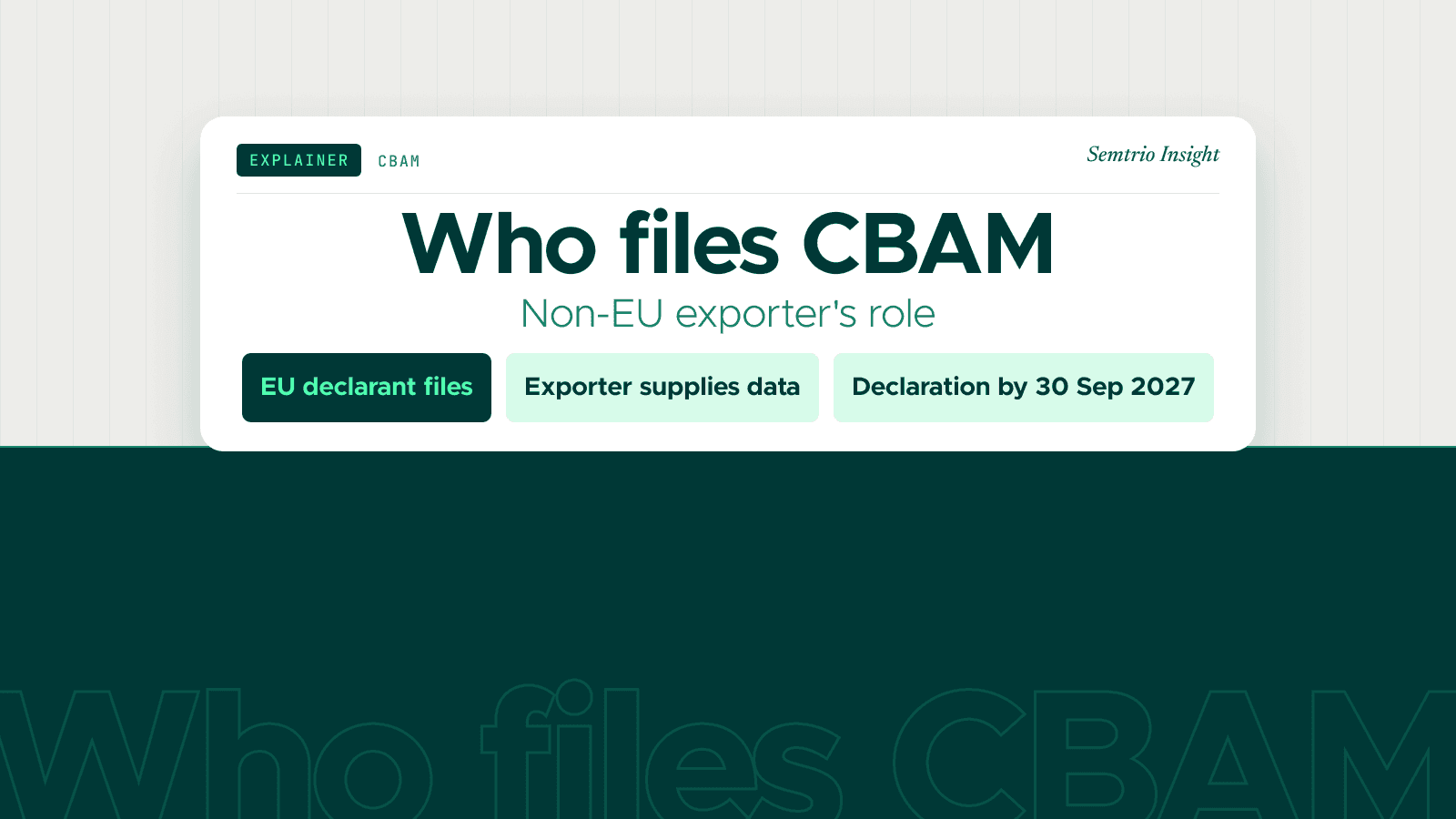
A non-EU exporter does not file the CBAM declaration. Where imports exceed 50 tonnes a year, the authorised CBAM declarant in the EU, the importer or its indirect customs representative, files it once a year by 30 September and surrenders the certificates. The exporter's installation supplies the data behind the number: embedded emissions per tonne of product, the data for the free allocation adjustment and any carbon price paid. The emissions and free allocation data are verified by an EU-accredited verifier, the carbon price documentation is certified by an independent person, and the data travels in the Commission's operator's emissions report template.
Last checked: 18 November 2026, against Regulation (EU) 2023/956 as amended by Regulation (EU) 2025/2083 and the Commission's guidance for non-EU operators of 14 August 2026.
The filer is always an authorised declarant established in the EU. Which company that is depends on who imports the goods.
| Your set-up | Who holds the declarant status and files | What falls to you |
|---|---|---|
| Your EU customer imports the goods | The customer, or the indirect customs representative it appoints | Installation data |
| Your company is the importer (an indirect customs representative lodges the customs declaration for you), but is not established in the EU | An indirect customs representative you appoint, which must hold the status | Installation data, plus appointing and briefing the representative |
| Your group's EU subsidiary imports | The subsidiary, if it holds the status | Installation data, shared within the group |
| You sell to a trader who sells into the EU | Whoever imports into the EU | Installation data, which the trader cannot produce for you |
| You sell to a non-EU producer that uses your goods as a precursor for CBAM goods | That producer's EU importer | Precursor data to your customer |
The second row is the one exporters miss. When you sell on terms where your own company clears the goods into the EU, you are the importer. Since you are not established in a Member State, the Regulation requires your indirect customs representative to hold the declarant status, and that representative takes on the declaration and certificate obligations for those goods.
The Commission's guidance for non-EU operators puts it plainly: wherever CBAM goods end up imported into the EU, "at some point the importer will contact you" for embedded emissions data.
From 2026, the data comes in a fixed format. The Commission's methodology act makes the operator's emissions report template mandatory where embedded emissions are based on actual data, together with a summary of that report. The template is in English, so customers in different Member States find the same information in the same field.
What your data has to cover, for each production process and reporting year:
Behind the emissions and free allocation data sits verification. Actual data replaces default values only once an EU-accredited verifier has verified it, and you, as operator, contract the verifier. The Commission advises looking for one early in the reporting period. For goods imported in 2026, the reporting period is calendar year 2026 unless the actual production date can be evidenced.
How to set up the monitoring that produces this data is a separate job; our guide to calculating embedded emissions and system boundaries covers it.
There are two routes, and the Commission recommends the first.
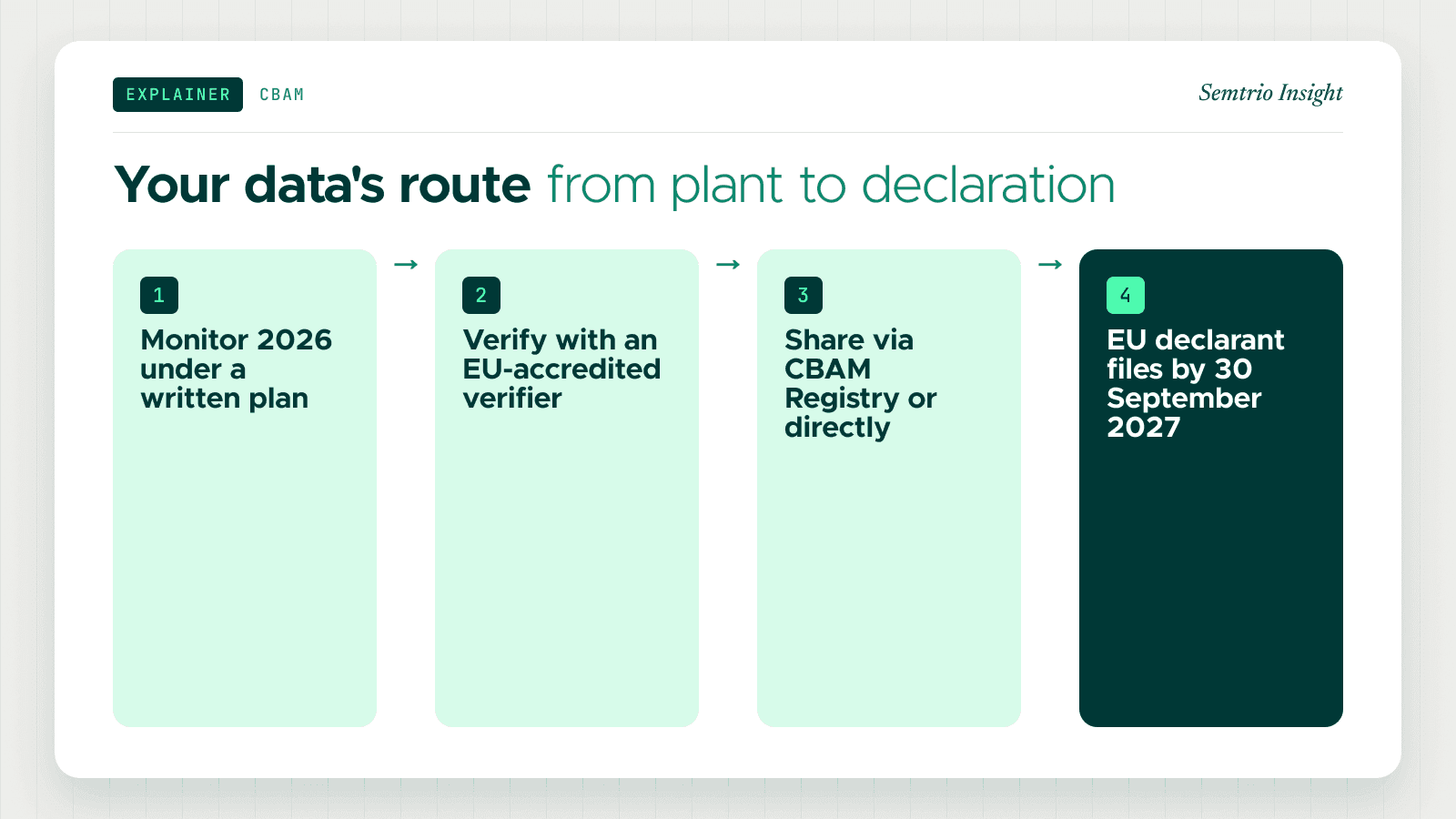
Through the CBAM Registry. You register the installation in the operator module (O3CI), upload the data once, and after verification share it with every declarant that imports your goods. Declarants see a summary of the emissions report, not the full report. Registration is voluntary today, valid for five years, and in 2027 the Registry is to be extended so you can also share data with other operators that use your goods as precursors. Our post on the CBAM Registry and the O3CI portal walks through registration.
Directly to each customer. You send the same template to each declarant yourself. The guidance notes the trade-off: without registration, declarants are obliged to request your complete emissions and verification reports so they can show them to authorities on review.
The declarant's certificate count is built from your numbers. Embedded emissions are determined either from actual emissions or by reference to default values, and the Regulation allows a carbon price deduction against actual data that has been effectively paid and documented. Without your data, your customer declares on default values, which our post on default values and country mark-ups explains.
Liability travels the same way. The declarant carries the penalty for surrendering too few certificates. Where that shortfall results from incorrect information supplied by an operator or a verifier, the competent authority may reduce the declarant's penalty. Expect EU buyers to write data accuracy into contracts; our post on collecting CBAM data from non-EU suppliers lists the clauses.
The first declaration, for 2026 imports, is due by 30 September 2027. Certificate sales start on 1 February 2027.
The data is built installation by installation, so a group with several plants repeats the work per site and has to keep one method across all of them. At Tosyalı Holding, a consistent CBAM process ran across nearly twenty production entities, with embedded emissions quantified from production-level data and sector-specific emission factors, and the same cycle was extended to sites in Algeria.
Across our CBAM work: every submission deadline met in the transitional period. Past results, not a guarantee.
No. The declaration is filed by an authorised CBAM declarant established in the EU. A Turkish exporter supplies the installation's embedded emissions data. If its own company clears the goods into the EU, an indirect customs representative holding the status files for it.
Yes, if the subsidiary is the importer and is established in a Member State. The subsidiary applies to the competent authority of that Member State, and the installation data stays within the group.
Not today. Registration is voluntary and recommended by the Commission. Without it, you send the same report template to each declarant, and each will ask for your complete emissions and verification reports.
No. Verification applies where embedded emissions are based on actual data. Default values do not reflect your installation's own performance.
Your goods are then a precursor in that producer's CBAM goods. It will ask you for precursor data, including your verification report, if it wants to use actual values instead of defaults.
Related reading: CBAM Registry and the O3CI portal · Collecting CBAM data from non-EU suppliers · CBAM default values and country mark-ups
Start with a per-customer map of who files for each of your EU flows and which of the seven data items your installation can already evidence; CBAM accounting and reporting delivers that scope document and the calculation file per product.
Get in touch
If something you've read here connects to a live project, a reporting deadline, or a decision you're weighing — we're happy to have a useful conversation.
Contact usLets talk about your sustainability goals.