Blog
Publish: 18 Nov 26Reading Time: 7 Min
CBAM does not ask you to report Scope 1, 2 and 3 emissions. It asks for the specific embedded emissions of each good, per tonne under its CN code (per tonne of clinker for most cement, and per kilogram of nitrogen or supplementary unit for fertilisers), for the installation where the good was produced: direct emissions, electricity-related indirect emissions for cement, fertilisers and other goods not listed in Annex II, and the embedded emissions of any covered precursor. Your corporate GHG inventory holds most of the raw data, but none of its totals can be submitted as they are.
Last checked: 18 November 2026, against Regulation (EU) 2023/956 as amended by Regulation (EU) 2025/2083, and Implementing Regulation (EU) 2025/2547.
Since 1 January 2026, embedded emissions are calculated with the methods in Annex IV of the CBAM Regulation and Implementing Regulation (EU) 2025/2547, which builds on the EU ETS monitoring rules. Five features separate this from a corporate inventory:
The three components are explained in our post on CBAM embedded emissions. This post covers how they relate to the scopes you already report.
No. ISO 14067 sets out a life-cycle product carbon footprint consistent with ISO 14040 and ISO 14044, and the GHG Protocol Product Standard covers raw materials, manufacturing, transport, storage, use and disposal. CBAM uses neither standard. It follows its own rules: a set system boundary per aggregated goods category, only the relevant precursors that are themselves CBAM goods, no transport, and attribution rules set by the Implementing Regulation. A product carbon footprint can share the same meter data, but its result cannot replace a CBAM calculation.
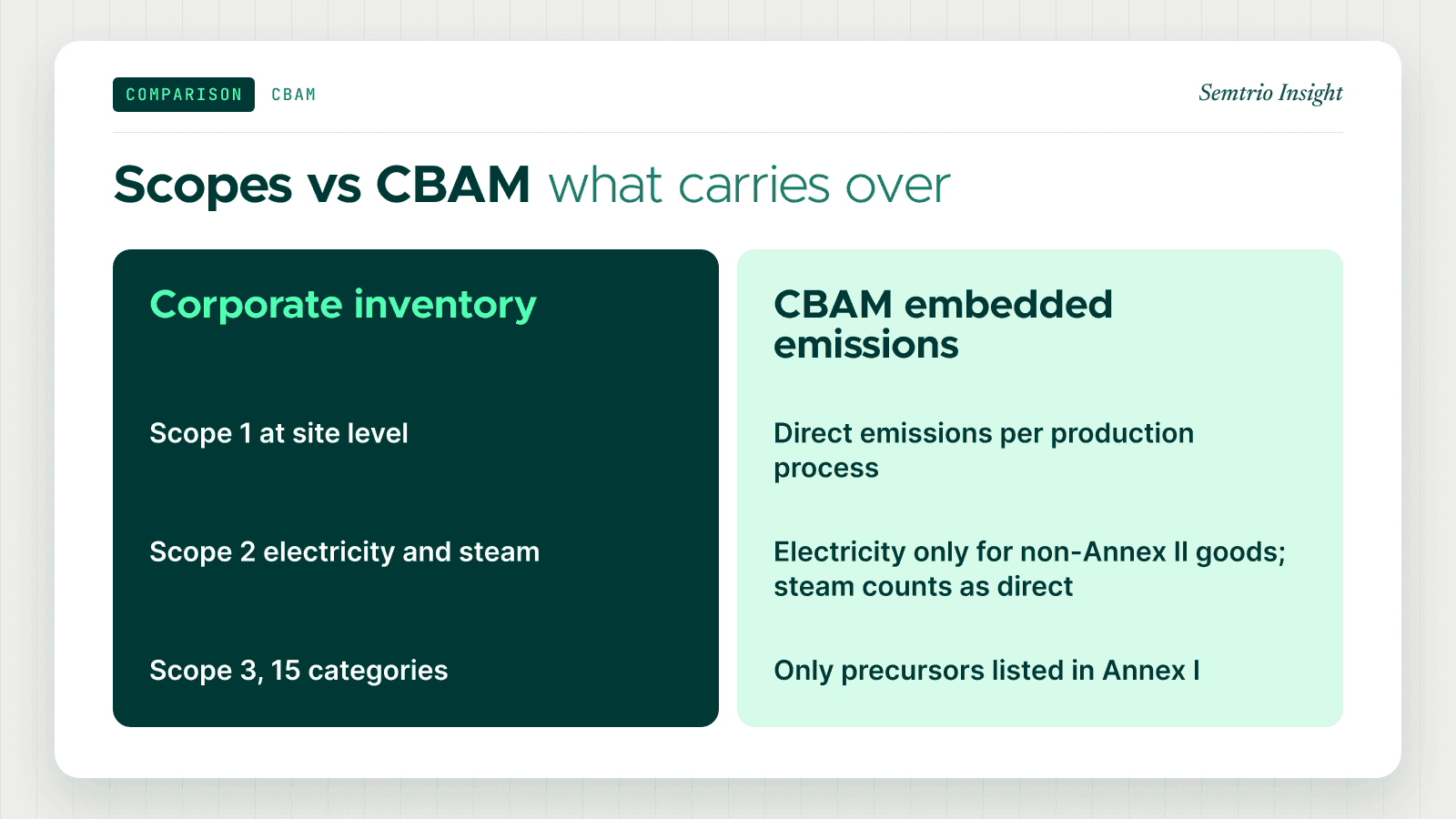
Each scope feeds part of the CBAM figure, and each needs adjusting first.
| Corporate inventory (GHG Protocol) | Where it goes in CBAM | What changes |
|---|---|---|
| Scope 1: fuel combustion and process emissions at your sites | Direct emissions of each production process | Split by production process; emissions from mobile machinery for transport are excluded; only the gases in Annex I count |
| Scope 2, electricity | Indirect emissions, only for goods not in Annex II (for example cement, fertilisers, agglomerated iron ore) | Not counted for iron and steel, aluminium or hydrogen; default factors apply unless a direct technical link or a qualifying PPA with a third-country producer is proven |
| Scope 2, purchased heat or steam | Direct emissions | CBAM counts heating and cooling consumed in production as direct emissions, wherever the heat was produced |
| Scope 3, Category 1 (purchased goods) | Precursor emissions, only for inputs listed in Annex I | Actual data from the supplier's installation or a default value; all other purchased materials drop out |
| Scope 3, other categories (transport, waste, business travel, use of sold products…) | Not counted | — |
Three rows in this table need particular care.
Market-based Scope 2 does not carry over. If your Scope 2 figure falls to zero because you bought renewable energy certificates, CBAM will not reflect that. Actual indirect values need a direct technical link to the generator or a PPA with a third-country electricity producer for physical delivery, both backed by smart-meter data in periods of one hour or less (Annex IV, point 6, of the CBAM Regulation; Annex II, point D.4.3, 2025/2547). Report location-based and market-based Scope 2 as before; just don't expect either to serve as the CBAM factor. The details are in our post on CBAM indirect emissions and PPAs.
Purchased steam moves into direct emissions. The CBAM Regulation defines direct emissions to include heating and cooling consumed in production, whatever their source (Article 3(21)). Steam from a neighbouring plant sits in your Scope 2, but in CBAM it adds to the direct figure, even for steel and aluminium.
A precursor made in your own group counts in both places. If one of your installations makes pig iron and another turns it into steel, both sets of emissions sit in your group's Scope 1. In CBAM, the precursor's embedded emissions are added to the steel's figure per tonne. That is not double counting, because the two answer different questions, but it means CBAM totals and Scope 1 totals will never match one to one.
Data gets collected twice when the inventory is built at company level and CBAM at installation level. The fix is to collect once at the lowest level and roll it up both ways.
Your Scope 3 work is useful here only where it overlaps: the supplier list behind Category 1 tells you which CBAM precursors you buy and from whom. Our Scope 3 guide covers the rest of the value chain.
When a group's corporate inventory is run at holding level and its CBAM data sits with each plant's technical team, the same fuel invoice is entered twice. The CBAM process we run with Tosyalı Holding covers about 20 production entities with one method, calculated from production-level data and repeated across wire rod, rolling mill, structural steel and spiral pipe operations (case study).
Our CBAM work to date: 100% of submission deadlines met across all quarterly reporting cycles in the transitional period. These are past results, not a guarantee.
No. CBAM needs embedded emissions per tonne of each good for each installation, calculated under Annex IV of the CBAM Regulation and Implementing Regulation (EU) 2025/2547. Your Scope 1 and 2 activity data can feed that calculation, but the totals cannot be declared.
Only one slice of them. CBAM includes the embedded emissions of precursors that are themselves CBAM goods, such as pig iron in steel or clinker in cement. Transport, packaging, other purchased materials and every downstream category are outside CBAM.
Electricity is not. Iron and steel, aluminium and hydrogen are listed in Annex II, so only direct emissions are counted for them. Purchased heat or steam still counts, because CBAM treats it as a direct emission.
No. A product carbon footprint follows life-cycle rules with its own boundary, gases and data choices. It can share meter data with the CBAM calculation, but the CBAM result has to follow the CBAM methodology and, where actual values are used, be verified by a CBAM-accredited verifier.
The operator of the installation calculates actual embedded emissions and prepares an operator's emissions report (Article 10, 2025/2547). The authorised CBAM declarant in the EU declares them by 30 September each year for the previous year, starting in 2027 for 2026, and makes sure actual values are verified.
Send us your latest Scope 1 and 2 inventory and we will return a mapping of your source streams to CBAM production processes, with each gap in installation-level data listed.
Get in touch
If something you've read here connects to a live project, a reporting deadline, or a decision you're weighing — we're happy to have a useful conversation.
Contact usLets talk about your sustainability goals.