Blog
Publish: 17 Sep 26Reading Time: 5 Min
CBAM liability is the product of two numbers: the quantity imported and the emissions embedded in that quantity. The whole mechanism therefore rests on one figure being right. That figure is not the corporate carbon footprint most companies already hold, nor the result of a product life cycle assessment, and it cannot be converted from either.
Embedded emissions are the greenhouse gases released in the course of producing a good and attributed to that good. The unit is tonnes of CO2 equivalent per tonne of product. In CBAM the functional unit is the tonnage produced under the same CN code, with special rules for cement, built on clinker, and fertilisers, built on nitrate content.
The word "embedded" does not mean the carbon is physically present in the product. A tonne of hot-rolled coil contains no meaningful carbon, but it carries the emissions released in making it.
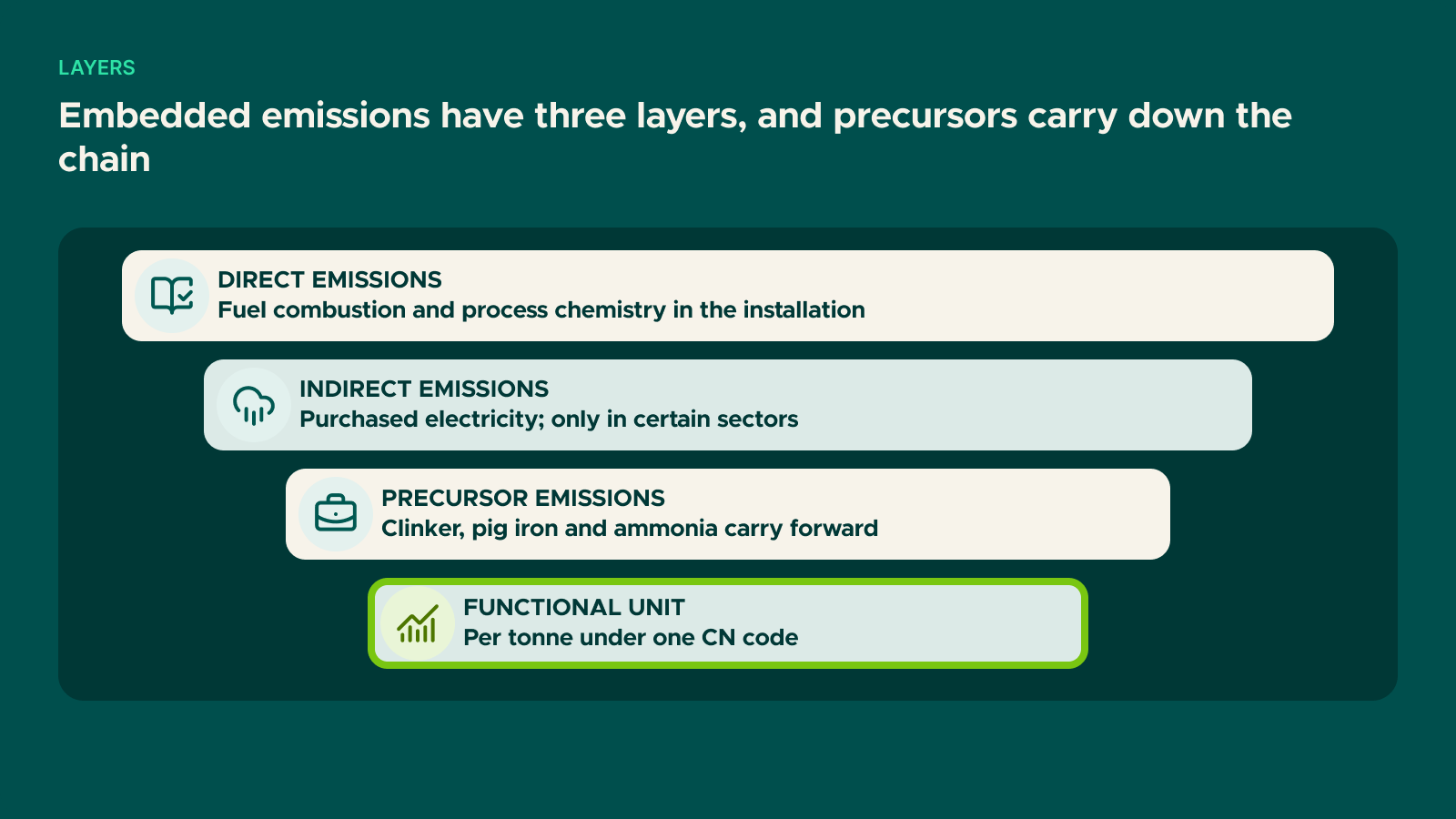
Emissions occurring inside the installation boundary, from two sources. Combustion emissions arise from burning natural gas, coal or petroleum coke. Process emissions arise from chemistry rather than fuel: the calcination of limestone in cement, the carbon in coke used as a reductant in ironmaking, nitrous oxide from the nitric acid process in fertiliser production.
The distinction matters because process emissions cannot be reduced by switching fuel. Limestone calcination releases the same CO2 regardless of how the kiln is heated. This is why emissions intensity in cement is reduced through clinker substitution rather than fuel conversion.
Emissions from the generation of purchased electricity. Under CBAM these are counted only for fertilisers, cement and agglomerated iron ore. Steel, aluminium and hydrogen are excluded — which is striking for aluminium, an electricity-intensive sector, and reflects the fact that EU producers in those sectors receive indirect cost compensation. The Commission's review proposes extending indirect emissions to those three sectors and removing that compensation.
Where indirect emissions do count, using actual values requires a direct technical connection, a power purchase agreement, or accepted renewable energy certificates. Guarantees of origin such as Türkiye's YEK-G and I-REC certificates are not accepted for this purpose. Otherwise the five-year average of the country grid emission factor applies. We set this out in CBAM indirect emissions and electricity.
The most frequently overlooked layer. The embedded emissions of a covered good include the emissions of its covered precursors. Where clinker becomes cement, pig iron becomes steel or ammonia becomes fertiliser, the precursor's emissions are carried forward.
The practical consequence is that the calculation does not stop at the installation fence. A re-roller buying semi-finished steel is determined far more by the emissions of that purchased input than by its own process. Where the supplier provides no data, a default value plus mark-up applies to the precursor — so an installation with excellent data of its own can still be pushed upward by its supplier's data policy.
Get in touch
If something you've read here connects to a live project, a reporting deadline, or a decision you're weighing — we're happy to have a useful conversation.
Contact us
Regulation & Compliance
Regulation & Compliance
Regulation & Compliance
Lets talk about your sustainability goals.
Most companies approach CBAM holding a corporate GHG inventory. That inventory is a useful starting point but not a substitute. The differences are structural:
| Dimension | Corporate carbon footprint | CBAM embedded emissions |
|---|---|---|
| Unit of account | Company or site, annual total | Product, per tonne |
| Boundary | Organisational and operational control | System boundaries defined in the Annexes |
| Value chain | Scope 3, fifteen categories | Covered precursors only |
| Electricity | Always included as Scope 2 | Only in specific sectors |
| Transport | Included | Excluded today; under review |
| Assurance | ISO 14064, voluntary | CBAM-accredited verifier, mandatory |
The same caution applies to life cycle assessments and EPDs. A cradle-to-gate EPD may share the underlying data infrastructure with a CBAM calculation — which is efficient — but the system boundaries and attribution rules do not coincide, and the resulting figures are not interchangeable.
An installation rarely makes one product. How emissions from shared boilers, shared power supplies and shared processes are allocated between outputs is the most technical part of the calculation and is defined in the Annexes. The principle is that emissions are defined at the level of production processes and attributed to each process's output on a measurable basis.
Three situations cause most of the difficulty: combined heat and power, waste gases fed as fuel into another process, and a single line producing goods under several CN codes. Each has rules in the Annexes, and the verifier looks precisely at how those decisions were justified. We work through the build in calculating CBAM embedded emissions.
Not on its own. The verifier must be accredited under CBAM and the verification performed against CBAM methodology. Existing ISO 14064 and ISO 17029 capability is taken into account in accreditation assessments.
No. Renewable electricity affects indirect emissions only, and only where the evidentiary conditions are met. Direct and process emissions are unaffected by electricity sourcing.
A default value plus the applicable mark-up is used for that precursor, raising the final figure.
Yes. The reporting period is the year in which the goods were produced or imported, and each period requires its own calculation and verification.
We work on building product-level embedded emissions calculations and adapting existing GHG inventories to CBAM methodology, under our CBAM accounting and reporting service. You can contact us with your questions.