Semtrio
ACADEMY
Partner Login
Contact

By subscribing you agree to receive marketing communications from Semtrio. You can unsubscribe at any time.

Be the first to know what’s changing.

Semtrio
Follow us on

Services

Compliance and RegulatoryClimate AccountingSustainability ReportingClimate and Sustainability StrategySupply Chain Sustainability
ESG RatingsSustainable FinanceCapacity Building and TrainingCarbon Markets and Climate Projects

Industries

ManufacturingEnergyAviationFinance and Banking
TelecomsRetail and ConsumerConstruction MaterialsGroup Companies and Holdings

Works

All Clients & ProjectsKey ProjectsAccreditations

Insights

Case StudiesBlogsGlossaryResources

About

Who We AreWhy SemtrioWork With Us

Contact

Contact Us

Our Partners

B Corp Certified
CDP
UN Global Compact
Ecovadis CoreEcovadis Platinum
GRI Community Member

Copyright © 2026 All Rights Reserved.

Legal
Policies
Peerless Ventures

Designed by

Fameus
Home
Insights
Blog
CBAM Indirect Emissions and Electricity: PPAs, Certificates and Grid Emission Factors

Blog

CBAM Indirect Emissions and Electricity: PPAs, Certificates and Grid Emission Factors

Indirect EmissionsElectricityPPAGuarantees of OriginCBAMGrid Emission Factor

Publish: 17 Sep 26Reading Time: 4 Min

Electricity looks like the most tractable part of an industrial emissions profile: change supplier, buy renewable certificates, watch the number fall. Under CBAM it is not that simple. Indirect emissions are counted only in certain sectors, the routes to using actual values are narrow, and the certificate instruments most widely used in practice are not currently accepted.

Which sectors count indirect emissions?

Under CBAM, indirect emissions — those arising in the generation of purchased electricity — are included for three product groups only: fertilisers, cement and agglomerated iron ore.

Steel, aluminium and hydrogen are excluded. That looks paradoxical at first: aluminium is among the most electricity-intensive industrial processes, and the emissions profile of primary aluminium is dominated almost entirely by its power source. The rationale is symmetry within the EU — producers in those sectors receive indirect cost compensation for electricity prices, so indirect emissions are not charged on the import side either.

That balance is set to change. The Commission's review proposes extending indirect emissions to steel, aluminium and hydrogen while removing the indirect compensation mechanism for EU producers. If adopted, the electricity source becomes a first-order cost variable in those three sectors overnight.
  1. 1Indirect emissions are counted only for fertilisers, cement and agglomerated iron ore.
  2. 2Actual values require a direct technical connection, a power purchase agreement, or accepted renewable certificates.
  3. 3Guarantees of origin such as YEK-G and I-REC are not accepted for this purpose.
  4. 4Where conditions are not met, the five-year average grid emission factor applies.
  5. 5Extending indirect emissions to steel, aluminium and hydrogen is under proposal.
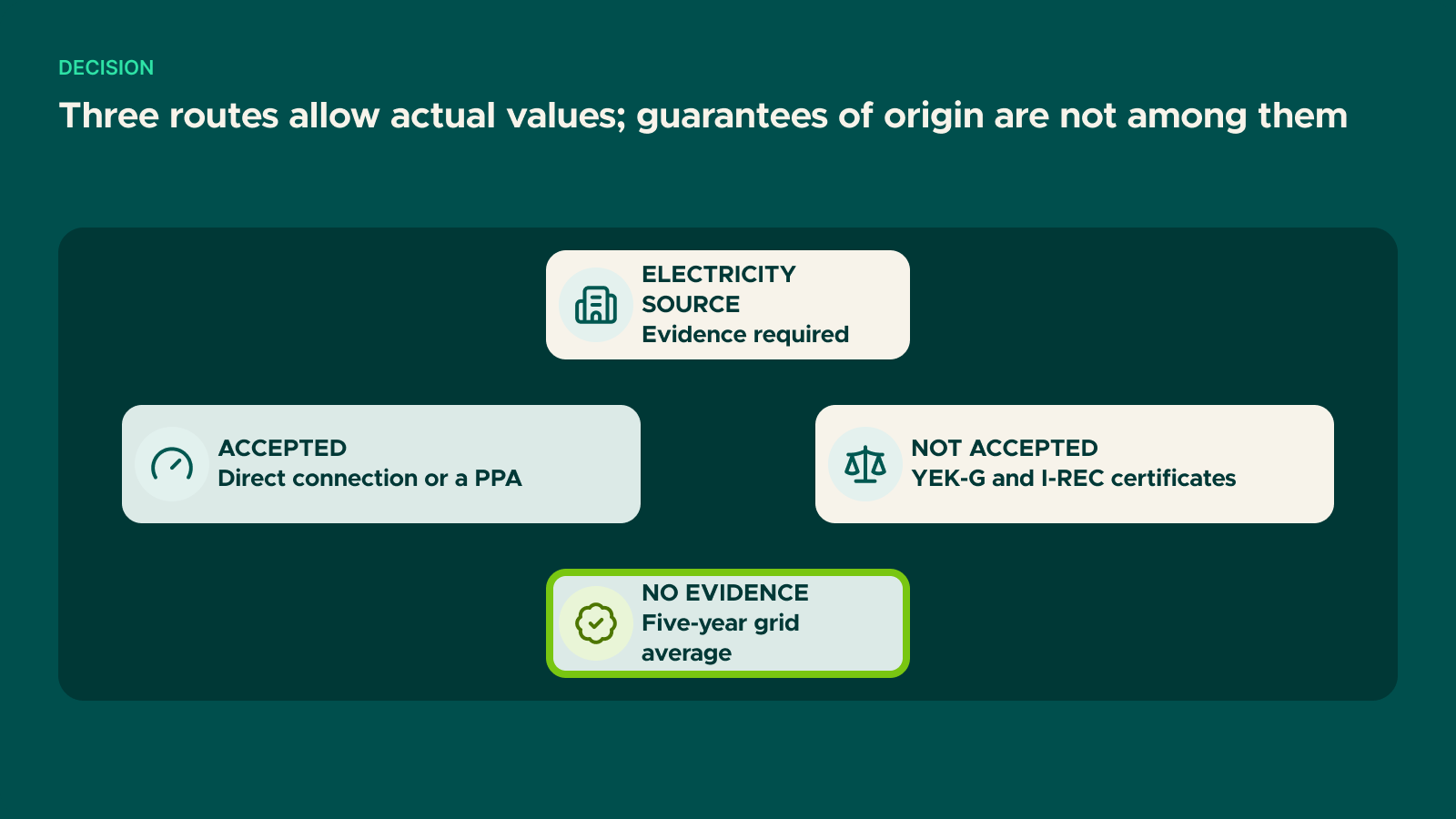
Diagram: Three routes allow actual values; guarantees of origin are not among them

Three routes to actual values

Using actual values for indirect emissions depends on being able to prove where the electricity came from. Three routes are accepted.

1. Direct technical connection

A direct physical connection between the production installation and a generating installation. Dedicated lines and on-site generation fall here. It is the easiest route to evidence and the hardest to challenge.

2. Power purchase agreement

A direct agreement demonstrating that electricity is purchased from a specific generating installation. Current rules attach conditions to this route that are difficult to evidence in practice. The Commission's revision proposals would relax them: accepting PPAs concluded through intermediaries and removing hard-to-prove conditions such as grid congestion and direct connection to the EU transmission system. For producers in countries where most bilateral contracts run through supply companies, this is a material opening.

3. Renewable energy certificates

Here lies the sharpest boundary: guarantees of origin such as YEK-G and I-REC are not accepted for CBAM indirect emissions. These instruments are widely used to evidence renewable consumption in corporate carbon footprints and are recognised under many reporting frameworks, but they do not satisfy the CBAM test.

This is one of the most common misconceptions in practice. An installation that has zeroed its Scope 2 emissions through annual certificate purchases cannot reproduce that result in its CBAM calculation.

What applies when none of the routes is available

Where none of the three can be evidenced, a default applies: the five-year average of the country grid emission factor. Using a five-year average means recent improvements in a grid feed into the calculation with a lag, which works against producers in rapidly decarbonising systems.

Emissions of electricity imported into the EU are calculated on the same basis.

The revision proposals contain two further electricity changes: using the exporting country's average grid emissions in place of a fossil-fuel-based emission factor, and a 30% reduction in electricity default values, together with the possibility of setting an alternative default value.

Practical implications in cement and fertilisers

  • Cement. Electricity consumption concentrates in grinding. Its share of total emissions is modest next to calcination, but as the clinker factor falls the volume of ground supplementary material rises and the weight of indirect emissions increases. Clinker substitution therefore reduces direct emissions while slightly raising indirect ones; the net gain remains clear, but both sides of the calculation need to be built.
  • Fertilisers. Electricity's share varies with process configuration. The sector's larger exposure is to natural gas, which is simultaneously feedstock and fuel. Fertilisers are also the only sector with the default-value mark-up fixed at 1%, which reduces the relative return on producing actual data.
  • Agglomerated iron ore. Electricity consumption in sintering enters the calculation.

What to do now

  1. Document the electricity supply structure. Which electricity is bought under which contract, by installation and by period.
  2. Review PPAs against CBAM conditions. Existing bilateral agreements should be re-read against the evidentiary requirements, and the relaxations under proposal tracked.
  3. Separate certificate-based claims. Keeping renewable claims used in corporate reporting apart from the CBAM calculation avoids inconsistency.
  4. Prepare for scope extension. Indirect emissions do not count in steel and aluminium today, but keeping electricity data traceable now is prudent given the proposal.

The wider calculation is covered in calculating CBAM embedded emissions, and the sector detail in aluminium and cement.

Frequently asked questions

How is electricity from our own solar plant treated?

On-site generation falls under direct technical connection, the strongest evidentiary position.

Are guarantees of origin likely to be accepted?

They are not accepted under current rules. The relaxations under proposal concern PPA criteria rather than certificates.

Should we collect electricity data in a sector where indirect emissions do not count?

It is not required for today's declaration, but it is prudent given the proposed scope extension and other reporting obligations.

Who publishes the grid emission factor?

The Commission publishes country-level emission factors within the default value annexes and updates them periodically.

Sources

  • European Commission — CBAM legislation and guidance
  • European Commission — CBAM definitive regime

We work on assessing electricity supply structures against CBAM conditions and building the indirect emissions calculation, under our CBAM accounting and reporting service. You can contact us with your questions.

Get in touch

Let's talk about what you're working on.

If something you've read here connects to a live project, a reporting deadline, or a decision you're weighing — we're happy to have a useful conversation.

Contact us
Related reading

Semtrio blog cover — schematic illustration of CBAM and EMISSIONS

Regulation & Compliance

7 Min17 Sep 26

What Is CBAM (Carbon Border Adjustment Mechanism)? The Definitive Regime Explained

Read
Semtrio blog cover — schematic illustration of TRANSITIONAL and DEFINITIVE

Regulation & Compliance

5 Min17 Sep 26

CBAM Definitive Regime: What Changed in 2026 and What the Omnibus Simplified

Read
Semtrio blog cover — schematic illustration of 50 TONNES and THRESHOLD

Regulation & Compliance

4 Min17 Sep 26

Authorised CBAM Declarant Status and the 50-Tonne Threshold: Who Must Apply?

Read

Get in Touch With Our Experts

Lets talk about your sustainability goals.