Blog
Publish: 17 Sep 26Reading Time: 4 Min
Aluminium sits awkwardly in CBAM. It is the most electricity-intensive sector in scope, yet indirect emissions are not counted for it. And because most aluminium trade with the EU consists of processed products rather than primary metal, the figure that determines CBAM cost is usually not generated in the exporting installation at all — it comes in with the billet.
The carbon profile of aluminium splits into two halves of the value chain.
Primary production runs from bauxite to alumina and from alumina to metal by electrolysis. The overwhelming share of emissions sits in the electricity consumed in electrolysis, with additional direct emissions from anode consumption and perfluorocarbon releases. Depending on the power source, the emissions intensity of primary aluminium can differ several-fold between a hydro-powered smelter and a coal-based one.
Secondary production is the remelting of scrap, requiring a small fraction of the energy. Because aluminium scrap is outside CBAM scope, it carries no embedded emissions as an input, so secondary production is structurally low-intensity.
Most aluminium reaching the EU from non-EU processors consists of extruded profiles, sheet, foil and fabricated articles — products at the downstream end of this chain. For those goods the determinant is not the installation's own process but its input.
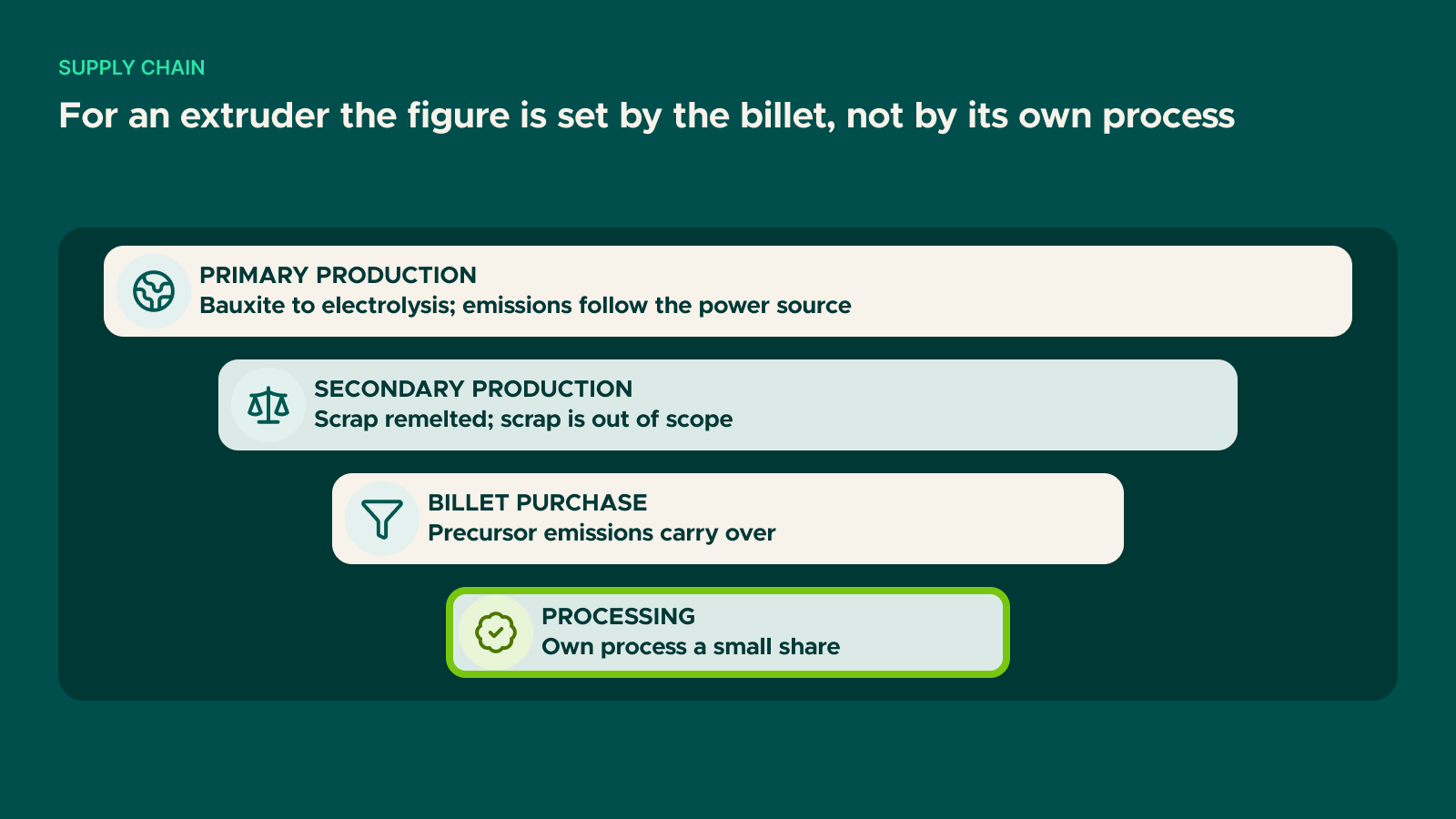
An extrusion plant's own emissions — homogenising furnace, press, ageing oven, surface treatment — account for a relatively small share of total embedded emissions. The bulk of the figure is set by the embedded emissions of the purchased billet or ingot.
The consequence is clear: efficiency improvements inside the extrusion plant move the number only modestly. What moves it is where the billet came from.
The strongest CBAM lever for an aluminium processor is therefore supplier selection and obtaining supplier data. That places the procurement function at the centre of CBAM preparation — where in practice the work is often left to environmental or quality teams.
Indirect emissions are counted under CBAM only for fertilisers, cement and agglomerated iron ore. Aluminium, despite being the most electricity-intensive sector in scope, is excluded.
The effect is counter-intuitive: because most of primary aluminium's footprint is electrical, excluding indirect emissions leaves high-carbon primary metal comparatively lightly treated in the calculation. The rationale is symmetry with the EU, where producers receive indirect cost compensation for electricity prices.
The Commission's review proposes changing that balance — extending indirect emissions to aluminium while removing the EU's indirect compensation mechanism. If adopted, the calculation across the aluminium chain is rebuilt and evidencing the electricity source moves to first place. The evidentiary rules are set out in CBAM indirect emissions and electricity.
Scope runs from unwrought aluminium (CN 7601) through bars and profiles, wire, plates and sheets, foil, tubes and certain aluminium articles. Aluminium scrap is excluded. Precursors such as alumina and aluminium hydroxide are among the items considered for future inclusion in the review.
Aluminium also features heavily in the 180 downstream goods proposed for 1 January 2028; the goods on that list have inputs averaging 79% steel and aluminium by content. We cover it in the CBAM downstream extension.
Across the transitional period, actual-data usage in aluminium ran lower than in other CBAM sectors. Two consequences follow under the definitive regime.
The first is direct cost: a default value is a country and route average with a mark-up added. The second is competitive position: when an EU buyer compares two suppliers, the one supplying verified data has a visible figure while the other is assigned an average. An installation producing genuinely low-emission metal that cannot demonstrate it has lost the advantage rather than merely failed to document it.
We quantify the gap in default values and country mark-ups.
No. Scrap brings no carried emissions load, but the remelting and processing steps have their own emissions.
A default value plus mark-up applies to the precursor, raising the embedded emissions of your product and affecting your price competitiveness.
The CBAM calculation rests on verified installation data rather than sector certification schemes. Certifications can support commercial communication but do not substitute for the calculation.
Yes. The further downstream the product, the greater the share of the precursor and the more important supplier data becomes.
We work on mapping precursors, structuring supplier data requests and building the emissions calculation, under our CBAM accounting and reporting service. You can contact us with your questions.
Get in touch
If something you've read here connects to a live project, a reporting deadline, or a decision you're weighing — we're happy to have a useful conversation.
Contact us
Regulation & Compliance
Regulation & Compliance
Regulation & Compliance
Lets talk about your sustainability goals.