Blog
Publish: 10 Nov 26Reading Time: 8 Min
Scope 3 emissions are the indirect greenhouse gas emissions in a company's value chain that are not counted in Scope 2: from the goods it buys and the transport it uses to the use and disposal of the products it sells. The GHG Protocol Corporate Value Chain (Scope 3) Standard, published in 2011, groups them into 15 categories, 8 upstream and 7 downstream. Scope 3 disclosure is required under IFRS S2 (after a first-year relief), asked for by category under ESRS E1 and CDP, and used by the SBTi to set target boundaries.
Most Scope 3 projects start with a request from outside: a customer asking for supplier data, a lender, an IFRS S2 or CDP deadline. The work goes faster when you know which categories matter for you before you start collecting data.
The GHG Protocol splits a company's emissions into three scopes so that each tonne is counted once per company:
One company's Scope 1 is its customers' Scope 3. That is why a Scope 3 inventory always depends on data from other companies.
| # | Category | Direction |
|---|---|---|
| 1 | Purchased goods and services | Upstream |
| 2 | Capital goods | Upstream |
| 3 | Fuel- and energy-related activities (not included in Scope 1 or 2) | Upstream |
| 4 | Upstream transportation and distribution | Upstream |
| 5 | Waste generated in operations | Upstream |
| 6 | Business travel | Upstream |
| 7 | Employee commuting | Upstream |
| 8 | Upstream leased assets | Upstream |
| 9 | Downstream transportation and distribution | Downstream |
| 10 | Processing of sold products | Downstream |
| 11 | Use of sold products | Downstream |
| 12 | End-of-life treatment of sold products | Downstream |
| 13 | Downstream leased assets | Downstream |
| 14 | Franchises | Downstream |
| 15 | Investments | Downstream |
Which categories dominate depends on the business model. A manufacturer is usually driven by category 1; a maker of energy-using products by category 11; a bank by category 15 (financed emissions).
The Scope 3 Standard requires companies to account for all Scope 3 emissions and to disclose and justify any exclusions. In practice, the inventory is built in four steps:
Get in touch
If something you've read here connects to a live project, a reporting deadline, or a decision you're weighing — we're happy to have a useful conversation.
Contact usLets talk about your sustainability goals.
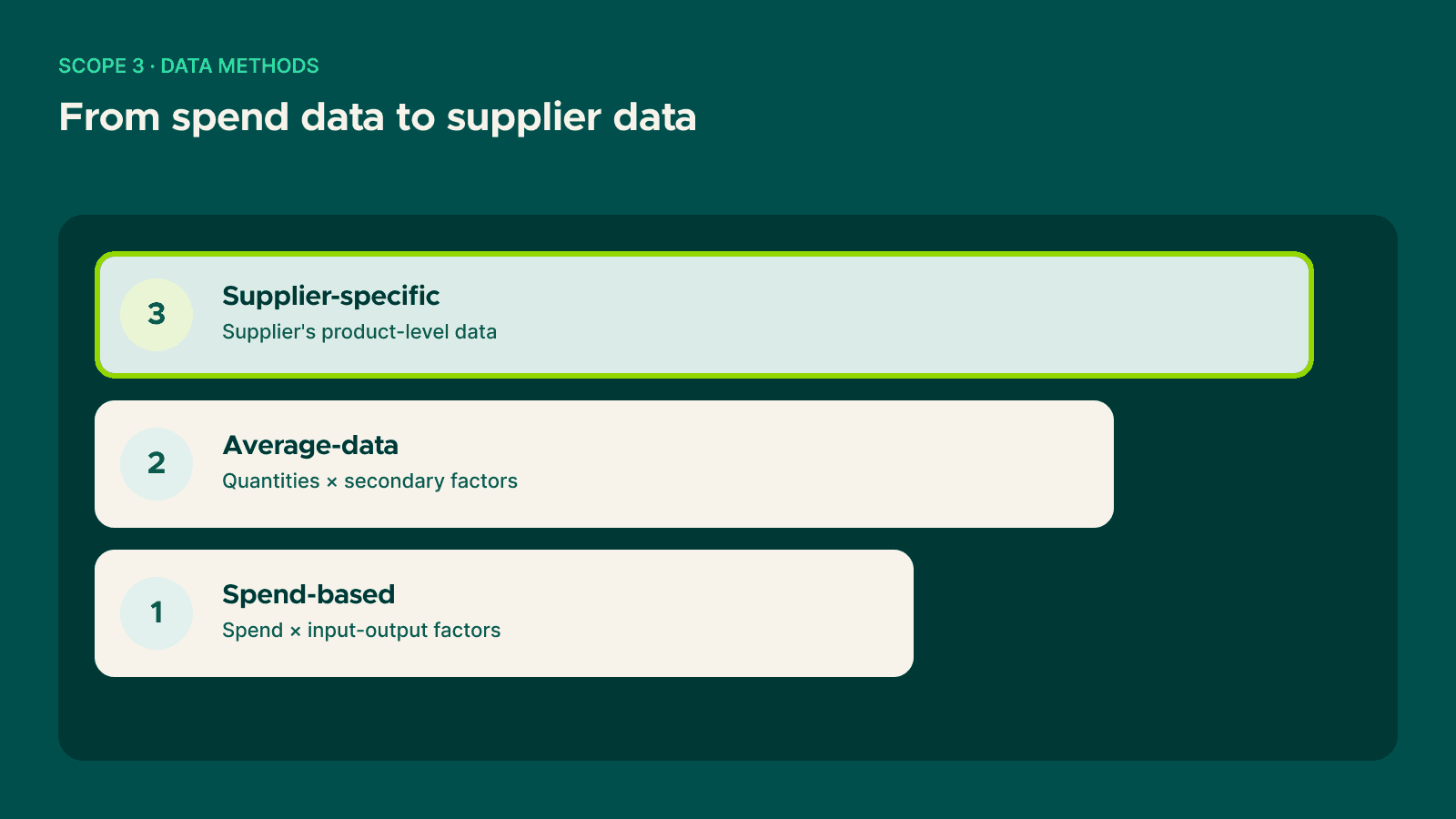
The data methods, from least to most specific:
| Method | What it uses | When it fits |
|---|---|---|
| Spend-based | Money spent per product type × environmentally extended input-output emission factors | Screening; long tail of suppliers |
| Average-data | Physical quantities (tonnes, kWh, km) × secondary emission factors | Material categories where you know volumes |
| Hybrid | Supplier activity data where available, gaps filled with secondary data | Key suppliers that share some, but not all, data |
| Supplier-specific | Product-level cradle-to-gate GHG data from the supplier | Your largest suppliers and products |
Moving a large category from spend-based to supplier-specific data is what makes reductions visible: a spend-based figure goes up when you pay more, even if the supplier has cut its emissions.
| Framework | What it asks for Scope 3 |
|---|---|
| IFRS S2 (ISSB) | Scope 3 emissions disclosure, with the categories included. Relief: Scope 3 may be omitted in the first annual reporting period of applying IFRS S2. December 2025 amendments, effective for periods beginning on or after 1 January 2027 (early application permitted), let companies limit category 15 to financed emissions |
| ESRS E1 (CSRD) | Gross Scope 3 emissions by significant category. The revised ESRS apply mandatorily from financial years beginning on or after 1 January 2027 |
| SBTi | Near-term criteria V5.3.1: Scope 3 target required if relevant Scope 3 is 40% or more of total Scope 1–3 emissions. Net-Zero Standard V2.0: Category A companies cover every Scope 3 category at or above 5% of Scope 3 emissions |
| CDP | Scope 3 emissions reported by category, with the evaluation status and calculation method for each, in gross figures |
For Turkish companies, IFRS S2 is the route through which Scope 3 reaches local reporting as well. Our posts on IFRS S1 and S2 and on IFRS S1–S2 vs CSRD/ESRS explain the scope and timelines.
Yes, but not yet. The GHG Protocol is revising its Corporate Standard, Scope 2 Guidance and Scope 3 Standard, and in July 2026 it announced that these will be merged with ISO 14064-1 into one consolidated GHG Protocol–ISO corporate standard. The current plan is a public consultation in Q2 2027 and publication in Q4 2028. Until then, the 2011 Scope 3 Standard and the 2015 Scope 2 Guidance remain the versions to report against.
The Scope 2 revision is the furthest along: its public consultation on the market-based method, including hourly matching and deliverability, ran from 20 October 2025 to 31 January 2026, and the feedback summary was published in July 2026. For Scope 3, the working groups have published progress updates on data quality, boundary setting and category 15, but no consultation draft yet.
A Scope 3 inventory holds up when the data is checked at the source, not only requested by email. At Roketsan, activity data for a multi-campus Scope 1–2–3 inventory was verified during site visits, under the operational control approach and aligned with the GHG Protocol and ISO 14064-1. At Borusan Otomotiv, all 15 categories were screened across the group's companies, and one consolidated dataset now serves IFRS S2, CBAM, CDP and SBTi. See our corporate GHG accounting service for how the work is structured.
Scope 3 emissions are the emissions a company causes indirectly through its value chain: what it buys, how goods move, how its products are used and disposed of, and what it invests in. They come from sources the company does not own or control.
The GHG Protocol requires you to account for all Scope 3 emissions and to disclose and justify any exclusions. Not every category applies to every company; a company without franchises reports category 14 as not relevant.
Yes. The spend-based method is one of the calculation methods in the GHG Protocol's Scope 3 technical guidance, and it suits screening and smaller categories. Its limit is that it tracks spending, not supplier performance, so material categories should move towards supplier-specific or average data over time.
Yes. IFRS S2 requires Scope 3 disclosure, but a company may omit Scope 3 in its first annual reporting period of applying the standard. In the second year, current-period Scope 3 must be disclosed.
It depends on the sector. For many manufacturers it is category 1 (purchased goods and services), for producers of fuels, vehicles or appliances category 11 (use of sold products), and for financial institutions category 15 (investments).
Request a Scope 3 screening: we estimate all 15 categories and return a ranked category list with a data method and supplier list for each one that matters.