Blog
Publish: 02 Sep 26Reading Time: 5 Min
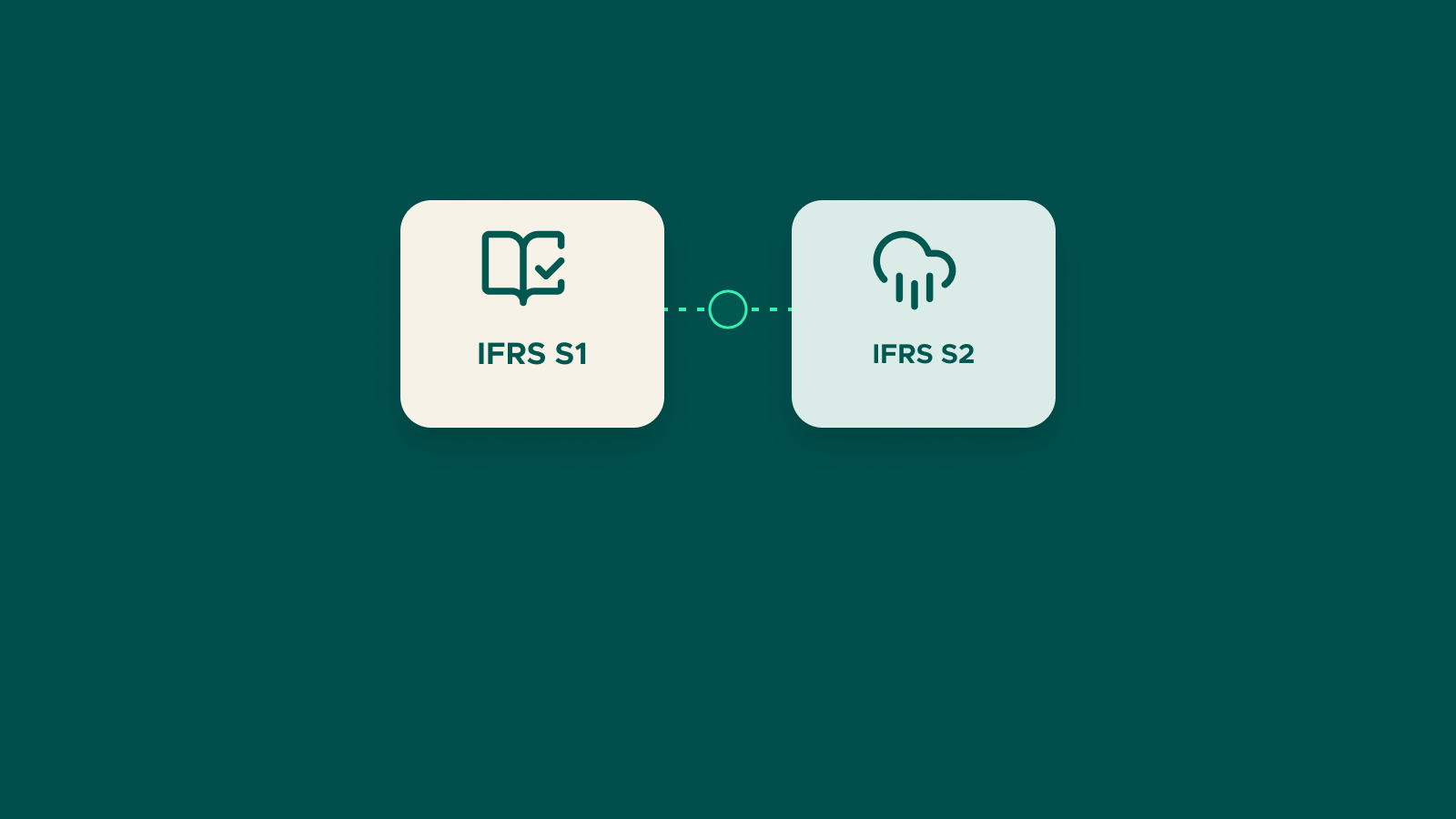
IFRS S1 and IFRS S2 are the two global sustainability disclosure standards issued by the International Sustainability Standards Board (ISSB) in June 2023. IFRS S1 sets general requirements for disclosing sustainability-related financial information, while IFRS S2 sets specific requirements for climate-related disclosures. Together, they give investors a common basis for assessing sustainability-related risks and opportunities across companies and markets.
Before 2023, companies reporting sustainability information to investors had no single global baseline. Frameworks such as the Task Force on Climate-related Financial Disclosures (TCFD), the Sustainability Accounting Standards Board (SASB) standards, and various national requirements coexisted, often with overlapping but non-identical content. The IFRS Foundation established the ISSB to consolidate this landscape into one investor-grade global baseline, comparable in status to IFRS Accounting Standards used for financial statements.
IFRS S1 and S2 were built directly on the TCFD's four-pillar structure, and the TCFD's own monitoring responsibilities were formally transferred to the ISSB in 2023. This means companies that already reported under TCFD have a running start: the underlying architecture of governance, strategy, risk management, and metrics carries over directly into IFRS S1/S2.
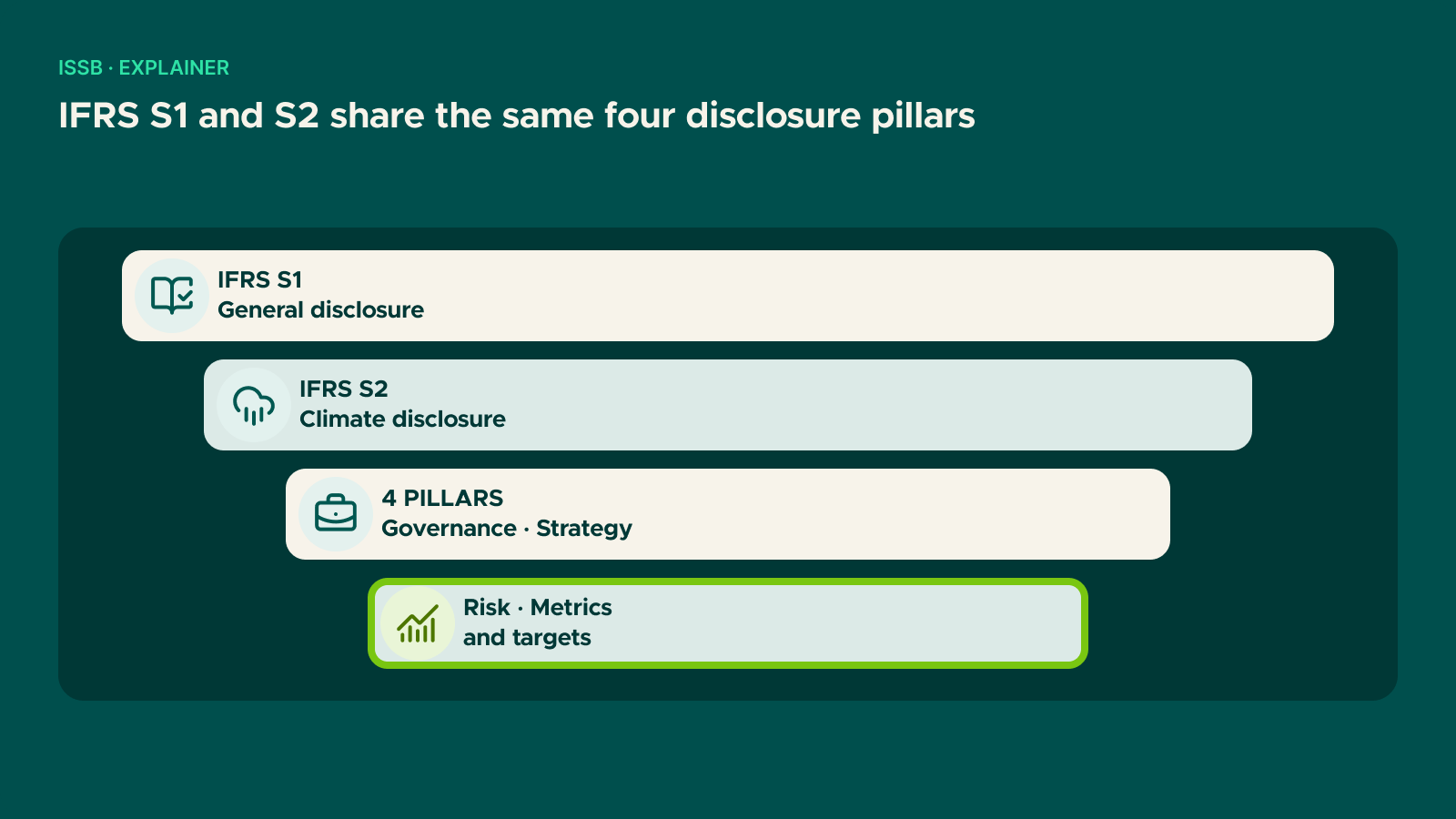
IFRS S1 sets the general framework for identifying, measuring, and disclosing sustainability-related risks and opportunities that could reasonably affect a company's cash flows, access to finance, or cost of capital over the short, medium, and long term. It is not limited to climate — it establishes the reporting architecture that applies across all sustainability topics a company determines are material to its investors, and it requires that sustainability disclosures be provided alongside general purpose financial statements, on the same reporting timeline.
IFRS S2 applies that same architecture specifically to climate. It requires disclosure of climate-related risks and opportunities, governance and strategy responses, the resilience of the company's strategy under different climate scenarios, and metrics and targets — including Scope 1 and Scope 2 greenhouse gas emissions and, where material, Scope 3 emissions, along with other climate-related KPIs relevant to the company's business model.
Both IFRS S1 and IFRS S2 are organized around four consistent pillars, mirroring the TCFD framework:
This shared structure is deliberate. It allows a company to build one integrated disclosure process rather than maintaining separate systems for general sustainability topics and for climate specifically.
The ISSB set the standards' effective date as annual reporting periods beginning on or after 1 January 2024. However, this is the date the ISSB itself recommended — it is not automatically binding on any company worldwide. IFRS S1 and S2 become mandatory only when a jurisdiction's securities regulator, stock exchange, or government formally endorses and incorporates them into local law or listing rules. As a result, actual mandatory compliance dates vary by jurisdiction, and multinational reporters need to track adoption status market by market rather than assuming a single global start date. We cover this jurisdiction-by-jurisdiction picture in detail in ISSB Adoption Timeline: Which Countries Have Mandated IFRS S1/S2 Reporting?.
Because IFRS S1/S2 consolidate and build on TCFD, companies already reporting under TCFD are well positioned. The relationship to the EU's CSRD/European Sustainability Reporting Standards (ESRS) is more nuanced, since ESRS applies a double-materiality lens (financial and impact materiality) rather than the investor-focused, single-materiality lens the ISSB uses. We address this comparison directly in IFRS S1/S2 vs CSRD/ESRS: Key Differences for Multinational Reporters.
For most organizations, the practical starting point is a structured gap analysis: mapping existing sustainability data, governance processes, and disclosures against the specific requirements of IFRS S1 and S2, then identifying where data, systems, or oversight need to be built out. Our guide, How to Start Your IFRS S1/S2 Compliance Journey: A Gap Analysis Guide, walks through this process step by step. Semtrio's IFRS S1/S2 advisory service supports this work from initial gap analysis through disclosure design and assurance readiness.
Semtrio Note: Semtrio is a member of the IFRS Sustainability Alliance, giving our advisory team direct access to ISSB implementation guidance and technical updates as the standards evolve — knowledge we apply directly in client gap analyses and disclosure design work.
IFRS S1 sets general requirements for disclosing all material sustainability-related risks and opportunities, while IFRS S2 applies that same framework specifically to climate-related risks, including GHG emissions metrics. They are designed to be used together.
Both standards are issued by the International Sustainability Standards Board (ISSB), a standard-setting body under the IFRS Foundation, which also oversees IFRS Accounting Standards.
No. The ISSB recommended an effective date of annual reporting periods beginning on or after 1 January 2024, but mandatory application depends on each jurisdiction's own regulator adopting the standards into local law or listing requirements.
Effectively, yes. IFRS S1/S2 were built on the TCFD's four-pillar structure, and the TCFD's monitoring role was transferred to the ISSB in 2023, making IFRS S2 the natural continuation of TCFD-aligned climate reporting.
A structured gap analysis comparing existing disclosures, data, and governance processes against IFRS S1/S2 requirements is the typical starting point before building out a full disclosure program.
If your organization is assessing what IFRS S1 and S2 mean for its reporting obligations, Semtrio's advisory team can help you understand your specific exposure and next steps. Contact Semtrio to start the conversation.
Get in touch
If something you've read here connects to a live project, a reporting deadline, or a decision you're weighing — we're happy to have a useful conversation.
Contact us
Regulation & Compliance
Regulation & Compliance
Regulation & Compliance
Lets talk about your sustainability goals.