Blog
Publish: 18 Nov 26Reading Time: 7 Min
CBAM reporting software is worth buying only if it turns your suppliers' installation data into the figures an authorised CBAM declarant submits in the CBAM Registry by 30 September each year, starting in 2027 for goods imported in 2026. Eight checks show whether a tool does that: three on the data that comes in, three on the calculation and evidence, and two on the declaration and certificate figures that come out. Run them in the demo, with your own CN codes and one real supplier file.
Last checked: 18 November 2026.
Since 1 January 2026 CBAM is in its definitive regime. Importers that bring in more than 50 tonnes of CBAM goods a year (iron and steel, aluminium, fertilisers and cement, counted together) need the status of authorised CBAM declarant, and they file one declaration a year. Under Article 6(2) of the CBAM Regulation, that declaration contains:
The CBAM Registry is where authorisations, declarations and certificates are handled. The work a tool does sits before that: collecting supplier data, calculating, keeping the evidence and preparing the numbers. Our post on what the CBAM declaration contains and when it is due covers the filing itself; this one covers the tool behind it.
The answer changes the shortlist.
The eight checks below are written for the declarant. Exporters can use checks 3 to 5 as they are.
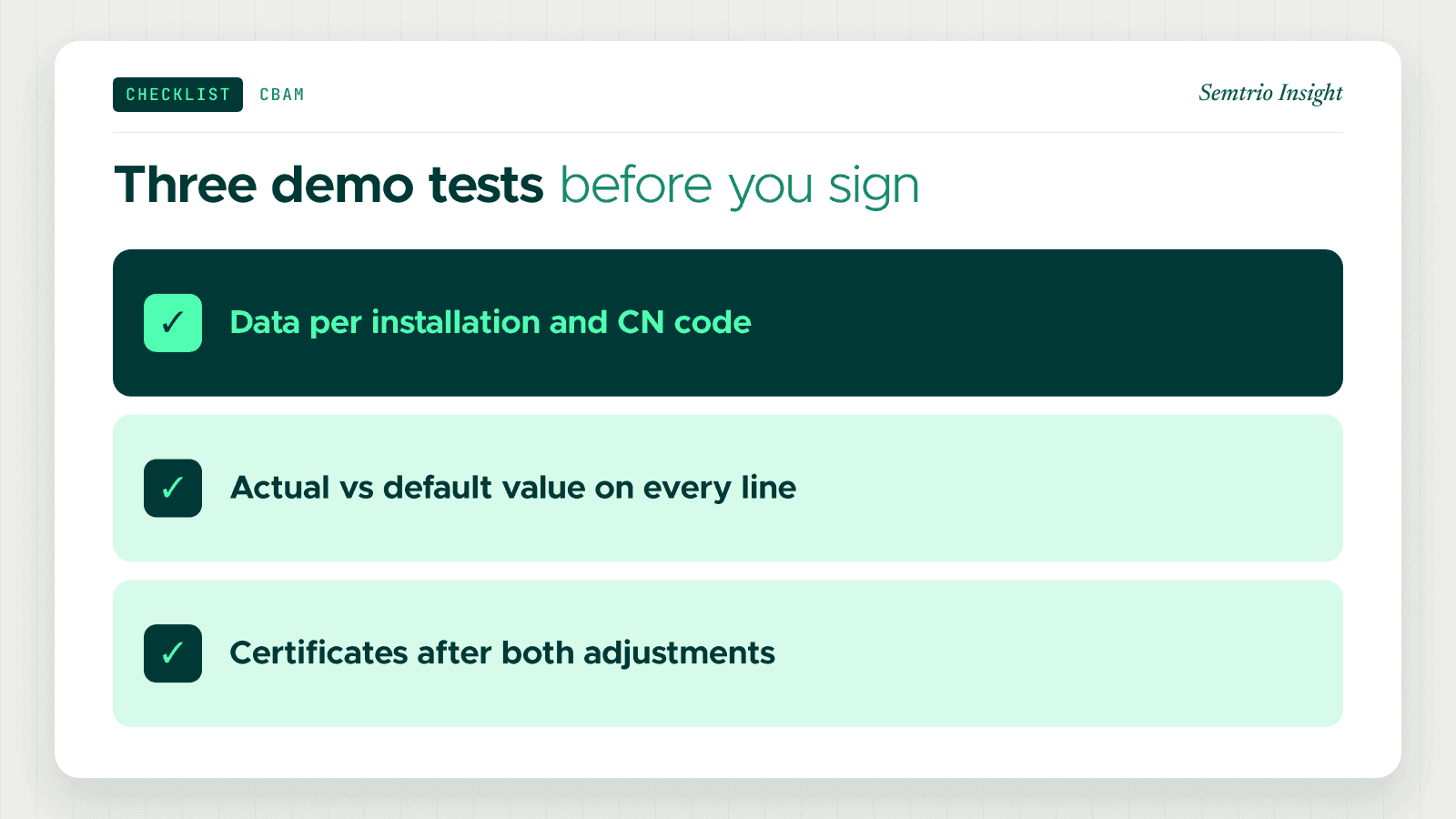
1. Does it hold data per installation and per CN code, not per supplier? One supplier can ship the same CN code from two plants with very different emissions. The Commission can set the standard declaration format to include detailed information for each installation and country of origin, so a tool that stores one figure per supplier will not hold what you need. In the demo, load a supplier with two installations and see whether the tool keeps them apart.
2. Does it mark each line as actual value or default value, with the current default values? Embedded emissions are either actual emissions or Commission default values. The binding default values are in Implementing Regulation (EU) 2025/2621, corrected by Implementing Regulation (EU) 2026/1740 in July 2026; the Commission's Excel file is for information only. Ask how the tool loads a correction, and whether it shows which lines rely on defaults. That list is where your cost sits; our post on default values and country mark-ups explains why.
3. Does it record where each supplier figure came from? Each actual value should carry its source: a supplier file or data shared through O3CI, the reporting period, and the verification report behind it. Without that, nobody can show later why a number was accepted.
4. Does the calculation follow CBAM's system boundaries and include precursors? Under Article 7 and Implementing Regulation (EU) 2025/2547, system boundaries of production processes are aligned with those of the EU ETS, and relevant input materials (precursors) are part of the calculation. Ask the vendor to show one steel or aluminium good with a precursor, step by step. Our guide to calculating embedded emissions and system boundaries is a useful script for that test.
5. Does it apply direct and indirect emissions by sector? For the goods listed in Annex II, which covers most iron and steel goods, aluminium and hydrogen, only direct emissions count. For cement and fertilisers, indirect emissions count as well. A tool that applies one rule to every sector gets one of these groups wrong.
6. Does it keep an evidence trail that survives a review four years later? The declarant has to keep the records behind embedded emissions, including the verifier's report, until the end of the fourth year after the year the declaration was or should have been submitted. The Commission can review declarations within that same period. The records must be detailed enough for a verifier and for the Commission's review. Ask to see the audit log for one figure: who changed it, when and why.
7. Does it produce every figure Article 6(2) asks for? Quantities, embedded emissions per tonne, and the certificate number after two adjustments: the deduction for a carbon price effectively paid in the country of production (with the evidence Article 9 requires, certified by an independent person) and the free allocation adjustment under Implementing Regulation (EU) 2025/2620. A tool that stops at "total tonnes of CO₂e" leaves the hardest part to a spreadsheet.
8. Does it show the quarterly certificate position from 2027? From 2027, at the end of each quarter, a declarant must hold certificates covering at least 50% of the embedded emissions in goods imported since the start of the year, based on default values without the mark-up or on the previous year's surrendered certificates for the same goods. Certificates go on sale on a common central platform from 1 February 2027. Their price is the quarterly average of EU ETS auction prices for 2026 imports and a weekly average from 2027. A useful tool shows this position per declarant entity, and it should reconcile with the Registry's own monitoring view, which tracks the 50% rule.
| # | Check | Ask the vendor to show | Basis |
|---|---|---|---|
| 1 | Data per installation and CN code | One supplier, two installations, kept apart | Art. 6(6) standard format |
| 2 | Actual vs default value per line | Lines on defaults; how a correction loads | IR 2025/2621, 2026/1740 |
| 3 | Source of each supplier figure | File or O3CI share, period, verification report | Art. 8, Art. 10 |
| 4 | System boundaries and precursors | One good with a precursor, step by step | Art. 7, IR 2025/2547 |
| 5 | Direct and indirect by sector | Iron and steel vs cement treatment | Annex II |
| 6 | Evidence trail | Audit log for one figure | Art. 7(5)–(6), Art. 19 |
| 7 | Declaration figures | Certificates after both adjustments | Art. 6(2), Art. 9, IR 2025/2620 |
| 8 | Quarterly certificate position | 50% view per entity, 2026 vs 2027 pricing | Art. 21, Art. 22 |
Software does not create actual data. If a supplier has no monitoring of its own, the tool can only fall back on default values.
It does not replace verification either. Where embedded emissions are based on actual emissions, they must be verified by a verifier accredited under Article 18. Keep the two roles apart: under the CBAM accreditation and verification rules, a verifier that provides technical assistance to develop or maintain an operator's monitoring and reporting system faces an unacceptable risk to its impartiality.
Most CBAM tool problems start upstream of the tool: an installation that cannot split its emissions by product, a precursor nobody traced, a supplier file without a period. At Tosyalı Holding, embedded emissions were quantified from production-level data, every calculation and cost estimate went through an internal technical review before reaching the facility team, and quarterly submission packages were prepared for each site across nearly twenty production entities, including wire rod, rolling mill, structural steel and spiral pipe operations.
Our CBAM work so far: every quarterly submission deadline met in the transitional period. Past results, not a guarantee of future outcomes.
The CBAM Registry is the official platform: declarants use it for authorisation, declarations and certificates, and non-EU operators use its O3CI portal to share installation data. Collecting supplier data and calculating embedded emissions happen before anything reaches the Registry, which is the gap commercial tools fill.
The obligation to declare sits with the EU declarant, not the exporter. Exporters need a calculation they can defend at installation level, and many register in O3CI to share it with buyers. Whether that needs a dedicated tool depends on how many installations and goods you report.
No. Where embedded emissions are based on actual emissions, they must be verified by an accredited verifier. Default values do not need verification, but they include a mark-up, so they rarely work in your favour.
Until the end of the fourth year after the year in which the CBAM declaration was or should have been submitted. For 2026 imports, declared in 2027, that means the end of 2031.
By 30 September 2027, covering goods imported in 2026. Certificates for those emissions are surrendered by the same date.
Related reading: CBAM declaration: content and deadline · CBAM default values and country mark-ups · Calculating embedded emissions: system boundaries · CBAM Registry and the O3CI operator portal
Before you shortlist a tool, map what it has to hold: CBAM accounting and reporting starts with a list of your CN codes, installations and the lines currently on default values, which becomes the test script for every vendor demo.
Get in touch
If something you've read here connects to a live project, a reporting deadline, or a decision you're weighing — we're happy to have a useful conversation.
Contact usLets talk about your sustainability goals.