Blog
Publish: 17 Sep 26Reading Time: 4 Min
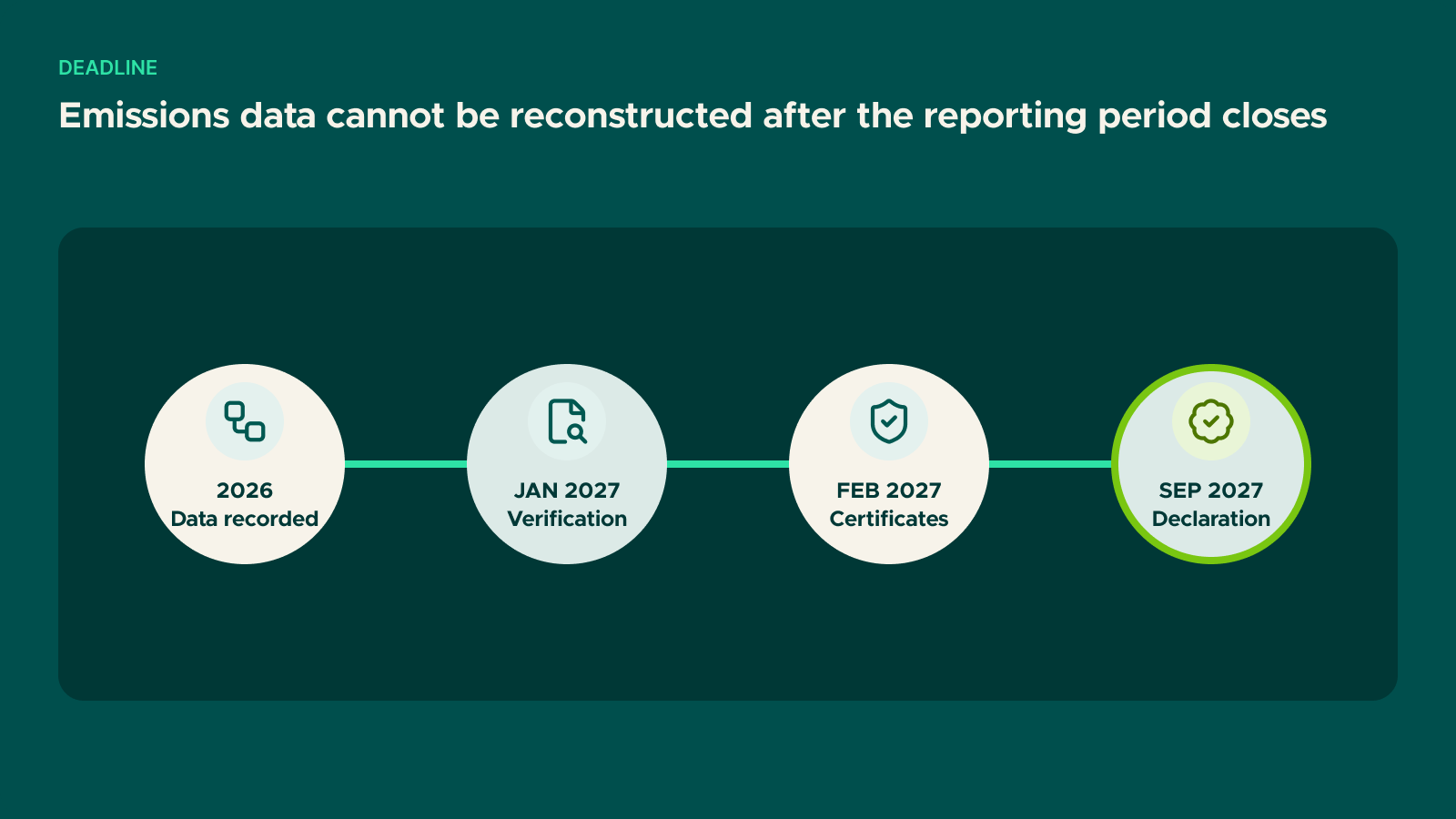
The annual CBAM declaration is the point where everything else in the mechanism converges. For 2026 imports it is due by 30 September 2027 — a date moved back from 31 May by the Omnibus Regulation to allow more time for verification. Because each of its four elements is produced by a separate process with its own lead time, the declaration is best planned backwards from the deadline.
The annual CBAM declaration is submitted by the authorised CBAM declarant through the CBAM Registry and reports four things:
Only the first element comes from the declarant's own records. The second and third originate in the production installation, and the fourth is a consequence of the first three. This is why the declaration is, in practice, a supply chain deliverable rather than an administrative form.
Each element has a lead time, and they run in sequence rather than in parallel.
| When | What has to be true |
|---|---|
| Throughout 2026 | Traceable emissions data is being recorded at the installation for the whole period |
| Late 2026 | Verifier engaged, accreditation scope confirmed, site visit scheduled |
| Q1 2027 | Verification performed; first verification reports expected from January 2027 |
| From 1 February 2027 | Certificates available for purchase |
| Q1-Q3 2027 | Emissions data shared with the declarant; quarterly 50% holding maintained |
| By 30 September 2027 | Declaration submitted and certificates surrendered |
The constraint that governs the whole chain is that emissions data cannot be reconstructed retrospectively. A gap in 2026 records cannot be repaired in 2027; the only available response is to fall back to default values for that period, with the mark-up applied.
Get in touch
If something you've read here connects to a live project, a reporting deadline, or a decision you're weighing — we're happy to have a useful conversation.
Contact us
Regulation & Compliance
Regulation & Compliance
Regulation & Compliance
Lets talk about your sustainability goals.
From 2027, a second obligation runs alongside the annual declaration. At the end of each quarter, declarants must hold at least 50% of the certificates corresponding to the embedded emissions of goods imported since the start of the year.
This changes the rhythm of the mechanism for suppliers as much as for importers. To calculate a quarterly position, the importer needs an emissions figure during the year, not only after verification. Data requests should therefore be expected periodically, and it matters that provisional figures are clearly labelled as such — an unlabelled estimate that later diverges from the verified number creates a commercial problem rather than a technical one.
There is no holding obligation for 2026, since certificate sales only begin in February 2027.
The reporting period is the year in which the goods were produced or imported into the EU, and it cannot precede 2026. Two consequences follow. Transitional-period data cannot be carried into a definitive-regime declaration. And a verified figure for one year cannot be reused for the next; each period requires its own calculation and its own verification.
The authorised CBAM declarant established in the EU. Producers outside the EU have no declaration obligation.
Corrections are provided for, but a shortfall in surrendered certificates attracts the €100 per tonne penalty, and paying it does not remove the surrender obligation. We cover this in CBAM penalties and enforcement.
Only where actual values are used. Default values are not subject to verification.
Yes. The declaration for 2027 imports falls due by 30 September 2028, on the same pattern.
We work on preparing verified emissions data in time for the declaration and on coordinating with declarants, under our CBAM accounting and reporting service. You can contact us with your questions.