Blog
Publish: 17 Sep 26Reading Time: 5 Min
For EU importers of cement, steel, aluminium and fertilisers, Türkiye is one of the most significant origins in CBAM scope — first in EU-bound cement and aluminium, fourth in steel. That makes supplier readiness in Türkiye a material factor in an importer's own 2027 declaration. The picture is uneven: strong on data availability in some sectors, incomplete in others, and with two open policy questions that affect the numbers directly.
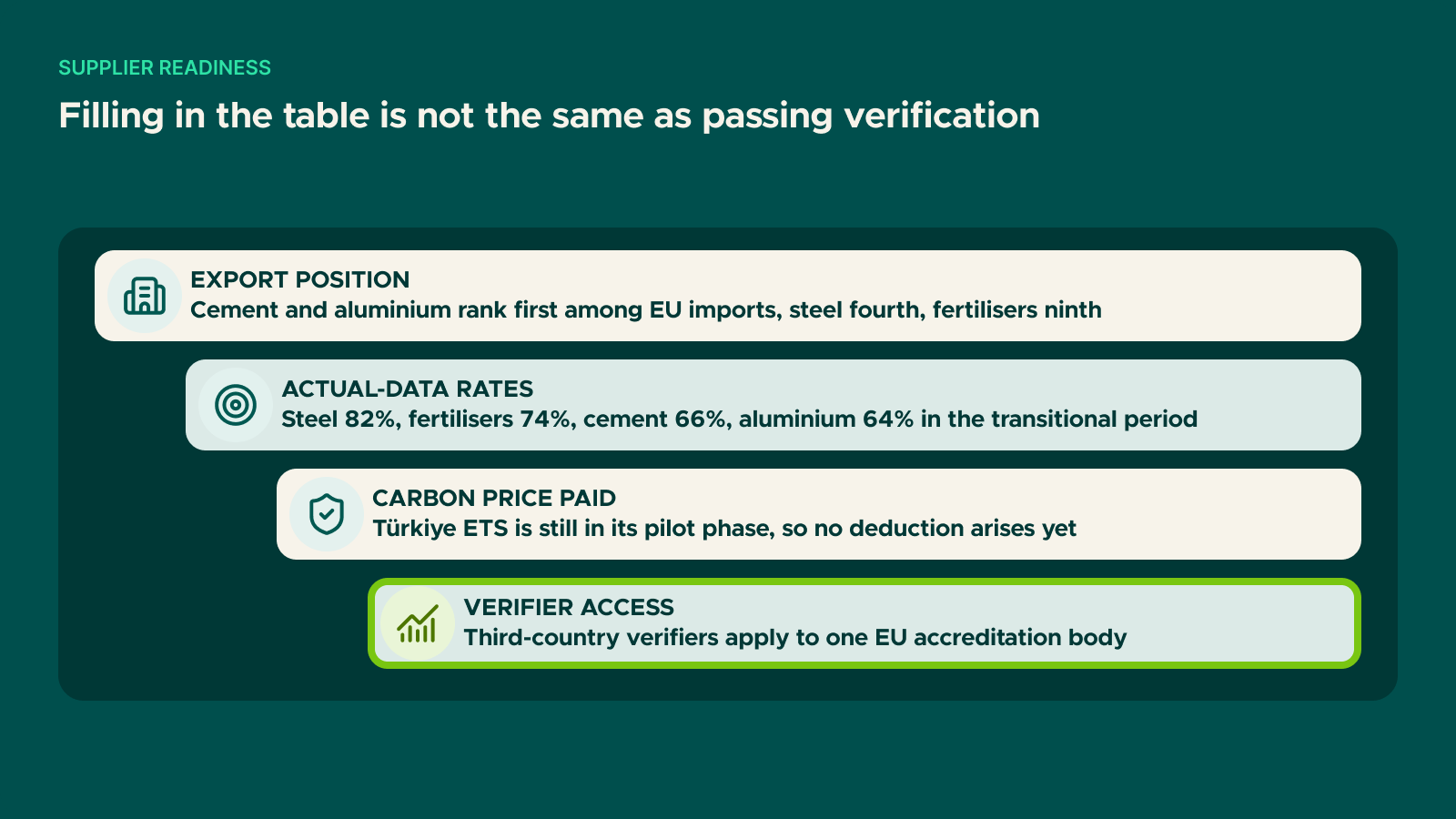
According to the Turkish Ministry of Trade's assessment of transitional-period registry data, Türkiye's position among countries exporting CBAM goods to the EU is as follows:
| Sector | Country ranking | Actual-data usage |
|---|---|---|
| Cement | 1st | 66% |
| Iron and steel | 4th | 82% |
| Aluminium | 1st | 64% |
| Fertilisers | 9th | 74% |
Two things follow for an EU importer. Türkiye is among the origins where the mechanism bites hardest, so a portfolio sourcing from Türkiye carries meaningful CBAM exposure. And the readiness of that supply base varies materially by sector — highest in steel, lowest in aluminium.
The usage rates above are a useful signal but are frequently over-read. They describe the share of transitional-period reporting that used actual emissions values rather than defaults. That data was not subject to verification.
Under the definitive regime the same figures must be verified by a verifier accredited under CBAM by an EU national accreditation body, with a physical site visit mandatory in the first year. Having been able to populate a template during the transitional period does not demonstrate an ability to pass that audit. The gap between the two is the gap between an estimate and an audited figure.
For an importer, the practical implication is that a supplier's transitional-period cooperation is not a sufficient indicator. The questions that matter are whether a monitoring methodology document exists, whether data was recorded traceably throughout 2026, and whether a verifier has been engaged.
Turkish steel is predominantly electric arc furnace based. Because scrap is outside CBAM scope and carries no embedded emissions as an input, this gives a structural advantage in the calculation — but one that only reaches the numbers if the production route is correctly declared and evidenced. The proposal to extend indirect emissions to steel would narrow this advantage, since much of an arc furnace's footprint is electrical. See CBAM and iron and steel.
Turkish EU-bound aluminium is largely extrusions, sheet, foil and fabricated articles. For those goods the determining figure is the embedded emissions of the purchased billet rather than the processor's own operations. An importer assessing an aluminium supplier should therefore ask about the billet's origin and data, not only the extruder's. See CBAM and aluminium.
Most cement emissions come from calcination and cannot be abated by fuel switching, so the clinker factor is the variable that matters. Cement also carries the highest CBAM cost relative to product value of any covered good, which makes it the sector where the 2029-2030 step-down in free allocation will be felt first. See CBAM and cement.
The default-value mark-up is fixed at 1% for fertilisers rather than rising to 30%, so the cost penalty for using defaults is small. That weakens the commercial pressure on suppliers to produce verified data, and an importer should not assume it will be volunteered.
Türkiye's emissions trading system regulation was published on 27 August 2026. The pilot period has been announced as 2026-2027, covering electricity generation, cement, iron and steel, aluminium and fertilisers, with a free allocation rate reported at 100%.
CBAM allows a carbon price actually paid in the country of production to be deducted from the obligation. The condition is that it was actually paid and not refunded. Where emissions are covered by free allocation, no amount is paid, so no deduction arises.
There is a subtlety worth understanding, because it is where deductible amounts will first appear. Free allocation under Türkiye's system, as under the EU ETS, is calculated against a benchmark rather than against actual emissions. An installation whose intensity exceeds the benchmark can therefore be short even at a nominal 100% free allocation rate, and the allowances it buys represent an amount actually paid. Whether that becomes deductible depends on documentation and on verification by the emissions verifier. See carbon price paid in a third country.
CBAM verification must be performed by a verifier accredited by an EU national accreditation body. Accredia, RvA, SWEDAC and PCA have indicated they accept applications from third-country verifiers.
Türkiye has accredited verification bodies operating in scopes that overlap with CBAM, but recognition of its national accreditation body, TÜRKAK, for CBAM purposes remains an open question and is listed among the Ministry of Trade's stated priorities. The Commission's revision proposals include the possibility of agreements on mutual recognition of third-country accreditation bodies.
Until such an agreement exists, the practical check is which accreditation a supplier's verifier actually holds. Holding ISO 14064 verification accreditation does not imply CBAM competence. See CBAM verification and accredited verifiers.
No. Only a carbon price actually paid, not refunded, documented and verified can be deducted. Free allocation produces no paid amount.
Guarantees of origin such as YEK-G are not accepted for CBAM indirect emissions. Direct technical connections and power purchase agreements are.
Not directly — the status requires EU establishment. Groups with an EU entity can apply through it.
On the transitional-period figures, aluminium and cement show the lowest actual-data usage, so supplier readiness there warrants the closest scrutiny.
We work with producers in Türkiye on embedded emissions calculation, monitoring methodology and verification readiness under our CBAM accounting and reporting service. You can contact us with your questions.
Get in touch
If something you've read here connects to a live project, a reporting deadline, or a decision you're weighing — we're happy to have a useful conversation.
Contact us
Regulation & Compliance
Regulation & Compliance
Regulation & Compliance
Lets talk about your sustainability goals.


