Blog
Publish: 17 Sep 26Reading Time: 5 Min
Iron and steel is the widest and most complex sector in CBAM scope, and the one where embedded emissions vary most between producers. Two installations shipping goods under the same CN code can generate CBAM costs that differ by a factor of several, depending on how the metal was made. Understanding where that variance comes from is the starting point for both importers assessing supply options and producers positioning themselves.
Steel's embedded emissions depend on what the process starts from. Three routes dominate:
Because default values are set by country and production route, the route is the entry point to the whole calculation. Declaring it correctly, and being able to evidence it, is a precondition for any route-based advantage appearing in the numbers.
Scrap does not appear in the CBAM scope list, and the consequence flows directly into the calculation: scrap is treated as an input carrying no embedded emissions. Where covered precursors carry their emissions into the final product, there is nothing to carry from scrap.
This pulls emissions intensity down sharply in scrap-intensive production and widens the gap between electric arc furnace and integrated producers. Two goods under the same CN code can therefore generate very different CBAM costs.
The Commission's anti-circumvention proposals include adding pre-consumer scrap as an input emission. If adopted, scrap arising within the production process and remelted would carry an emissions load, narrowing part of the advantage. Post-consumer scrap is not covered by the proposal.
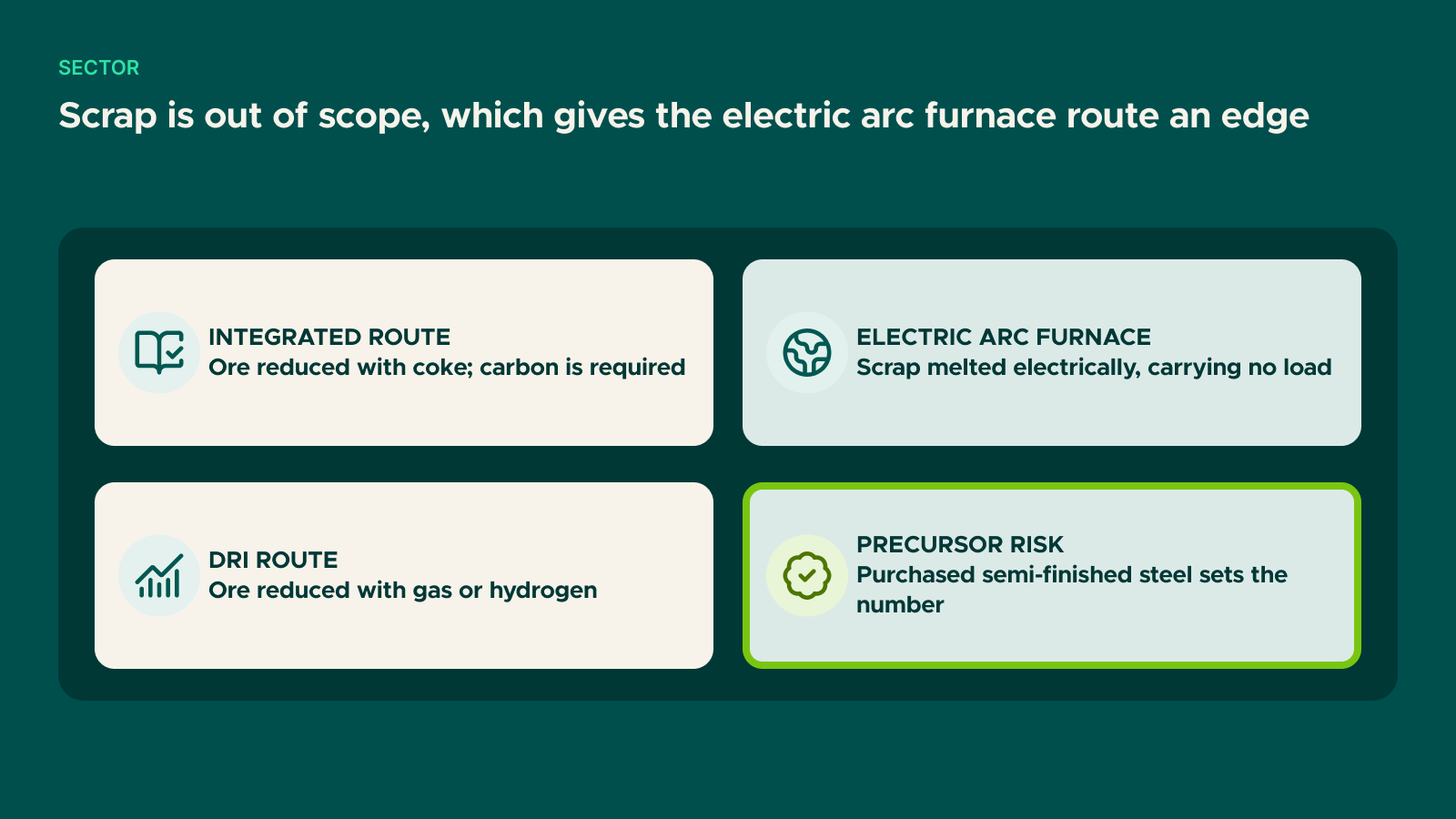
The most commonly overlooked part of the steel calculation is precursors. An installation that buys a covered precursor and processes it has embedded emissions equal to its own process emissions plus those of the purchased input. Typical precursors:
Consider a re-roller or coater buying semi-finished steel. Its own process accounts for a small share of the total; the bulk of the figure is set by the purchased input. Where the supplier provides no verified data, a default value plus mark-up applies to the precursor — 10% in 2026, rising to 30% from 2028.
The result is that an installation with excellent data of its own can lose competitiveness because of its supplier's data policy. Mapping covered precursors by supplier, and writing the data requirement into supply contracts, is therefore part of the immediate workload.
Indirect emissions do not count in steel today. Since much of an electric arc furnace's footprint sits in electricity, that exclusion amplifies the route's advantage.
The Commission's review proposes extending indirect emissions to steel, aluminium and hydrogen, removing in parallel the indirect cost compensation available to EU producers. If adopted, the calculation is rebuilt: the direct-emissions advantage of the scrap route survives, but an indirect load based on the grid emission factor is added.
In that scenario the decisive factor becomes the ability to evidence the electricity source. Direct technical connections and power purchase agreements are accepted; guarantees of origin are not. We set out the rules in CBAM indirect emissions and electricity.
Scope draws on a substantial part of CN chapters 72 and 73: pig iron, semi-finished products, flat and long products, wire, tubes and hollow profiles, structural components, reservoirs and tanks, stranded wire, and fasteners.
It is not, however, the whole of those chapters. Part of the ferro-alloys is listed and part is not, and scrap is excluded. Scope checks therefore need to run at eight-digit level; chapter-level matching produces both false positives and false negatives. We cover the method in CBAM goods and CN codes.
The proposed 180-code downstream list is largely made up of steel- and aluminium-using sectors: motor vehicles and chassis, industrial machinery, articles of metal, vehicle parts, household appliances, construction and lifting equipment.
For a steel producer this has a second-order consequence: domestic customers will begin requesting emissions data too. Today only customers exporting directly to the EU ask. From 2028, customers that process the steel and then sell into the EU will need the same figures — which multiplies both the volume of requests and the number of counterparties. Under the proposal, only the emissions of the CBAM-covered input count towards a downstream good.
Usually not. Default values are route-specific but carry the mark-up, so installations performing below the route average gain materially from actual data.
Yes. Emissions data originates in the production installation; an intermediary cannot generate or transfer it.
The calculation is built per production process, and each route's output is treated separately. Which route a given consignment came from must be traceable.
They operate independently — one on volumes and tariffs, the other on carbon cost — but export planning needs to consider both together.
We work on declaring production routes correctly, mapping precursors and building the emissions calculation, under our CBAM accounting and reporting service. You can contact us with your questions.
Get in touch
If something you've read here connects to a live project, a reporting deadline, or a decision you're weighing — we're happy to have a useful conversation.
Contact us
Regulation & Compliance
Regulation & Compliance
Regulation & Compliance
Lets talk about your sustainability goals.