Blog
Publish: 02 Sep 26Reading Time: 4 Min
Improving an EcoVadis score requires building documented policy evidence and verifiable action records across all four themes — Environment, Labor & Human Rights, Ethics, and Sustainable Procurement — rather than relying on ambitious commitments alone. The most reliable lever is evidence quality, not the scale of stated goals.
A common mistake is treating an EcoVadis submission as a communications exercise: describing ambitious targets, values statements, or future plans. EcoVadis analysts score documented evidence — existing policies, implementation records, training completion data, monitoring reports, and outcome measures — not stated intentions. A net-zero target with no supporting emissions tracking or reduction plan scores lower than a modest, fully documented energy-efficiency program with two years of monitoring data behind it.
This is the single most consistent gap Semtrio sees across first-time assessments, and it is explored in more depth in Common Reasons Companies Score Low on EcoVadis.
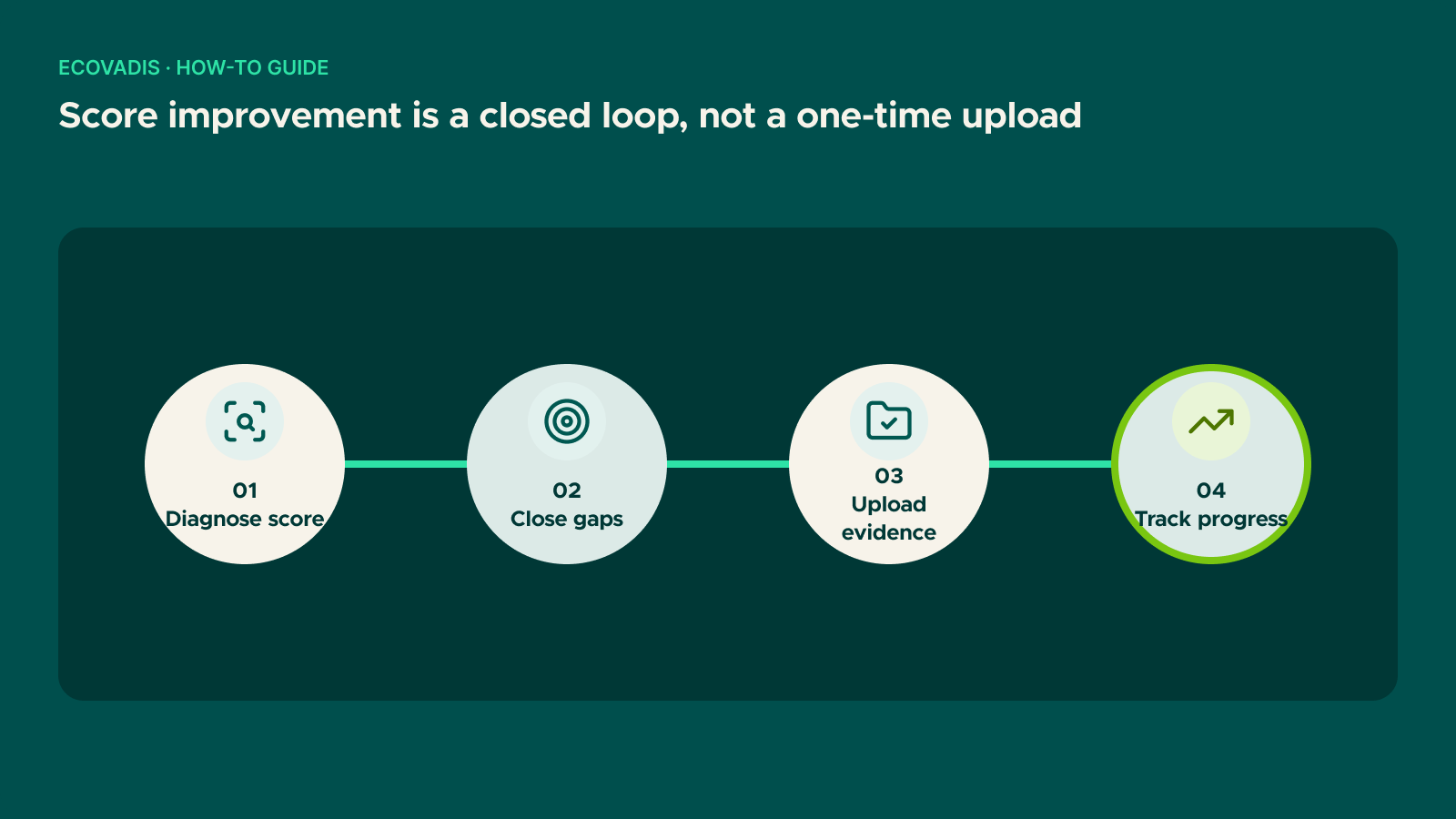
Improvement is most effective when it targets the weakest theme first, since medals require a minimum score of 30 in each of the four themes individually. A company strong on Ethics and Environment but weak on Sustainable Procurement will not earn a medal until that weakest theme clears the threshold, regardless of how strong the other three scores are. Reviewing the prior scorecard's theme-by-theme breakdown — not just the overall score — is the starting point for any improvement plan.
For each theme, EcoVadis looks for three layers of evidence: a written policy, an implementation mechanism (training, monitoring, responsible owner), and outcome data (audit results, incident records, corrective action logs). Companies frequently have the first layer — policies exist — but are missing the second and third. Building out implementation and outcome evidence, not just writing new policies, tends to produce the largest score gains.
Practical priorities typically include:
A full list of documents typically requested is covered in Preparing for Your EcoVadis Assessment: Document Checklist.
Because EcoVadis medals are awarded by percentile rank, the score needed for each tier has been trending upward, based on third-party tracking rather than fixed EcoVadis policy — Silver moved from roughly 68 to roughly 72 and Gold from roughly 77 to roughly 78 between mid-2025 and early 2026. This means an improvement plan targeting last year's threshold risks falling short by the time the next assessment is reviewed. Building in a margin above the previous cycle's published threshold is a more reliable target than matching it exactly. The mechanics of this percentile system are explained fully in How Does the EcoVadis Scoring System Work?.
Score improvement is incremental and evidence-driven, not immediate. Building out missing policies, implementation records, and monitoring systems takes time, particularly where a company is starting from a low baseline across multiple themes. Companies that treat EcoVadis as a recurring cycle — reviewing and strengthening evidence before every reassessment — see compounding gains over successive submissions, rather than companies that only prepare intensively before the first assessment and then let documentation lapse.
Semtrio Note: Organizations Semtrio supports achieve an average first-year improvement of 25.6 points, reaching an average client score of 73.2 against a global first-year average of 48.4, with a 100% medal-earning rate. Returning clients see a further average improvement of 10.5 points — evidence that the most reliable lever is documented policy evidence and verifiable action records, applied consistently across cycles, not ambitious commitments made once.
Semtrio, an EcoVadis Accredited Consulting Partner holding Platinum status itself, works with ESG and procurement teams to audit existing documentation against all four themes, prioritize the gaps most likely to move the score, and build evidence records that hold up under EcoVadis analyst review. Learn more at Semtrio's EcoVadis consulting page.
There is no shortcut around evidence: the fastest reliable path is identifying which of the four themes is weakest and building documented policy, implementation, and outcome evidence for that theme first.
Recognized certifications can serve as supporting evidence, but they are one input among several — EcoVadis still expects policy documentation and implementation records alongside any certification.
Documentation should be reviewed on an ongoing basis, not just before a reassessment cycle, since gaps identified early are easier to close than gaps discovered close to a submission deadline.
Yes, though it typically requires either internal capacity dedicated to the task or external support experienced in EcoVadis's specific evidence requirements, given how much of the process is documentation-intensive.
If you want a structured view of where your evidence gaps sit before your next assessment, talk to Semtrio's team.
Get in touch
If something you've read here connects to a live project, a reporting deadline, or a decision you're weighing — we're happy to have a useful conversation.
Contact us
Regulation & Compliance
Regulation & Compliance
Regulation & Compliance
Lets talk about your sustainability goals.