Blog
Publish: 02 Sep 26Reading Time: 4 Min
EcoVadis scores companies from 0 to 100 across four themes — Environment, Labor & Human Rights, Ethics, and Sustainable Procurement — based on documentary evidence reviewed by EcoVadis analysts. Since 2024, medals are awarded by percentile rank against all assessed companies, not by fixed score bands, meaning the bar shifts as more companies are assessed.
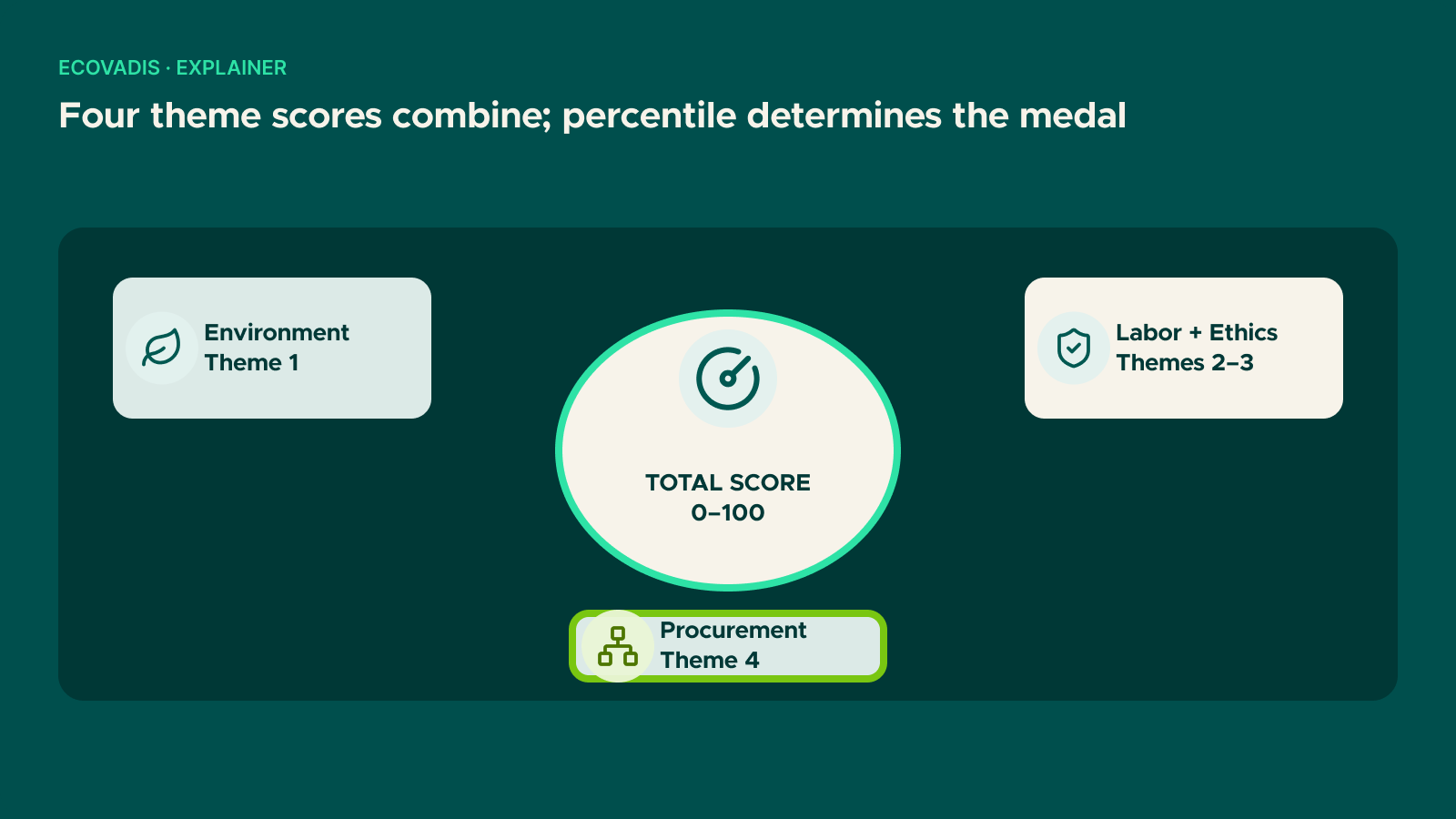
Every EcoVadis assessment is built around four themes, each scored independently:
A company's overall score is a weighted combination of these four theme scores, with weighting adjusted for sector, company size, and country risk profile. This is why two companies with similar overall scores can have quite different theme-level profiles — one may be strong on Environment and weaker on Sustainable Procurement, for instance.
EcoVadis does not accept narrative claims at face value. Each theme is assessed against documentary evidence: written policies, certifications, monitoring data, training records, and outcome measures such as incident logs or supplier audit results. EcoVadis analysts review this evidence and score it for both the presence of a policy and the depth of implementation behind it.
This is a critical distinction for anyone preparing a submission. A policy statement without supporting records (training completion, monitoring reports, corrective actions) scores lower than the same policy backed by two or three years of documented implementation. The practical implications of this for document preparation are covered in Preparing for Your EcoVadis Assessment: Document Checklist.
Since 2024, EcoVadis medals are no longer tied to fixed score thresholds. Instead, they are awarded by percentile rank against all companies assessed in the relevant period:
Earning any medal also requires a minimum score of 30 in each of the four themes individually — a company cannot compensate for a weak theme with strong performance elsewhere and still qualify for a medal. Two badges sit below medal level: "Committed" (score of 45 or higher, but below medal threshold) and "Fast Mover" (score of 34–44, with at least a 6-point improvement within 18 months).
A full breakdown of what each medal signals commercially is available in EcoVadis Medals Explained: Bronze, Silver, Gold, and Platinum.
Because medal thresholds are percentile-based rather than fixed, the score needed to reach each medal tier is an observed trend rather than a number EcoVadis publishes as fixed policy. Third-party trackers have reported that between mid-2025 and early 2026, the Silver threshold rose from roughly 68 to roughly 72, and the Gold threshold rose from roughly 77 to roughly 78. This reflects a rating pool where overall performance is improving year over year: as more companies submit stronger assessments, the percentile bar for each medal rises with them.
The practical takeaway for ESG teams is that matching last year's Gold or Silver score is not a safe target. A company should aim meaningfully above the prior year's threshold, since the goalposts move upward each assessment cycle. Since 2025, EcoVadis has also used unrounded, decimal scores on the scorecard, which allows for more precise tracking of exactly where a company sits relative to a moving threshold.
Because thresholds move, a static preparation approach — assembling the same documents used in a prior submission cycle — risks a company falling behind even if its absolute score stays flat. Effective preparation treats each cycle as a moving target: theme scores need to keep improving, not just hold steady, to retain the same medal standing. This is one of the most common blind spots behind unexpected score drops, discussed further in Common Reasons Companies Score Low on EcoVadis.
Semtrio Note: Organizations Semtrio supports achieve an average first-year improvement of 25.6 points, reaching an average client score of 73.2 against a global first-year average of 48.4, with a 100% medal-earning rate. Returning clients see a further average improvement of 10.5 points — evidence that consistent, evidence-based preparation compounds across cycles rather than being a one-time exercise.
Scoring well on EcoVadis is a documentation and evidence exercise, not a marketing exercise. Semtrio's EcoVadis consulting services help ESG and procurement teams map existing policies and records against the four themes, identify gaps before submission, and target scores that account for where thresholds are heading — not just where they sat last year.
Yes. Because medals are percentile-based, a static score can fall out of medal range if other assessed companies improve faster during the same period.
No. Weighting is adjusted by sector, company size, and country risk, so the same absolute theme score can carry different weight for different companies.
A company needs at least 30 in each of the four themes to qualify for any medal, regardless of its overall score.
Since 2025, EcoVadis has used unrounded, decimal scores on the scorecard rather than whole numbers, allowing more precise positioning relative to medal thresholds.
To understand exactly where your current documentation stands against this year's likely thresholds, talk to Semtrio's team about a scorecard review.
Get in touch
If something you've read here connects to a live project, a reporting deadline, or a decision you're weighing — we're happy to have a useful conversation.
Contact us
Regulation & Compliance
Regulation & Compliance
Regulation & Compliance
Lets talk about your sustainability goals.


