Semtrio
ACADEMY
Partner Login
Contact

By subscribing you agree to receive marketing communications from Semtrio. You can unsubscribe at any time.

Be the first to know what’s changing.

Semtrio
Follow us on

Services

Compliance and RegulatoryClimate AccountingSustainability ReportingClimate and Sustainability StrategySupply Chain Sustainability
ESG RatingsSustainable FinanceCapacity Building and TrainingCarbon Markets and Climate Projects

Industries

ManufacturingEnergyAviationFinance and Banking
TelecomsRetail and ConsumerConstruction MaterialsGroup Companies and Holdings

Works

All Clients & ProjectsKey ProjectsAccreditations

Insights

Case StudiesBlogsGlossaryResources

About

Who We AreWhy SemtrioWork With Us

Contact

Contact Us

Our Partners

B Corp Certified
CDP
UN Global Compact
Ecovadis CoreEcovadis Platinum
GRI Community Member

Copyright © 2026 All Rights Reserved.

Legal
Policies
Peerless Ventures

Designed by

Fameus
Home
Insights
Blog
Voluntary carbon market explained: carbon credits, integrity and claims

Blog

Voluntary carbon market explained: carbon credits, integrity and claims

voluntary carbon marketcarbon creditsICVCMCore Carbon PrinciplesVCMIArticle 6carbon neutralityDirective 2024/825

Publish: 10 Nov 26Reading Time: 8 Min

The voluntary carbon market is where companies buy and retire carbon credits by choice, not because a law requires them to. A carbon credit is a certificate representing one tonne of CO₂ equivalent reduced, avoided or removed by a project, issued by a crediting programme such as Verra or Gold Standard after independent verification. What credits can support in a claim is now tightly defined: the SBTi does not count them toward reduction targets, and from 27 September 2026 EU consumer law bans claims that a product is climate neutral because of offsetting.

Companies usually come to carbon credits from one of two directions: a commercial team that wants to say "carbon neutral", or a sustainability team that wants to fund action beyond its own value chain. The rules below decide which of those two goals credits can still serve.

What is a carbon credit?

A carbon credit is a tradable unit equal to one tonne of CO₂e that a project has kept out of the atmosphere or taken out of it, compared with what would have happened without the project. Each credit goes through the same life cycle:

  1. Project design and validation. The project applies an approved methodology, for example efficient cookstoves, landfill gas capture or reforestation, and an independent body checks the design.
  2. Monitoring and verification. The project measures its results, and an independent verifier confirms the tonnes.
  3. Issuance. The crediting programme issues credits with unique serial numbers in its registry.
  4. Retirement. When a buyer uses a credit for a claim, it is retired in the registry so it cannot be sold or claimed again.

Two distinctions matter for every later decision. Reduction or avoidance credits come from projects that emit less than a baseline; removal credits come from projects that take CO₂ out of the atmosphere and store it. The SBTi treats them differently, as shown below.

What is the difference between compliance and voluntary carbon markets?

Compliance market Voluntary market
Why companies take part A law caps their emissions Their own choice: targets, claims, contribution
Unit traded Allowances set by the regulator (e.g., in the EU ETS, one allowance = the right to emit 1 tonne of CO₂e) Carbon credits issued by independent crediting programmes
Who sets the rules Governments (EU ETS covers electricity and heat generation, industrial manufacturing, aviation and, since 2024, maritime transport) Crediting programmes and integrity bodies such as ICVCM and VCMI
What it proves Legal compliance for the covered installation Only what the credit's quality and the claim's wording support

The two worlds are linked by the Paris Agreement. Under Article 6.2, countries can transfer mitigation outcomes (ITMOs) to each other and count them toward their national climate targets (NDCs), with corresponding adjustments so the same tonne is not counted by both countries. Article 6.4 created a UN-supervised crediting mechanism, the Paris Agreement Crediting Mechanism, whose Supervisory Body approved its first credit issuance in February 2026. When a voluntary buyer sees an "Article 6 authorised" or "corresponding adjustment" label, it means the host country has agreed not to count those tonnes toward its own target.

For how compliance carbon pricing reaches exporters, see our posts on CBAM vs EU ETS and on carbon prices paid in third countries.

How can you tell whether a carbon credit is high quality?

Two independent initiatives now set the reference points: one for the credit, one for the claim.

ICVCM Core Carbon Principles (supply side). The Integrity Council for the Voluntary Carbon Market (ICVCM) sets 10 Core Carbon Principles in three groups:

  • Governance: effective governance; tracking; transparency; robust independent third-party validation and verification.
  • Emissions impact: additionality; permanence; robust quantification of emission reductions and removals; no double counting.
  • Sustainable impact: sustainable development benefits and safeguards; contribution toward the net zero transition.

A credit can carry the CCP label only if two gates are passed: the crediting programme must be assessed as CCP-Eligible, and the credit must come from a category of credits (methodology type) that the ICVCM has approved.

VCMI Claims Code of Practice (demand side). The Voluntary Carbon Markets Integrity Initiative (VCMI) sets out when a company may make a claim with credits. Before any claim, it must meet foundational criteria, including a public annual emissions inventory and science-aligned near-term targets, and show progress against them. Claims are then tiered Silver, Gold or Platinum depending on how much of the company's remaining emissions it covers with retired high-quality credits, which VCMI links to the ICVCM principles. Credits used for these claims do not count toward the company's own reduction targets.

How can carbon credits be used in climate claims?

This is where most rules changed. Three points apply in 2026:

  • SBTi targets. Under the Corporate Near-Term Criteria V5.3.1, carbon credits must not be counted as emission reductions toward near-term targets. Under the Corporate Net-Zero Standard V2.0 (published June 2026), residual emissions at the net-zero year must be neutralised with eligible carbon removals, and credits supported under the voluntary "ongoing emissions responsibility" programme cannot be netted from the inventory or counted toward targets. Our SBTi advisory page explains how targets are built under both versions.
  • EU product claims. Directive (EU) 2024/825 on empowering consumers for the green transition adds to the EU's list of banned commercial practices any claim, based on greenhouse gas offsetting, that a product has a neutral, reduced or positive impact on the environment in terms of greenhouse gas emissions. Member States had to adopt their rules by 27 March 2026 and apply them from 27 September 2026.
  • EU company-level claims. The European Commission's FAQ on the directive says this specific ban does not cover offsetting claims made at company level, but those claims stay subject to the directive's other rules. The same FAQ says generic claims such as "carbon neutral" or "climate neutral" are banned unless the trader can show recognised excellent environmental performance relevant to the claim. Check the national transposition in each market where you sell.

Carbon neutrality vs net zero. "Carbon neutral" usually describes a company or product whose remaining emissions over a period are compensated with credits. "Net zero" in the SBTi sense means cutting value chain emissions to a residual level on a science-based pathway and neutralising only that residual with removals. The two are not interchangeable, and credits cannot turn the first into the second.
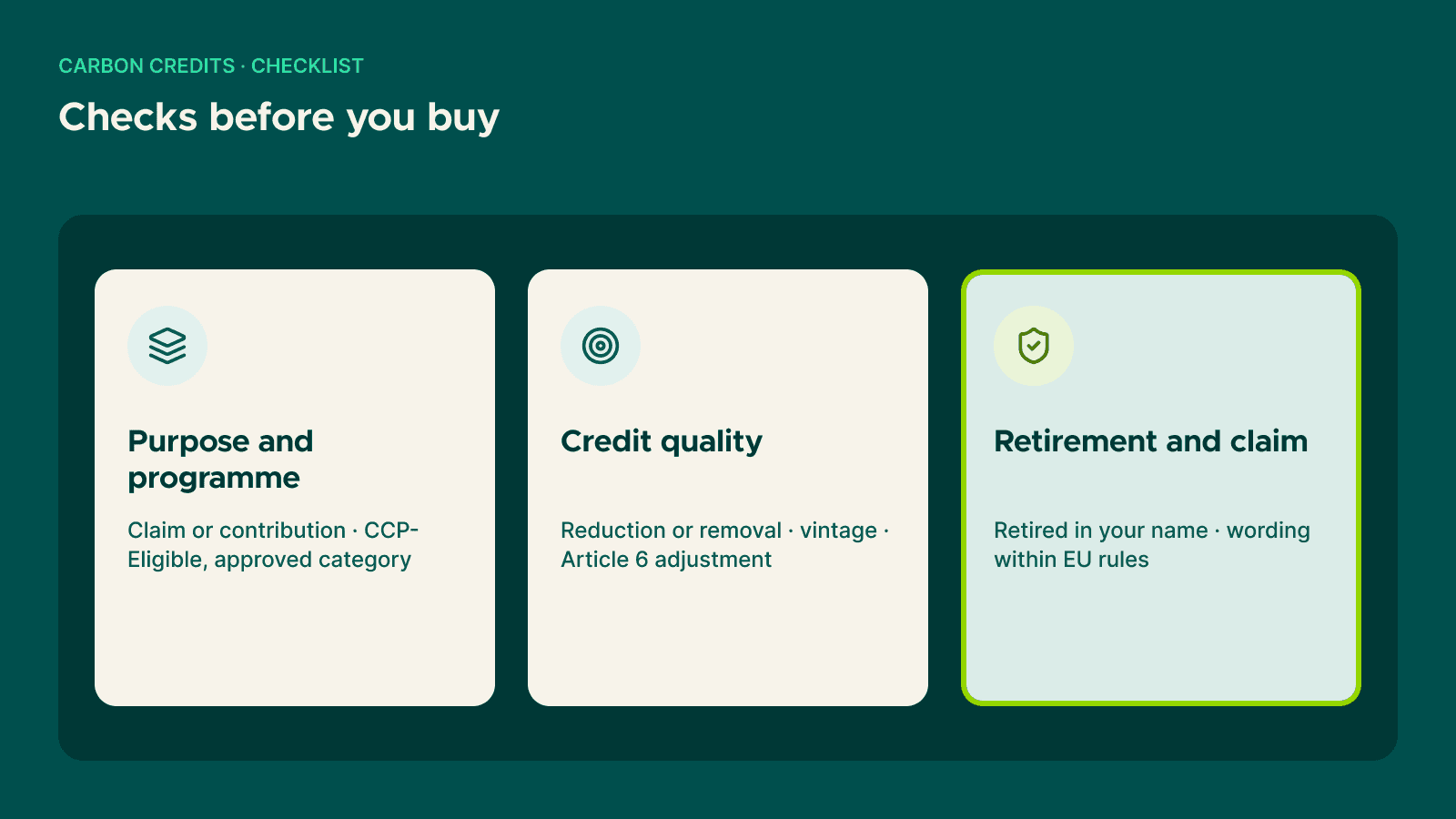
What should you check before buying carbon credits?

Six-item checklist for buying carbon credits, from purpose to claim wording
  1. Your purpose. Decide whether the credits support a claim, a contribution beyond your value chain, or neither. The answer sets the quality bar and the wording.
  2. Programme and label. Is the crediting programme CCP-Eligible, and does the credit come from an ICVCM-approved category?
  3. Credit type and vintage. Reduction or removal, which year the tonnes were achieved, and, for removals, how long the carbon is stored.
  4. Corresponding adjustment. Has the host country authorised the credits under Article 6, or will the tonnes also count toward its own target?
  5. Registry evidence. Serial numbers and a retirement record in your company's name, for the reporting period of the claim.
  6. Claim wording. For EU consumer-facing claims, no product-level "neutral" or "reduced" claim based on offsetting; for corporate claims, follow the VCMI structure and state what the credits did and did not do.

What we see in practice

Buyers who start from the claim, and then choose the credit, avoid buying credits they cannot use. The questions above are the same ones we answer as project developers: our own projects have avoided 250,000+ tonnes of CO₂ (Safe Water Uganda under Gold Standard and Re&Up under Verra) and 40,000 tonnes of plastic under Verra's Plastic Waste Reduction Standard (PWRS). These are past results, not a commitment for future projects. See how we develop emission reduction projects and plastic credit projects, and our glossary for key terms.

Frequently asked questions

What does carbon credit mean?

A carbon credit is a certificate that represents one tonne of CO₂ equivalent reduced, avoided or removed by a project, verified by an independent body and issued with a serial number in a registry. It is used for a claim only once, by retiring it.

Is the voluntary carbon market regulated?

Not like a compliance market. Integrity is set by crediting programmes and by initiatives such as ICVCM and VCMI, while claims made to consumers fall under consumer protection law, including the EU's Directive 2024/825 from 27 September 2026.

Can my company still call itself carbon neutral in the EU?

The 2024/825 ban targets product-level claims based on offsetting. According to the European Commission's FAQ, company-level offsetting claims are not covered by that specific ban, but they remain subject to the directive's other rules, and the FAQ treats a generic "carbon neutral" claim as banned unless the trader can show recognised excellent environmental performance. The wording and evidence need legal review in each market.

Do carbon credits count toward an SBTi target?

No. Credits are not counted as emission reductions toward SBTi near-term targets. Under the Net-Zero Standard V2.0, carbon removals are used to neutralise residual emissions at the net-zero year, and voluntary contributions beyond the value chain are reported separately.

What is a corresponding adjustment?

It is an accounting entry under Article 6 of the Paris Agreement: when a country authorises the transfer of mitigation outcomes, it adjusts its own emissions balance so that the same tonne is not counted toward two countries' targets.

Book a carbon credit claims review: we check your planned claim and credit portfolio against ICVCM, VCMI, SBTi and Directive 2024/825 and return a list of usable credits and claim wording.

Sources

  • ICVCM, Core Carbon Principles – https://icvcm.org/core-carbon-principles/ (checked 2026-11-10)
  • VCMI, Claims Code of Practice v3.0 (April 2025) and FAQs – https://vcmintegrity.org/wp-content/uploads/2025/04/VCMI-Claims-Code-of-Practice-April-2025-Version-3.0.pdf ; https://vcmintegrity.org/frequently-asked-questions/ (checked 2026-11-10)
  • UNFCCC, "UN carbon market approves first-ever issuance of credits under the Paris Agreement" – https://unfccc.int/news/un-carbon-market-approves-first-ever-issuance-of-credits-under-the-paris-agreement (checked 2026-11-10)
  • UNFCCC, Article 6.2 Reference Manual – https://unfccc.int/sites/default/files/resource/Article_6.2_Reference_Manual.pdf (checked 2026-11-10)
  • UNFCCC, Article 6.4 mechanism – https://unfccc.int/process-and-meetings/the-paris-agreement/article-64-mechanism (checked 2026-11-10)
  • European Commission, About the EU ETS – https://climate.ec.europa.eu/eu-action/carbon-markets/about-eu-ets_en (checked 2026-11-10)
  • Directive (EU) 2024/825 – https://eur-lex.europa.eu/eli/dir/2024/825/oj/eng (checked 2026-11-10)
  • European Commission, FAQ on the Empowering Consumers for the Green Transition Directive – https://commission.europa.eu/document/download/3c257883-bb2a-4dd9-a6dc-501d587bb34f_en?filename=faq-empowerting-consumers-gtd.pdf (checked 2026-11-10)
  • SBTi Corporate Near-Term Criteria V5.3.1 – https://files.sciencebasedtargets.org/production/files/SBTi-criteria.pdf ; Corporate Net-Zero Standard V2.0 Criteria – https://files.sciencebasedtargets.org/production/files/Corporate-Net-Zero-Standard-V2-Criteria.pdf (checked 2026-11-10)

Get in touch

Let's talk about what you're working on.

If something you've read here connects to a live project, a reporting deadline, or a decision you're weighing — we're happy to have a useful conversation.

Contact us

Related reading

CDP disclosure explained: scoring levels and the 2027 scoring deadline in the week of 26 July

Sustainability Reporting

7 Min10 Nov 26

CDP disclosure explained: how scores work and the 2027 timeline

Read
EU greenwashing rules: Directive (EU) 2024/825 applies from 27 September 2026

Regulation & Compliance

7 Min10 Nov 26

EU greenwashing rules in 2026: what changed for green claims

Read
EU ETS explainer cover with a globe icon and the 62% by 2030 emissions cap target

Regulation & Compliance

7 Min10 Nov 26

EU ETS explained: what it means for non-EU and Turkish exporters

Read

Get in Touch With Our Experts

Lets talk about your sustainability goals.