Blog
Publish: 10 Nov 26Reading Time: 8 Min
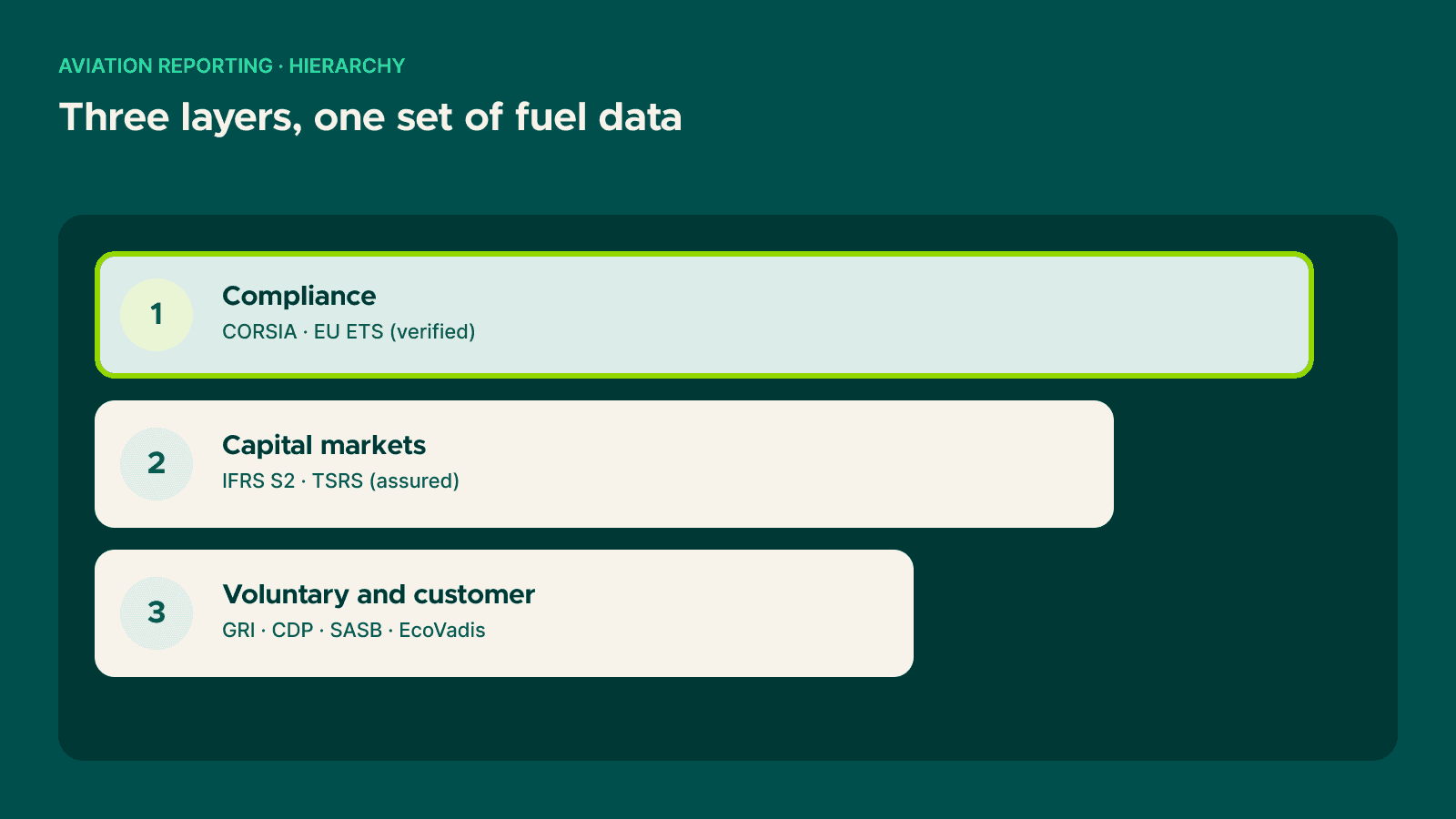
An airline typically reports under three layers at once: carbon compliance schemes (ICAO's CORSIA for international flights and, for flights in Europe, the EU Emissions Trading System), capital-market disclosure (IFRS S2 or a national adoption such as TSRS in Türkiye), and voluntary or customer-driven frameworks (GRI, CDP, the SASB Airlines Standard and, for MRO and ground-service suppliers, EcoVadis). The compliance schemes require verification by accredited verifiers; TSRS reports in scope need assurance by KGK-authorised auditors; the voluntary frameworks set their own rules. The practical challenge is that the same fuel and emissions data feeds all of them.
| Framework | Who requires it | What it asks | Assurance |
|---|---|---|---|
| CORSIA (ICAO) | States implementing ICAO Annex 16, Volume IV, for operators of international flights | CO₂ monitoring, reporting and verification (MRV) for operators above 10,000 t CO₂ a year from international flights; offsetting obligations by phase | Verification by an accredited verification body |
| EU ETS aviation | EU law, for operators of flights in scope (currently limited to flights within the EEA) | Monitoring plan, annual emissions report, surrender of allowances; non-CO₂ monitoring from 2025 | Verification by accredited verifiers under Implementing Regulation (EU) 2018/2067 |
| IFRS S2 | Jurisdictions that adopt ISSB Standards | Climate governance, strategy, scenario analysis, Scope 1–3 emissions, targets, industry metrics | Set by each jurisdiction |
| TSRS 1 and 2 (Türkiye) | KGK, for in-scope entities | IFRS S1/S2-based sustainability and climate disclosures | Assurance by audit firms authorised by KGK |
| GRI Standards | Voluntary | Impact reporting, including emissions (GRI 305) and material topics | Voluntary; external assurance optional |
| CDP | Investor and customer requests | Annual questionnaire responses on climate change and water security | Voluntary third-party verification |
| SASB Airlines Standard | Voluntary; a source of industry guidance under IFRS S1 | Industry metrics such as Scope 1 emissions, fuel consumed and the share of alternative and sustainable fuel | Voluntary |
| EcoVadis | Corporate customers' procurement teams | Supplier rating across environment, labour and human rights, ethics and sustainable procurement | Rated by EcoVadis on submitted documents |
CORSIA. Since 1 January 2019, an aeroplane operator whose international flights emit more than 10,000 tonnes of CO₂ a year must monitor, report and verify those emissions. The operator follows an emissions monitoring plan approved by its state, has its annual emissions report checked by an accredited verification body, and both reports go to the state, which passes data to ICAO. Offsetting runs in phases: a pilot phase (2021–2023), a first phase (2024–2026) for volunteering states, and a second phase (2027–2035) that applies to all ICAO contracting states, with exemptions. From 2024 the baseline is 85% of 2019 CO₂ emissions.
EU ETS. The EU has temporarily limited aviation coverage to flights within the European Economic Area, a restriction extended until the start of 2027. Free allocation for aviation was cut by 25% in 2024 and 50% in 2025, with full auctioning by 2026. A monitoring, reporting and verification system for non-CO₂ effects applies from 1 January 2025. On 17 July 2026, the European Commission proposed a targeted revision of the EU ETS that also covers aviation. It is a proposal, so check its progress before planning for changes in scope.
For a Turkish carrier, CORSIA is the main compliance scheme for international flights; EU ETS obligations depend on whether you operate flights within its scope.
The same tonne of SAF is evidenced differently in each scheme, which is where reporting errors start:
Keep one fuel ledger, with batch, supplier, sustainability evidence and the scheme each tonne is claimed under, so that one claim cannot appear twice.
IFRS S2 and TSRS are the mandatory layer for listed and large companies where adopted. In Türkiye, KGK's TSRS thresholds for size-based scope are TRY 1 billion total assets, TRY 2 billion annual net sales and 500 employees, for periods beginning on or after 1 January 2025. IFRS S2 asks for scenario analysis and Scope 3, and its industry-based guidance includes airline-specific metrics. See GRI vs IFRS S1/S2 for how the two sets relate.
GRI is the framework for impact reporting: it covers effects on people and the environment, not only financial risk, so it usually carries the annual sustainability report.
CDP turns the same data into a scored questionnaire that investors and large customers read. For an airline, that means fuel, SAF, CORSIA and water data, as in the Turkish Airlines case below.
SASB Airlines gives the industry metrics. The ISSB now maintains the SASB Standards and is enhancing them in stages.
Two standards set the rules for lifecycle carbon in aviation reporting:
MROs, caterers and ground handlers sit in an airline's Scope 3 and can receive supplier assessments from their own customers. An EcoVadis rating is one common format; EcoVadis vs CDP explains how the two differ.
How assurance works under the ISSB Standards is set out in how does assurance work for IFRS S1 and S2.
Aviation teams rarely lack data; they hold it in separate places for separate schemes. For Turkish Airlines, one CDP Climate Change and Water Security response for the 2026 cycle was built on SAF, CORSIA and ground-operations water data, with every answer authored by the airline. Turkish Technic, the MRO subsidiary, ran its EcoVadis gap analysis and GRI-indexed sustainability report from one shared data foundation. Pegasus Airlines built a double materiality assessment aligned with GRI and CSRD/ESRS from stakeholder surveys. For Çelebi, a second-party opinion assessed a sustainability-linked loan framework against the Sustainability-Linked Loan Principles for IFC-linked financing. More on the sector: aviation.
There is no official ranking, but the same set recurs in airline reporting. For the annual report: GRI and, where adopted, IFRS S2 or national versions such as TSRS. For ratings and investors: CDP and the SASB Airlines Standard. For compliance: CORSIA for international flights and the EU ETS for flights within the EEA.
No. CORSIA is ICAO's global offsetting scheme for international aviation, applied through states. The EU ETS is an EU cap-and-trade system in which operators surrender allowances; its aviation scope is currently limited to flights within the EEA.
CORSIA applies to aeroplane operators of international flights, not to maintenance providers as such. MROs are more likely to face customer requests, such as EcoVadis assessments and CDP supply chain requests, and TSRS if they meet KGK's scope criteria.
CORSIA and EU ETS emissions reports must be verified by accredited verifiers. TSRS reports in scope need assurance from KGK-authorised auditors. For other frameworks, assurance is voluntary but strengthens the response.
Record each SAF batch once, with its sustainability evidence and the scheme it is claimed under. Under CORSIA, eligible fuels must achieve at least a 10% life-cycle reduction against 89 gCO₂e/MJ, and claims must be verified.
IFRS S2 is accompanied by industry-based guidance, which includes an airlines volume with metrics such as Scope 1 emissions and fuel use, including the share of sustainable fuel.
Get one framework map for your airline or MRO: which CORSIA, EU ETS, TSRS, CDP and GRI datapoints come from the same source, and where assurance applies. Aviation sustainability services.
Get in touch
If something you've read here connects to a live project, a reporting deadline, or a decision you're weighing — we're happy to have a useful conversation.
Contact usLets talk about your sustainability goals.