Blog
Publish: 02 Sep 26Reading Time: 4 Min
EcoVadis and CDP both assess corporate sustainability, but for different audiences and purposes. EcoVadis is a supply chain due diligence tool used by procurement teams to qualify suppliers across four broad themes. CDP is primarily an investor-facing disclosure platform focused on climate, water, and forests data.
CDP is a disclosure platform through which companies report detailed environmental data — primarily on climate change, water security, and forests — for use by investors, financial institutions, and, increasingly, regulators and customers requesting climate-specific transparency. A CDP response is typically a detailed, sector-specific questionnaire focused on quantitative environmental performance: emissions inventories, climate risk exposure, water withdrawal data, and deforestation-linked commodity sourcing.
CDP scoring exists on its own letter-grade scale (from D to A), and disclosure is often driven by investor requests, stock exchange expectations, or customer-specific climate disclosure programs.
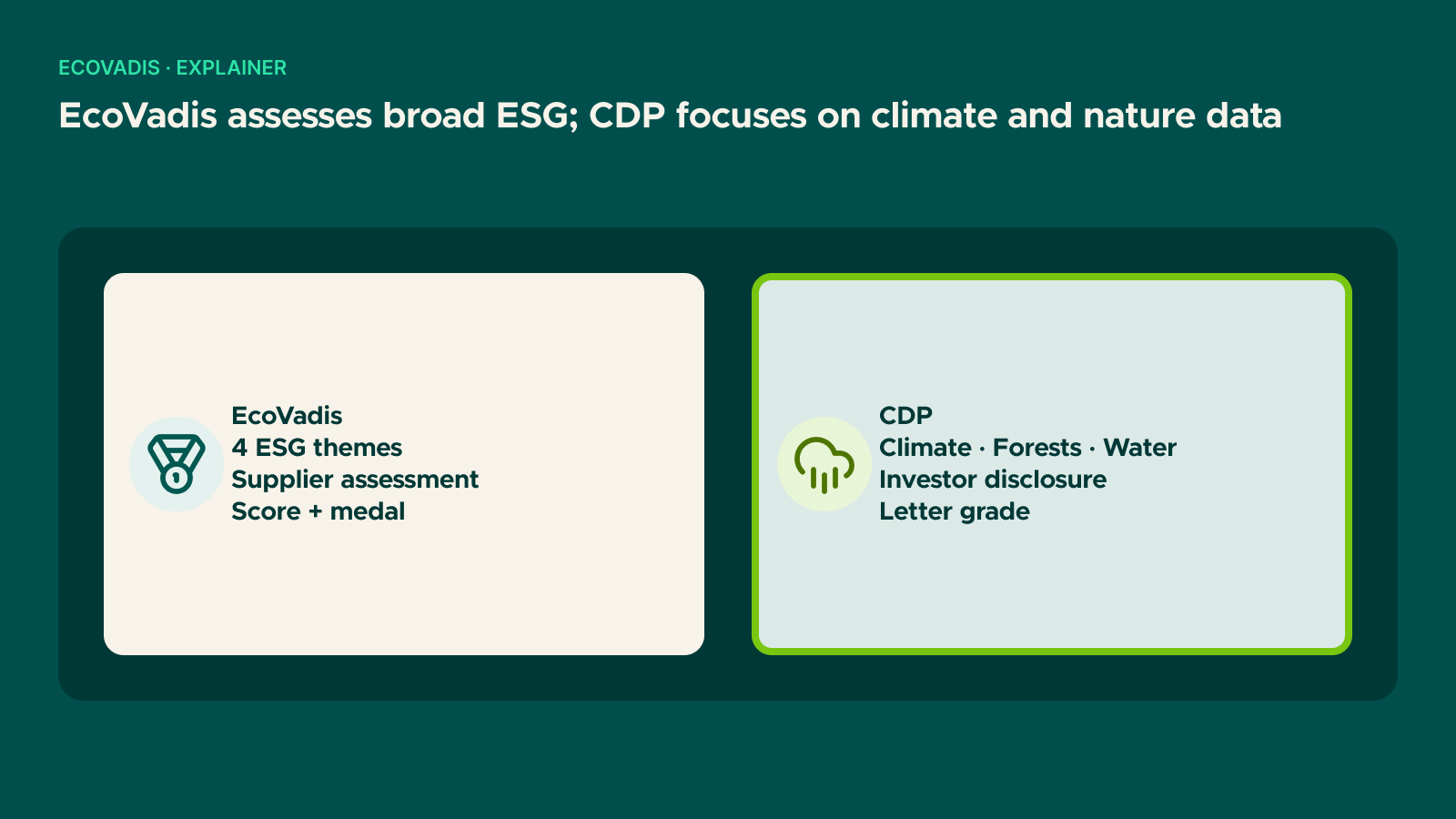
EcoVadis is a supply chain assessment tool. Rather than being driven primarily by investors, it is driven by procurement teams at large buying organizations who need a standardized way to evaluate supplier sustainability risk across an entire vendor base. EcoVadis assessments cover four themes — Environment, Labor & Human Rights, Ethics, and Sustainable Procurement — rather than focusing exclusively on climate and environmental metrics.
Often, yes. A company with institutional investors is likely to face CDP disclosure requests independent of any supply chain relationship, while the same company's largest customers may separately require an EcoVadis assessment as a condition of the commercial relationship. The two are not substitutes: a strong CDP climate score does not satisfy a buyer's EcoVadis requirement, and a strong EcoVadis score does not satisfy an investor's CDP request. See EcoVadis vs GRI: Which One Do You Need for Supplier Assessment? for how a third framework fits into this picture.
Yes, substantially. Emissions data, energy consumption figures, and water usage records prepared for a CDP submission frequently serve as supporting evidence for EcoVadis's Environment theme, and vice versa. Companies preparing for both should build one shared data collection process rather than treating the two as entirely separate exercises — this is one of the more common efficiency gains ESG teams miss when the two processes are owned by different functions.
This depends on what is actually being requested. If an institutional investor, lender, or stock exchange is asking for climate disclosure, that points to CDP. If a customer's procurement team has flagged EcoVadis as a supplier requirement, that response is specific to EcoVadis and cannot be satisfied by a CDP score alone. Many large companies end up maintaining both in parallel rather than choosing one over the other.
Semtrio Note: Semtrio holds CDP Accredited Solutions Provider status alongside EcoVadis Accredited Consulting Partner status and its own Platinum rating, giving the firm direct, practitioner-level fluency in both frameworks' distinct evidence requirements.
If your organization is managing CDP and EcoVadis requests as separate, disconnected processes, Semtrio's team can help design a shared evidence base that serves both without duplicating data collection. Talk to Semtrio about coordinating your CDP and EcoVadis workstreams.
No. They serve different audiences and different requesters — a strong EcoVadis score does not satisfy a CDP request from an investor, and vice versa.
Not directly, but the underlying data — emissions figures, energy and water records — can be reused as supporting evidence for EcoVadis's Environment theme.
Institutional investors, financial institutions, and increasingly stock exchanges or large customers with their own climate disclosure commitments.
It is less common for smaller suppliers, but companies in sectors like automotive or financial services with complex supply chains sometimes face both requests depending on their customer base.
If you are managing both CDP and EcoVadis requirements, talk to Semtrio's team about building one coordinated evidence process.
Get in touch
If something you've read here connects to a live project, a reporting deadline, or a decision you're weighing — we're happy to have a useful conversation.
Contact us
Regulation & Compliance
Regulation & Compliance
Regulation & Compliance
Lets talk about your sustainability goals.