Blog
Publish: 02 Sep 26Reading Time: 4 Min
GRI and EcoVadis serve different purposes and are not interchangeable. GRI is a reporting framework a company uses to structure its own sustainability report. EcoVadis is an externally conducted rating system that scores a company's sustainability performance based on evidence, typically for supplier qualification purposes.
The Global Reporting Initiative (GRI) provides a comprehensive set of standards that companies use to structure and disclose their own sustainability reporting. A company using GRI selects relevant standards and disclosures, gathers its own data, and publishes a report describing its performance across topics it determines to be material. The output of a GRI-aligned process is a document: the company's own sustainability report, written and published by the company itself.
GRI reporting is self-directed. The company controls what is disclosed, how it is framed, and when it is published, within the bounds of the standards it claims to follow.
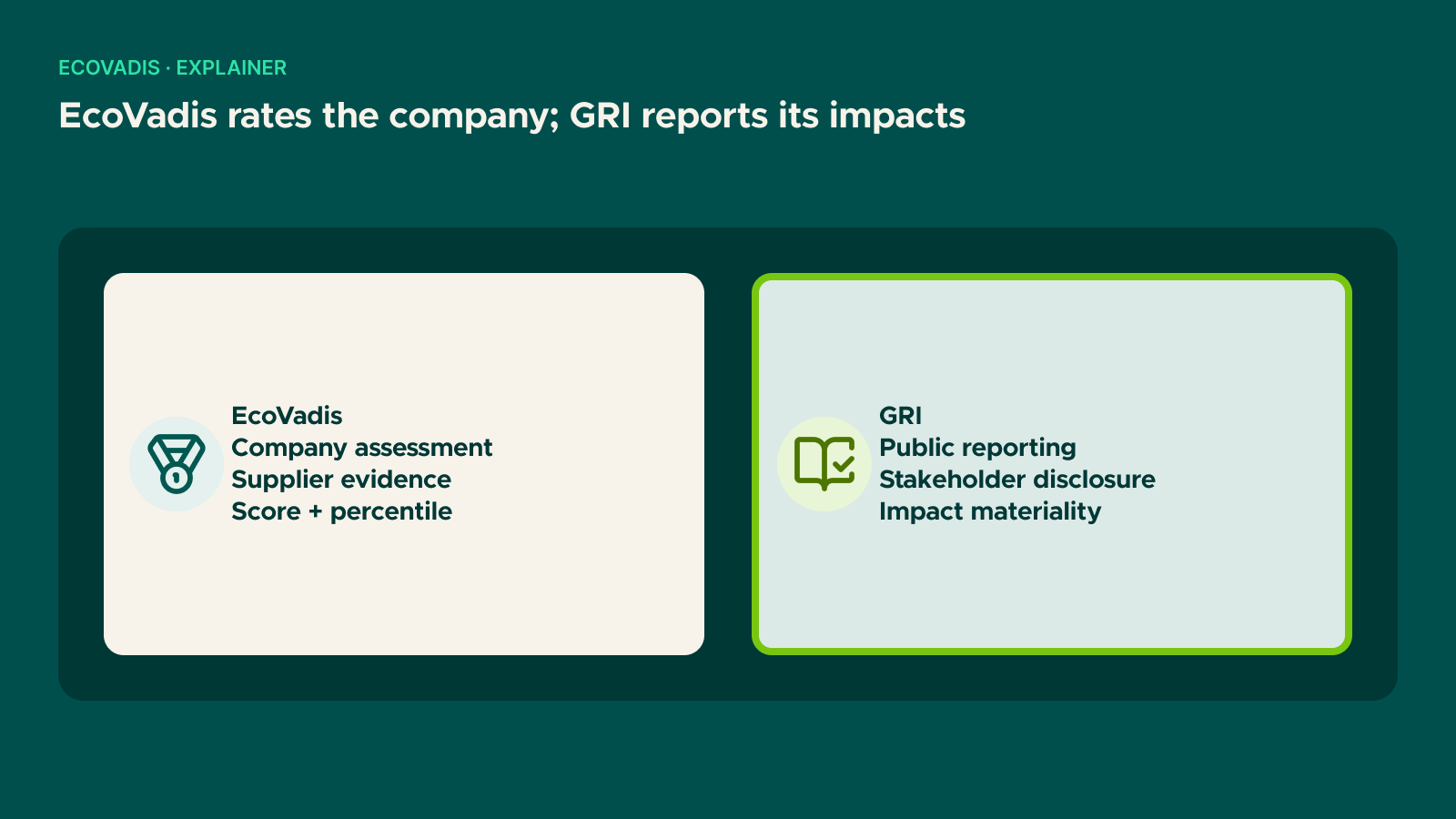
EcoVadis is different in a structural way: it is an externally conducted assessment. A company submits documentary evidence, and EcoVadis analysts independently review and score that evidence across four themes — Environment, Labor & Human Rights, Ethics, and Sustainable Procurement. The output is a scorecard: a numeric rating (0–100) and, where thresholds are met, a medal, produced by a third party rather than the company itself.
This distinction — self-reported document versus externally verified score — is the core difference buyers care about. A GRI report tells a reader what a company says about itself. An EcoVadis score reflects what an independent analyst concluded after reviewing evidence.
Yes, and this is one of the more useful relationships between the two. A well-structured GRI report often contains data, policies, and disclosures that can be repurposed as supporting evidence for an EcoVadis submission — GHG emissions data, labor policies, and governance disclosures frequently overlap across both. However, having a GRI report does not automatically produce a strong EcoVadis score, because EcoVadis analysts evaluate the underlying evidence directly rather than accepting a published report's conclusions. A general overview of what EcoVadis evaluates is available in What Is EcoVadis? An Introduction to Sustainability Ratings.
The determining factor is who is asking, and why:
Many large suppliers eventually need both: a GRI-aligned report for public disclosure, and a separate EcoVadis assessment to satisfy customer-side supply chain due diligence. Neither substitutes for the other in a formal sense, even though the underlying evidence can be shared between them.
Regulators are increasingly referencing EcoVadis specifically as a recognized tool for supply chain due diligence under frameworks like the CSDDD, which places direct requirements on how large companies monitor sustainability performance across their supply chains. GRI reporting, while valuable for public disclosure, is not the mechanism procurement teams use to screen and qualify suppliers under these due diligence obligations. More detail on this regulatory link is covered in Why EcoVadis Is Becoming More Important Under the CSDDD.
Semtrio Note: Semtrio is an EcoVadis Accredited Consulting Partner and holds Platinum status itself. Organizations Semtrio supports achieve an average first-year improvement of 25.6 points, reaching an average client score of 73.2 against a global first-year average of 48.4, with a 100% medal-earning rate.
If a customer has specifically requested an EcoVadis assessment, existing GRI-aligned reporting can shorten preparation time — but it needs to be translated into the evidence structure EcoVadis analysts expect. Semtrio's EcoVadis consulting team helps companies map existing disclosures to EcoVadis's four themes and close the gaps that a report alone does not cover.
No. EcoVadis analysts assess underlying evidence independently; a report's existence does not automatically translate into strong theme-level scores.
GRI itself is a voluntary framework, though some jurisdictions and stock exchange listing rules reference GRI-aligned disclosure requirements. EcoVadis, by contrast, is typically required by individual customers rather than by regulation directly, though regulatory frameworks increasingly reference it.
Yes — many suppliers, particularly smaller ones without public reporting obligations, complete only an EcoVadis assessment because that is what their customers require.
Timeframes vary widely by company size and existing documentation, but EcoVadis assessments are generally scoped to a defined review cycle set by EcoVadis, whereas GRI reporting timelines depend entirely on a company's own internal reporting process.
To determine which of the two your business actually needs to prioritize, talk to Semtrio's team.
Get in touch
If something you've read here connects to a live project, a reporting deadline, or a decision you're weighing — we're happy to have a useful conversation.
Contact us
Regulation & Compliance
Regulation & Compliance
Regulation & Compliance
Lets talk about your sustainability goals.