Blog
Publish: 02 Sep 26Reading Time: 5 Min
EcoVadis is a sustainability rating platform, founded in 2007, that evaluates companies on environmental, labor and human rights, ethics, and sustainable procurement performance using documentary evidence rather than self-declared claims. Large buyers in automotive, retail, financial services, and chemicals use EcoVadis scores to qualify, monitor, and compare suppliers on sustainability.
EcoVadis was founded in 2007 to solve a specific problem: large enterprises with thousands of suppliers had no standardized way to compare sustainability performance across companies, sectors, and geographies. Before platforms like EcoVadis existed, procurement teams relied on supplier questionnaires that varied in format, depth, and rigor from one buyer to the next. A supplier working with twenty different customers might face twenty different sustainability audits, each asking similar questions in a different structure.
EcoVadis addressed this by building a single, standardized methodology that any buying organization could reference. Instead of each customer running its own assessment, a supplier completes one EcoVadis assessment and shares the resulting scorecard with any number of business partners. This is what makes EcoVadis fundamentally a supply chain due diligence tool, distinct from disclosure frameworks aimed at investors or the public.
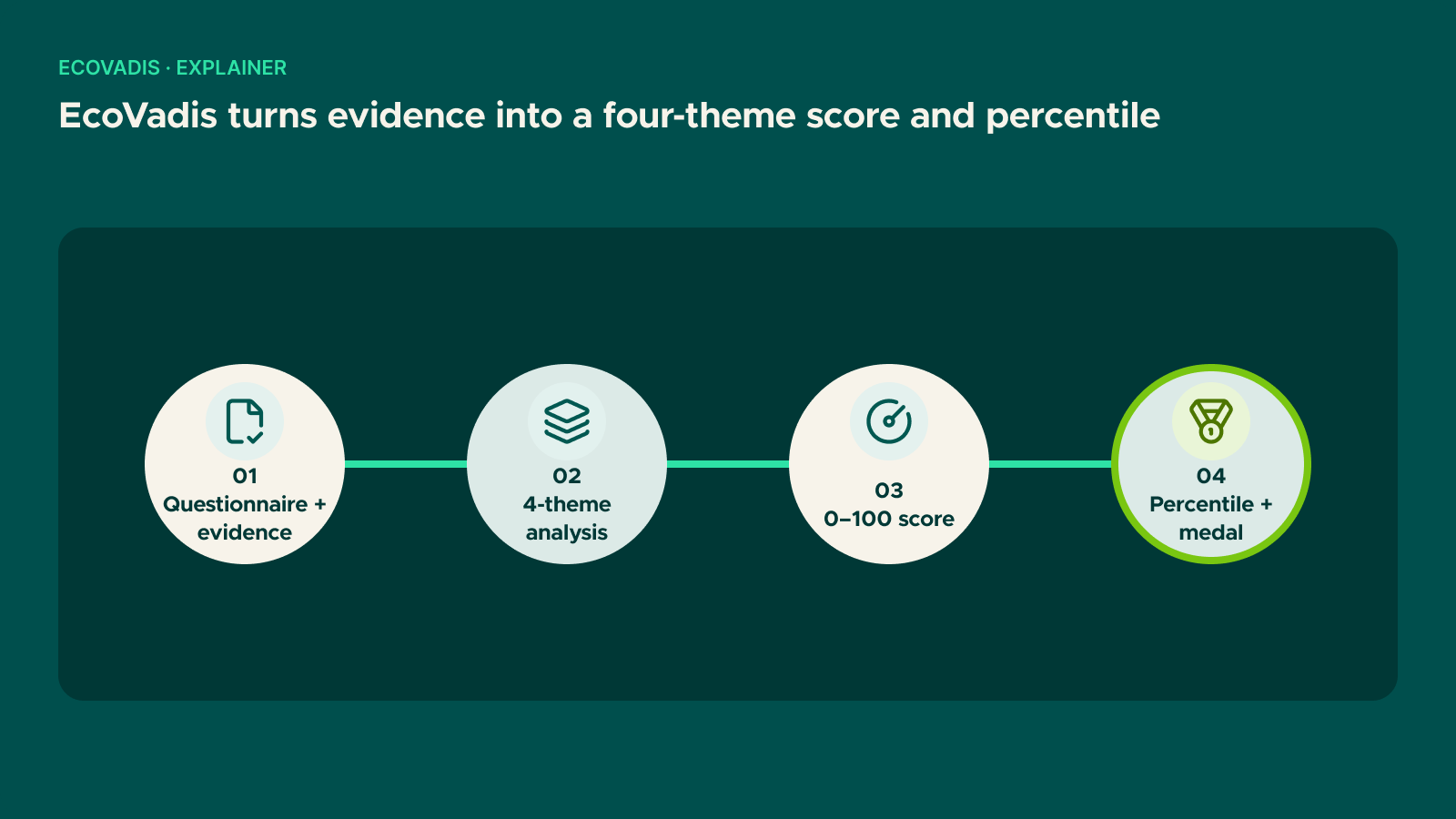
A company can publish a sustainability report, a corporate website statement, or a set of public commitments describing its environmental and social ambitions. None of this, on its own, is independently verified. EcoVadis operates differently: it collects documentary evidence — policies, certifications, reporting data, training records, audit results — and has that evidence reviewed by EcoVadis analysts rather than accepted at face value.
This evidence-based structure is precisely why large buyers treat EcoVadis scores as a reliable proxy for supplier risk. A supplier cannot earn a strong score by describing good intentions; it must show policies that exist, actions that were taken, and records that can be checked. This distinction matters for anyone preparing an assessment: the details of how EcoVadis actually scores each theme are covered in How Does the EcoVadis Scoring System Work?.
EcoVadis assesses four themes:
Each theme is scored from 0 to 100, and the weighting applied to each theme depends on a company's sector, size, and location, since risk exposure differs by industry. A chemicals manufacturer, for example, carries different environmental risk weighting than a professional services firm.
EcoVadis assessments are mandated or recommended by procurement teams at large global companies across automotive, FMCG, retail, financial services, chemicals, and aerospace. For these buyers, an EcoVadis score is a fast, standardized way to screen thousands of suppliers for sustainability risk without running individual audits on each one.
For the supplier being assessed, the score has become a commercial credential. Regulators are also increasingly referencing EcoVadis as a recognized tool for supply chain ESG due diligence, a trend explored further in Why EcoVadis Is Becoming More Important Under the CSDDD.
The commercial stakes attached to an EcoVadis score are direct. Gold and Platinum status unlocks preferred-supplier programs, green supply chain financing, and a competitive edge in ESG-scored tenders. Bronze and Silver ratings keep a supplier eligible for business but can still trigger audit requirements from the requesting organization. A missing medal, or a score below 45, carries the risk of elimination from major customer supplier programs altogether — a real commercial consequence, not a reputational inconvenience.
This is why EcoVadis has moved from a compliance checkbox to a strategic priority for ESG managers, procurement leaders, and increasingly, CFOs and boards evaluating revenue risk tied to supply chain relationships.
Semtrio Note: Semtrio is an EcoVadis Accredited Consulting Partner and itself holds EcoVadis Platinum status. Organizations Semtrio supports achieve an average first-year improvement of 25.6 points — reaching an average client score of 73.2 versus a global first-year average of 48.4 — with a 100% medal-earning rate. Returning clients see an average additional improvement of 10.5 points.
Understanding what EcoVadis measures is the first step. Turning that understanding into a strong, evidence-backed score is a separate discipline — one that depends on how documentation is prepared, organized, and presented to EcoVadis analysts. Semtrio's team, as an Accredited Consulting Partner, works directly with ESG managers and procurement teams to close this gap. Explore Semtrio's EcoVadis consulting services to see how a structured assessment approach compares to a first-time, unsupported submission.
No. EcoVadis issues a rating with a numeric score and, where thresholds are met, a medal or badge. It is not a pass/fail certification and does not expire in the way a management-system certification does — assessments are typically renewed on a recurring cycle set by the requesting buyer.
EcoVadis itself does not mandate participation. However, individual buying organizations — particularly in automotive, retail, and financial services — increasingly require suppliers to complete an EcoVadis assessment as a condition of doing business.
Timeframes vary by company size and document readiness, but most first-time assessments require several weeks of internal document gathering before submission, followed by an EcoVadis analyst review period.
No. EcoVadis is a supply chain rating tool, not a public disclosure framework. Companies with reporting obligations under frameworks like GRI still need those reports separately; the difference is explained in EcoVadis vs GRI: Which One Do You Need for Supplier Assessment?
If your organization has been asked to complete an EcoVadis assessment, or wants to understand where it currently stands, talk to Semtrio's team about a readiness review.
Get in touch
If something you've read here connects to a live project, a reporting deadline, or a decision you're weighing — we're happy to have a useful conversation.
Contact us
Regulation & Compliance
Regulation & Compliance
Regulation & Compliance
Lets talk about your sustainability goals.