Blog
Publish: 02 Sep 26Reading Time: 6 Min
EcoVadis is becoming more important under the CSDDD because regulators are increasingly referencing it as a recognized tool for supply chain ESG due diligence, giving large buyers a standardized way to demonstrate compliance with due diligence obligations across their supplier base — though the CSDDD itself was substantially narrowed in scope in early 2026, which changes exactly which companies feel this pressure.
The Corporate Sustainability Due Diligence Directive (CSDDD) places due diligence obligations on large companies regarding human rights and environmental impacts across their own operations and their supply chains. In practice, this means affected companies need systematic processes to identify, assess, and address sustainability risk among their suppliers — not just within their own operations. This creates direct pressure on procurement teams to have a defensible, standardized method for evaluating supplier risk at scale.
The EU Council approved the "Omnibus I" simplification package on 24 February 2026; the revised directive was published in the Official Journal on 26 February 2026 and entered into force on 18 March 2026. This package substantially narrowed CSDDD's scope compared to the directive's original 2024 form. The current thresholds are:
These thresholds are considerably higher than the directive's original scope (roughly 1,000 employees / €450 million), reflecting an explicit EU policy goal of boosting competitiveness and reducing the indirect compliance burden the directive would otherwise place on smaller companies through their supply chains.
The timeline was also pushed back: Member States now have until 26 July 2027 to transpose the directive into national law, and the first application phase — covering only the largest in-scope companies — has been delayed to 26 July 2028. As with several other sustainability regulations updated around the same period, the earlier general assumption that CSDDD's scope would only expand over time did not hold; the actual 2026 development moved in the opposite direction, narrowing scope and extending timelines.
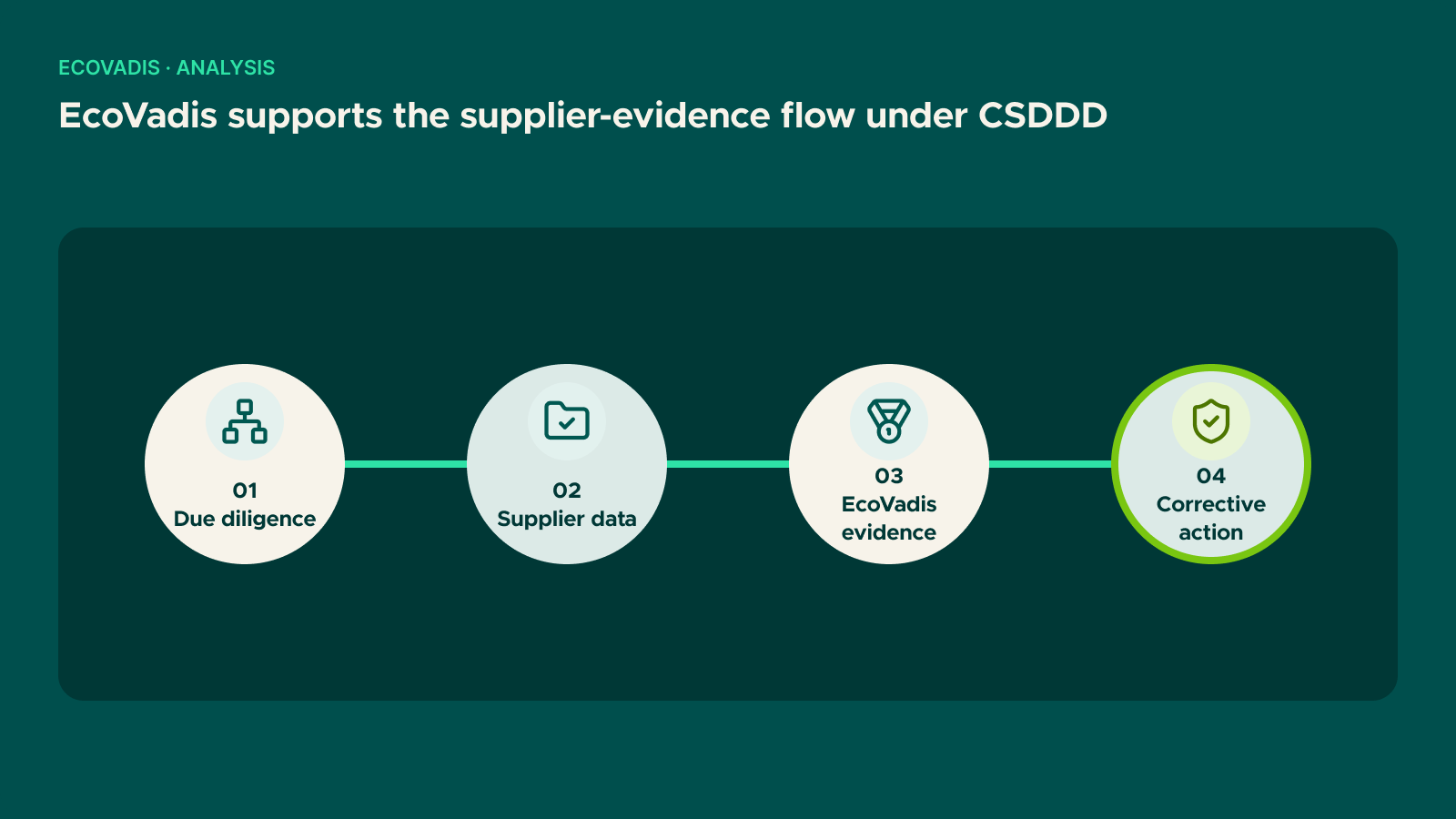
EcoVadis already solves the exact operational problem the CSDDD creates: it provides a standardized, evidence-based, third-party-reviewed score that a buying organization can apply consistently across thousands of suppliers, rather than building a bespoke due diligence process from scratch for each one. Regulators are increasingly referencing EcoVadis as a recognized tool precisely because it already does at scale what due diligence obligations require companies to demonstrate: documented evidence of supplier sustainability performance across environmental, labor, and ethics dimensions. This reinforces EcoVadis's core identity as a supply chain due diligence tool, distinct from investor-facing frameworks like CDP, as covered in EcoVadis vs CDP: What's the Difference?
For a supplier, this regulatory link raises the stakes attached to an EcoVadis score beyond commercial preference — though the narrowed scope means this pressure is now concentrated around a smaller group of very large buyers (5,000+ employees, €1.5 billion+ turnover) and their direct supply chains, rather than a broader population of mid-sized companies. Where an EcoVadis assessment was previously a competitive differentiator — helping win preferred-supplier status or better financing terms — it is increasingly becoming a baseline expectation tied to a buyer's own regulatory compliance obligations, for companies supplying into that specific, large-enterprise tier.
This shifts EcoVadis from a "nice to have" credential toward something closer to a market-access requirement in sectors already heavily reliant on it — automotive, retail, financial services, chemicals, and aerospace among them, as outlined in What Is EcoVadis? An Introduction to Sustainability Ratings.
The existing commercial consequences of EcoVadis performance — Gold and Platinum unlocking preferred-supplier programs and green financing, Bronze and Silver still triggering audit requirements, and no medal or a sub-45 score risking elimination from supplier programs — become sharper under a regulatory backdrop, at least for suppliers to the largest CSDDD-scoped buyers. A buyer under CSDDD due diligence obligations has an added compliance incentive, not just a commercial preference, to consolidate its supply chain around suppliers with demonstrable, verified sustainability evidence. This raises the practical cost of scoring low, a topic explored in Common Reasons Companies Score Low on EcoVadis.
Because regulatory reliance on EcoVadis reinforces existing customer-driven pressure rather than replacing it, the preparation approach does not fundamentally change — but the urgency now depends heavily on where a company sits relative to the narrowed CSDDD scope and its delayed 2028 first-application date. Companies supplying into the largest global enterprises still have a clear reason, tied to those buyers' compliance obligations, to prioritize a strong, well-evidenced score rather than a minimal, one-time submission. A structured improvement plan across all four themes, detailed in How to Improve Your EcoVadis Score: A Practical Guide, is the practical response to this shift.
Semtrio Note: Semtrio is an EcoVadis Accredited Consulting Partner and itself holds Platinum status. Organizations Semtrio supports achieve an average first-year improvement of 25.6 points, reaching an average client score of 73.2 against a global first-year average of 48.4, with a 100% medal-earning rate — positioning them well ahead of the baseline buyers are increasingly expecting under due diligence-driven procurement requirements.
As regulatory frameworks increasingly point to EcoVadis as a recognized due diligence tool, the cost of an unprepared or low-scoring assessment grows for companies in scope of these largest-buyer relationships. Semtrio's EcoVadis consulting team helps companies build the evidence base needed not just to pass a single assessment, but to hold up as a credible, ongoing part of a buyer's due diligence documentation.
No. The CSDDD does not name EcoVadis as a mandatory tool; rather, regulators and large buyers increasingly reference it as a recognized, practical means of demonstrating supply chain due diligence.
Following the Omnibus I simplification package (in force since 18 March 2026), the CSDDD applies to EU companies with more than 5,000 employees and more than €1.5 billion in net turnover, and to non-EU companies with more than €1.5 billion in EU-generated turnover (no employee threshold for non-EU companies). The first application phase, for the largest in-scope companies, is delayed to 26 July 2028.
No. EcoVadis is one recognized input supporting supply chain due diligence documentation, not a complete compliance program on its own.
Yes, indirectly, though less urgently than under the directive's original 2024 scope — suppliers to the very large companies that remain in scope after the 2026 narrowing are still increasingly asked to provide EcoVadis or similar evidence as part of their customer's own due diligence obligations, even where the supplier itself is not directly regulated.
To understand how CSDDD-driven due diligence expectations affect your current EcoVadis position, talk to Semtrio's team.
Get in touch
If something you've read here connects to a live project, a reporting deadline, or a decision you're weighing — we're happy to have a useful conversation.
Contact us
Regulation & Compliance
Regulation & Compliance
Regulation & Compliance
Lets talk about your sustainability goals.