Blog
Publish: 02 Sep 26Reading Time: 4 Min
GRI and IFRS S1/S2 are not competing versions of the same thing — they answer different questions for different audiences. GRI is a voluntary, stakeholder-inclusive reporting framework covering broad economic, environmental, and social impact. IFRS S1/S2 are investor-focused disclosure standards, limited to financially material sustainability information, and increasingly mandatory in the jurisdictions that adopt them.
Confusing the two, or assuming one supersedes the other, is a common and costly mistake for reporting teams building a multi-year disclosure roadmap.
IFRS S1 and S2 are the sustainability disclosure standards issued by the International Sustainability Standards Board (ISSB), sitting under the IFRS Foundation — the same body responsible for international financial accounting standards. IFRS S1 sets general requirements for disclosing sustainability-related risks and opportunities; IFRS S2 focuses specifically on climate-related disclosures. Their audience is explicitly investors and capital providers, and their materiality lens is financial materiality: information is disclosed if it is reasonably expected to affect the company's cash flows, cost of capital, or access to finance.
Because IFRS S1/S2 is issued by a body tied to financial accounting standard-setting, jurisdictions that choose to adopt it typically do so through a legal or regulatory mandate — meaning that once adopted locally, it is not optional for in-scope companies in the way GRI is.
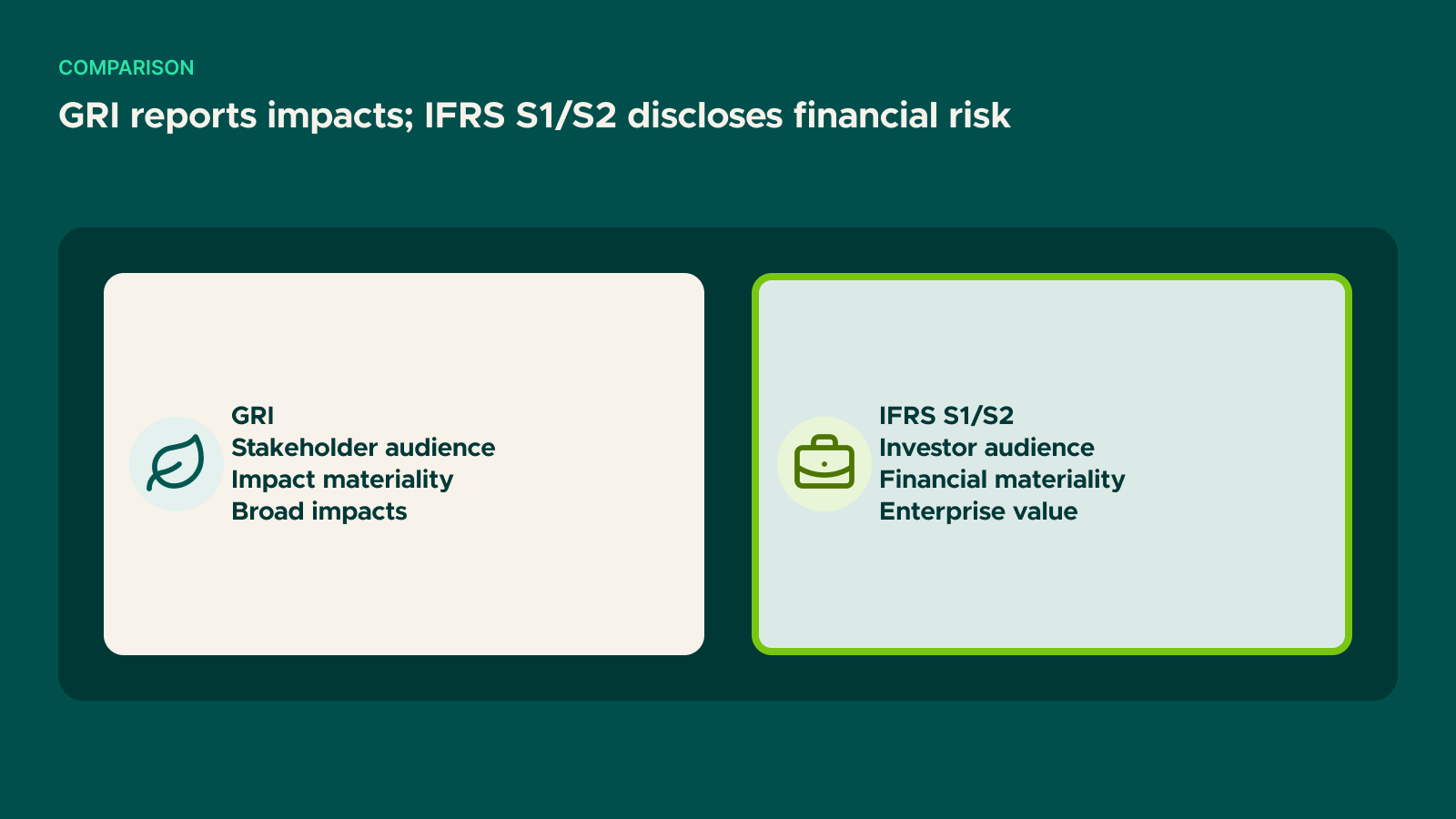
GRI, as covered in What Is GRI? An Introduction to the Global Reporting Initiative, takes a stakeholder-inclusive approach: it covers the organization's impact on the economy, environment, and people, regardless of whether that impact is financially material to the company itself. This is often described as "impact materiality" rather than "financial materiality." GRI is voluntary — organizations use it because stakeholders including employees, communities, customers, and civil society expect transparency, not because a regulator requires this specific standard in most jurisdictions.
Yes, and many large companies do exactly this. IFRS S1/S2 satisfies regulatory and investor-facing compliance requirements where adopted; GRI provides the broader stakeholder narrative that a purely financially-material disclosure set does not capture — supply-chain labor practices, community impact, biodiversity effects, and other topics that matter to non-investor stakeholders even when they are not decision-useful for capital allocation. Companies operating in jurisdictions that have adopted IFRS S1/S2 frequently continue publishing a GRI-referenced report specifically to maintain this wider stakeholder relationship.
IFRS S1/S2 and the EU's ESRS (under CSRD) are often discussed together because both are becoming mandatory disclosure regimes, but they are not identical — ESRS applies double materiality (both impact and financial materiality) rather than IFRS S1/S2's financial-materiality-only approach. See GRI vs ESRS/CSRD: Which Framework Should Your Company Use? for that comparison in full.
The honest answer is that this depends on jurisdiction, listing status, and stakeholder base rather than a universal ranking. A company listed in a jurisdiction that has adopted IFRS S1/S2 has a compliance obligation that GRI reporting does not substitute for. A company with a broad stakeholder base — supply-chain partners, NGOs, community relationships — has reasons to maintain GRI reporting regardless of what regulatory regime applies. Most large enterprises end up doing both, sequenced by which obligation is time-bound.
Semtrio Note: Semtrio has been a GRI Community Member since 2020 and supports clients in scoping GRI reporting alongside separate IFRS S1/S2 or other regulatory disclosure obligations, rather than treating the two as substitutes for one another.
If your organization is mapping out which combination of frameworks applies to its reporting obligations, our sustainability reporting team can help clarify where GRI fits alongside investor-facing disclosure requirements.
No. They serve different audiences and materiality definitions. A company adopting IFRS S1/S2 for regulatory compliance does not automatically satisfy the broader stakeholder reporting that GRI provides.
No — adoption depends on jurisdiction. Where a regulator has adopted IFRS S1/S2 into local requirements, it becomes mandatory for in-scope companies; elsewhere it remains a standard companies can choose to apply voluntarily.
GRI, founded in 1997 with guidance issued since 1999, predates the ISSB and IFRS S1/S2 by roughly two decades.
This depends entirely on whether the company falls within scope of an IFRS S1/S2 mandate in its operating jurisdiction. Where no mandate applies, a company can choose GRI alone, both, or neither — the decision should reflect stakeholder demand and any customer or investor requirements.
Get in touch
If something you've read here connects to a live project, a reporting deadline, or a decision you're weighing — we're happy to have a useful conversation.
Contact us
Regulation & Compliance

Regulation & Compliance
Regulation & Compliance
Lets talk about your sustainability goals.