Blog
Publish: 02 Sep 26Reading Time: 4 Min
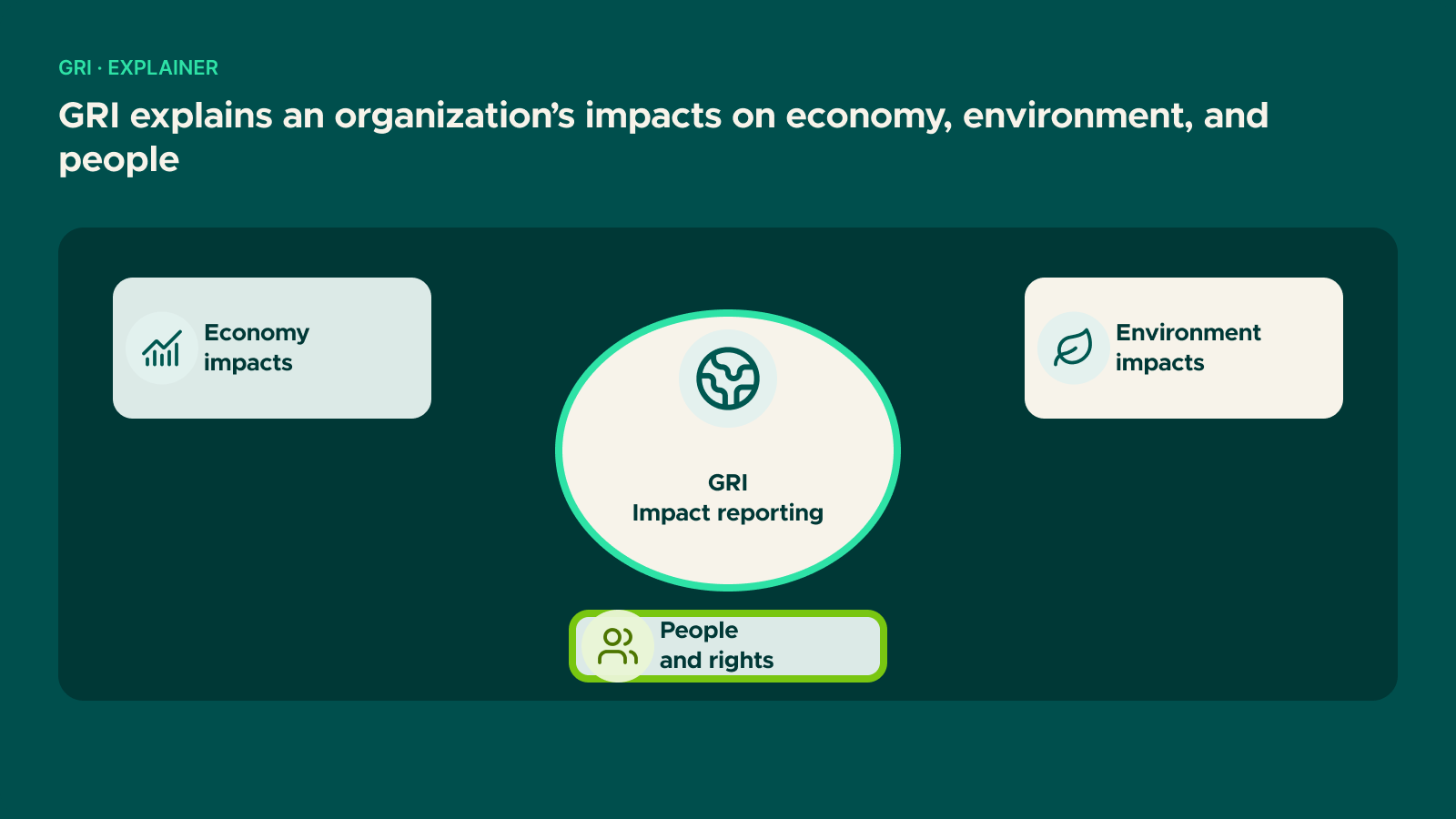
GRI stands for the Global Reporting Initiative, an independent, non-profit international organization that has provided sustainability reporting guidance since 1999. It is the most widely used sustainability reporting standard globally, giving organizations a common language to report their economic, environmental, and social impacts to stakeholders.
Unlike financial accounting standards, which have existed in codified form for over a century, sustainability reporting is a comparatively young discipline. GRI was founded in 1997 to close that gap — to give companies, investors, civil society, and regulators a consistent, comparable way to understand an organization's impact on the world beyond its balance sheet.
GRI develops and maintains the GRI Standards — a modular set of disclosures that organizations use to report on topics ranging from greenhouse gas emissions and water use to labor practices, anti-corruption, and community impact. The Standards are freely available, sector-informed, and updated through a multi-stakeholder process that includes business, investors, labor, and civil society representatives.
Reporting "in accordance with" or "with reference to" the GRI Standards means an organization has followed a defined, auditable process: it has identified its material topics, disclosed against the relevant Universal, Sector, and Topic Standards, and published a content index showing exactly where each disclosure appears in its report. (For a deeper look at how the Standards are organized, see our companion article, How Are the GRI Standards Structured?.)
Before GRI, sustainability reporting was fragmented — every company effectively invented its own format, making comparison across organizations, sectors, and years difficult. GRI's founding mission was to standardize this practice, in the same way financial accounting standards standardized corporate reporting decades earlier. Since 1999, GRI guidance has been adopted by tens of thousands of organizations worldwide, spanning listed multinationals, state-owned enterprises, and mid-sized private companies.
GRI's user base spans nearly every sector and geography. Large enterprises use it to report to institutional investors and regulators; mid-market companies use it to respond to customer and supply-chain due-diligence requests; and public-sector organizations use it for accountability to citizens and oversight bodies. Two audiences inside a reporting company typically engage with GRI directly: the CSO or CFO setting reporting strategy and risk exposure, and the ESG or sustainability reporting manager responsible for the operational workflow — data collection, materiality assessment, and content index preparation.
No. GRI is voluntary. This is one of the most important distinctions in the current reporting landscape, and one every board and reporting team should understand clearly. Frameworks such as the IFRS Sustainability Disclosure Standards (IFRS S1/S2) and the EU's Corporate Sustainability Reporting Directive (CSRD, applying the European Sustainability Reporting Standards, ESRS) are becoming legal requirements in the jurisdictions that adopt them. GRI is not a legal mandate in most jurisdictions — organizations choose it because it supports stakeholder trust, transparency, and international comparability, not because a regulator requires it.
That voluntary status does not make GRI a lesser standard. It is often the most comprehensive framework available for reporting broad-based impact — economic, environmental, and social — rather than only the subset of issues that are financially material to investors. We explore this distinction in detail in GRI vs IFRS S1/S2: What's the Difference Between Reporting and Disclosure Standards? and GRI vs ESRS/CSRD: Which Framework Should Your Company Use?
Most large organizations today do not choose a single framework — they layer several. A company might use IFRS S1/S2 or ESRS to meet regulatory or investor-facing obligations, CDP to respond to specific climate, water, or forest disclosure requests from institutional investors, and GRI to provide the broader stakeholder-facing narrative that ties the whole reporting program together. Because GRI's scope is the widest of the major frameworks, it frequently serves as the connective layer across a company's full disclosure program.
Semtrio Note: Semtrio has been a GRI Community Member since 2020, working directly with the standards described in this article across materiality assessment, content index preparation, and reporting process design engagements.
Getting started with GRI reporting is a structured process, not a single document. If your organization is evaluating whether GRI is the right foundation for its reporting program, our sustainability reporting team can walk through what a first cycle looks like in practice.
No. ESG reporting is a broad practice; GRI is one specific standard-setter within it, alongside others such as CDP, IFRS S1/S2, and ESRS. A company's "ESG report" may draw on GRI, another framework, or several in combination.
No. The GRI Standards are freely published and any organization can report against them. Membership (such as Semtrio's GRI Community Membership) reflects ongoing engagement with GRI's standard-setting process, not a licensing requirement to use the Standards.
GRI reviews and revises Standards on a rolling basis, including recent updates to Topic Standards on biodiversity, climate change, and energy. See Is Your Industry Covered by a GRI Sector Standard? (2026 Update) for the current state of these revisions.
GRI is used by organizations of every size and ownership structure, including private and state-owned entities. Since GRI reporting is voluntary and modular, an organization can scope its first report to the topics most relevant to its size and impact profile.
Get in touch
If something you've read here connects to a live project, a reporting deadline, or a decision you're weighing — we're happy to have a useful conversation.
Contact us
Regulation & Compliance
Regulation & Compliance
Regulation & Compliance
Lets talk about your sustainability goals.