Blog
Publish: 02 Sep 26Reading Time: 4 Min
Four GRI Sector Standards are currently published: GRI 11 (Oil and Gas), GRI 12 (Coal), GRI 13 (Agriculture, Aquaculture and Fishing), and GRI 14 (Mining). Standards for banking, insurance, and capital markets are under development, as is a new standard for textiles, apparel, and footwear. If your industry isn't on this list yet, your organization still reports under GRI using the Universal Standards and applicable Topic Standards.
This article gives reporting teams a current-state view of GRI's Sector Program, plus a summary of the 2025-2026 Topic Standard revisions that affect nearly every reporting organization regardless of sector.
Sector Standards exist to make materiality assessments more consistent and more rigorous within a given industry. Rather than every company in, say, mining independently deciding which impacts are likely material, GRI 14 identifies the impacts most commonly material for that sector based on extensive research and multi-stakeholder input, giving companies a documented starting point their own assessment must engage with. This is covered in more detail in How Are the GRI Standards Structured? and How to Conduct a GRI Materiality Assessment.
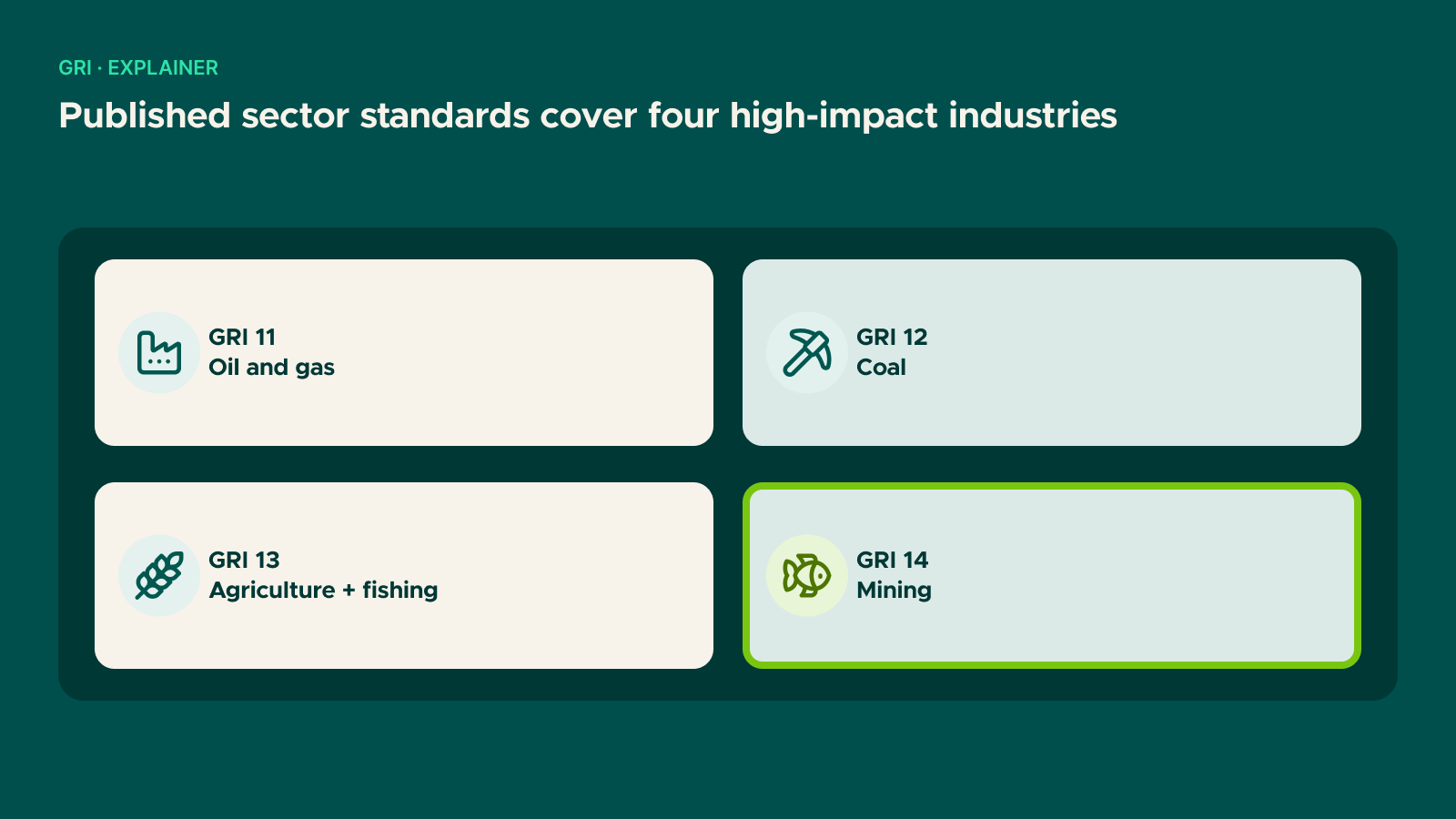
These four were prioritized first because GRI's Sector Program targets the highest-impact sectors before moving to the rest of its roadmap.
Exposure drafts for banking, capital markets, and insurance Sector Standards were open for public comment through May 2025, with the final standards expected to be approved in the second or third quarter of 2026. A separate standard for textiles, apparel, and footwear is expected to be finalized in the fourth quarter of 2026 (some sources point to an earlier second-quarter timeline — the exact date should be confirmed against GRI's current published Standards development schedule). This matters particularly for financial-sector organizations: once the banking and insurance standard is published, Sector Standard application will be expected for companies in scope.
GRI's stated ambition for its Sector Program is to eventually cover roughly 40 sectors, prioritizing those with the greatest economic, environmental, and social impact first. This means the current four published standards, plus those in development, represent an early stage of a longer rollout rather than a near-complete library.
An organization in a sector without a published Standard is not exempt from rigorous materiality assessment — it simply conducts that assessment using the Universal Standards' general requirements and the Topic Standards relevant to its identified material topics, without a sector-specific reference document to draw on. In practice, this often means drawing more heavily on peer benchmarking, industry-specific research, and stakeholder engagement to compensate for the absence of a GRI-published sector reference.
Independent of the Sector Program, GRI has revised several widely-used Topic Standards, and these changes affect reporting organizations across every sector:
Any organization currently preparing a content index (see How to Build a GRI Content Index: A Step-by-Step Guide) should confirm it is citing these current numbers and versions rather than the superseded legacy standards, since the renumbering is a genuine, substantive change rather than a cosmetic one.
Semtrio Note: As a GRI Community Member since 2020, Semtrio tracks Sector Program developments and Topic Standard revisions directly, and applies current versions in client materiality assessments and content index preparation.
If you are unsure whether a GRI Sector Standard applies to your industry, or which Topic Standard version your next report should cite, our sustainability reporting team can confirm current applicability before your reporting cycle begins.
Yes. You apply the Universal Standards and the Topic Standards relevant to your material topics; a Sector Standard is only required where one has been published for your industry.
Exposure drafts for banking, capital markets, and insurance were open for public comment through May 2025, with final standards expected in Q2 or Q3 2026. The textiles, apparel, and footwear standard is expected around Q4 2026, though timelines should be confirmed directly with GRI.
If your prior content index cites the legacy GRI 304, 305, or 302 numbers, you should confirm whether the current version (GRI 101, 102, or 103 respectively) now applies to your next reporting cycle.
GRI's Sector Program targets roughly 40 sectors over time, prioritized by impact, with four standards published to date and several more in active development.
Get in touch
If something you've read here connects to a live project, a reporting deadline, or a decision you're weighing — we're happy to have a useful conversation.
Contact us
Regulation & Compliance

Regulation & Compliance
Regulation & Compliance
Lets talk about your sustainability goals.