Blog
Publish: 02 Sep 26Reading Time: 4 Min
A GRI content index is a structured table mapping every disclosure an organization reports against its relevant GRI Standard, disclosure number, and the exact location in the report (or a stated omission with reason) where that disclosure appears. It is a required element of reporting "in accordance with" GRI, and the single most technical, detail-sensitive document in a GRI reporting cycle.
Because the content index is what most external reviewers — investors, assurance providers, benchmarking organizations — check first, errors or gaps here undermine confidence in the whole report, even when the underlying data is sound.
Before building the index, confirm whether the report is being prepared "in accordance with" or "with reference to" GRI (see What Is a GRI-Referenced Sustainability Report? for the difference), since this determines how complete the index needs to be. The organization's material topics — the output of the GRI 3 process described in How to Conduct a GRI Materiality Assessment — must be finalized before the index is built, since they determine which Topic Standard disclosures are in scope.
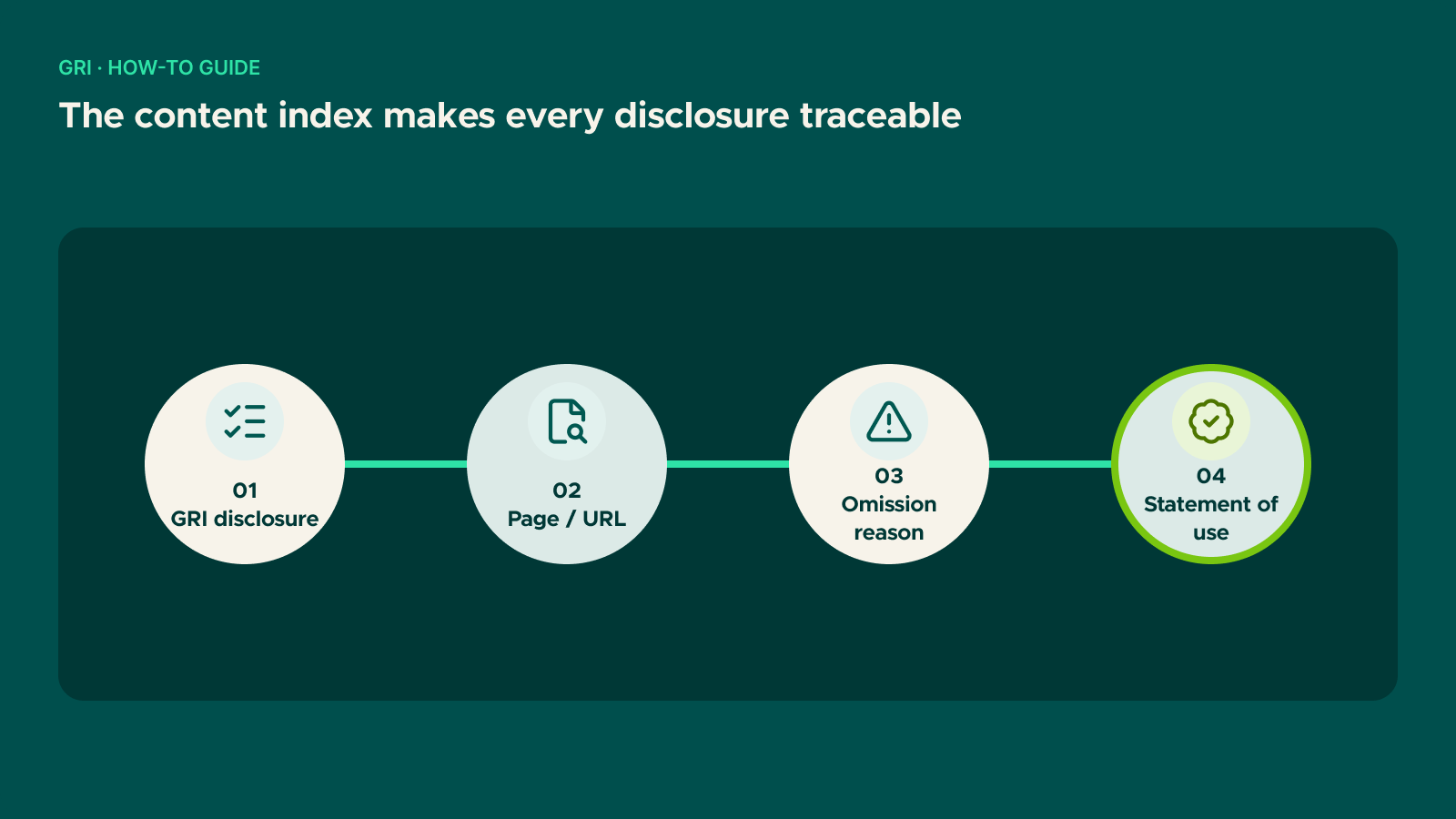
Every "in accordance with" report includes disclosures from GRI 1 (Foundation, primarily the statement of use and any omissions), GRI 2 (General Disclosures — organizational profile, governance, stakeholder engagement, and related items), and GRI 3 (Material Topics — the process, and the list of material topics itself). These form the fixed opening section of the content index regardless of sector.
If a Sector Standard exists for the organization's industry — currently GRI 11 (Oil and Gas), GRI 12 (Coal), GRI 13 (Agriculture, Aquaculture and Fishing), or GRI 14 (Mining) — the disclosures it identifies as likely material must be addressed in the index, either with a disclosure and location, or a stated reason if the organization determined the topic is not material for its context. See Is Your Industry Covered by a GRI Sector Standard? (2026 Update) to confirm whether this step applies.
For each material topic identified in the assessment, list the corresponding Topic Standard disclosures the organization is reporting against. This is where version accuracy matters most: confirm whether a legacy Topic Standard or its current successor applies — for example, whether biodiversity disclosures should reference the 2024-revised GRI 101, whether climate disclosures should reference the new 2025 GRI 102 rather than the legacy GRI 305, and whether energy disclosures should reference the 2025-revised GRI 103 rather than the legacy GRI 302. Citing a superseded standard number in a live content index is one of the most common and most visible errors in GRI reporting.
Each row in the index needs a precise location reference — a page number, section name, or a direct link if the report is published digitally. Vague references ("see Environmental section") should be avoided in favor of specific page or paragraph pointers, since the content index exists precisely so that a reader can verify each disclosure without searching the full report.
GRI permits omitting a disclosure under specific circumstances — for example, where information is confidential or not yet available — but requires the omission and its reason to be stated in the content index itself, not silently dropped. An index with unexplained gaps is a materially weaker document than one that transparently states why a given disclosure was omitted.
Before finalizing, cross-check the content index against the GRI 3 process documentation to confirm that every material topic identified in the assessment has corresponding disclosures in the index, and that no disclosures appear for topics that were not identified as material. Mismatches between the two documents are a common finding when reports are reviewed or assured externally.
The recurring errors in content index preparation are: citing superseded Topic Standard numbers (see Step 4); vague or missing location references; omissions stated without a reason; and a content index that does not match the material topics list produced by the separate GRI 3 assessment.
Semtrio Note: Content index preparation is one of Semtrio's core sustainability reporting services, reflecting Semtrio's GRI Community Membership since 2020 and direct familiarity with current Standard versions and numbering.
If your reporting team needs support building or reviewing a GRI content index, our sustainability reporting team can check disclosure mapping and Standard-version accuracy before publication.
Yes, for reports prepared "in accordance with" GRI. Reports prepared "with reference to" GRI are not required to include a full index but benefit from a partial one covering the disclosures actually used.
GRI does not mandate a single position, but it is commonly placed at the end of the report, or published as a standalone document accompanying it, so readers can reference it independently.
Omissions are permitted under defined circumstances but must be stated in the index along with the reason — silent gaps undermine the report's credibility and are typically flagged by assurance providers or informed readers.
Check GRI's published Standards library for the current in-effect version before finalizing the index — recent revisions to biodiversity, climate change, and energy Topic Standards mean older report templates may reference superseded numbers.
Get in touch
If something you've read here connects to a live project, a reporting deadline, or a decision you're weighing — we're happy to have a useful conversation.
Contact us
Regulation & Compliance

Regulation & Compliance
Regulation & Compliance
Lets talk about your sustainability goals.