Blog
Publish: 02 Sep 26Reading Time: 4 Min
A GRI-referenced sustainability report is one that uses selected GRI Standards disclosures to structure its content, without necessarily meeting the full "in accordance with" requirements. Companies choose this path voluntarily — GRI carries no legal mandate in most jurisdictions — because it delivers stakeholder trust, comparability, and a disclosure structure that a mandatory framework alone may not provide.
Understanding the distinction between "in accordance with" and "with reference to" GRI matters for any board or reporting team weighing how much of the Standards to adopt in a first cycle.
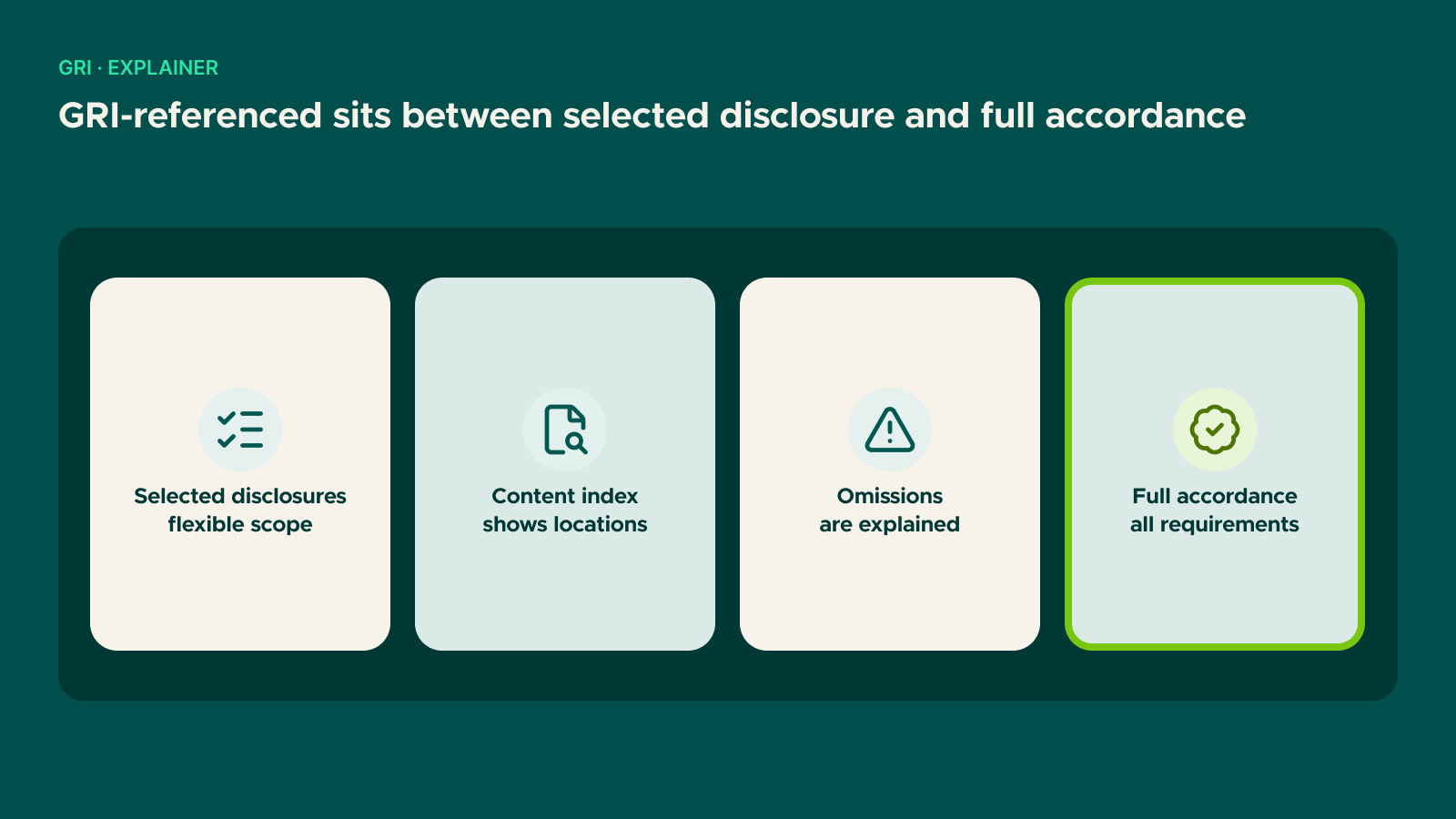
GRI 1: Foundation sets out two ways an organization can use the Standards. Reporting "in accordance with" GRI requires applying all three Universal Standards in full, including a complete GRI 3 materiality assessment and a full content index. Reporting "with reference to" GRI is a lighter-touch option: the organization uses selected GRI disclosures relevant to its needs — for example, specific Topic Standard disclosures on energy or labor practices — without claiming full compliance with every Universal Standard requirement.
"With reference to" reporting is common for organizations in their first one or two reporting cycles, or for companies that want to disclose against specific topics raised by customers or investors without yet committing to the full materiality and content index process. It is a legitimate, GRI-recognized starting point, not a shortcut that undermines credibility — provided the report is transparent about which option was used.
GRI predates most of today's mandatory disclosure regimes by over two decades. It was built as a market-driven standard: something organizations adopt because stakeholders — investors, customers, employees, communities, and regulators in some jurisdictions — increasingly expect transparency on non-financial impact, not because a law requires the specific GRI framework. This is fundamentally different from frameworks like the EU's CSRD/ESRS or IFRS S1/S2, which are becoming legal requirements in the jurisdictions that adopt them. See GRI vs ESRS/CSRD: Which Framework Should Your Company Use? and GRI vs IFRS S1/S2: What's the Difference Between Reporting and Disclosure Standards? for how these compare directly.
Three reasons recur across sectors:
Comparability. GRI's broad, long-established adoption means a GRI-structured report can be benchmarked against peers, competitors, and prior-year performance using a shared disclosure language — something a bespoke, non-standardized ESG report cannot offer.
Stakeholder scope. GRI's impact-materiality approach captures the organization's effects on the economy, environment, and people broadly — not only the issues that are financially material to investors. For companies whose stakeholders include employees, communities, NGOs, and supply-chain partners as well as shareholders, this wider lens is often the more relevant one.
Supply-chain and customer requirements. Large buyers increasingly ask suppliers to complete due-diligence questionnaires and disclosures that mirror GRI's structure, even where no regulation requires it. A company already reporting against GRI Topic Standards is better positioned to respond to these requests without duplicating data-collection work.
Not necessarily. A full "in accordance with" GRI report — with a complete GRI 3 materiality assessment across all applicable Universal, Sector, and Topic Standards, and a properly built content index — is a substantial undertaking regardless of whether a regulator requires it. What voluntary status changes is the organization's control over scope and pace: a company can choose to start with a "with reference to" report covering a handful of priority topics, then expand toward full "in accordance with" reporting in later cycles.
Many companies operating in the EU or other jurisdictions with mandatory disclosure regimes still choose to publish a GRI-referenced report alongside their mandatory filing. The mandatory filing satisfies the legal requirement; the GRI report serves broader stakeholder communication, often including topics or a materiality lens the mandatory framework does not cover in the same depth.
Semtrio Note: Semtrio has been a GRI Community Member since 2020 and regularly advises clients on the choice between "in accordance with" and "with reference to" reporting as part of scoping a first GRI reporting cycle.
If your organization is deciding how much of the GRI Standards to adopt in its first report, our sustainability reporting team can help scope a "with reference to" starting point or a full "in accordance with" program based on stakeholder demand and internal readiness.
It is a different, GRI-recognized scope, not a lesser-quality report. Credibility depends on the report being transparent about which option was used and disclosing accurately within that scope.
Yes. This is a common progression — organizations often start with selected topic disclosures and expand toward a full materiality assessment and content index in subsequent cycles.
GRI does not itself mandate third-party assurance, though many organizations choose external assurance voluntarily to strengthen credibility, and some mandatory regimes layered alongside GRI reporting do require it.
Institutional investors increasingly expect broad, comparable non-financial disclosure as part of standard due diligence, and GRI's wide adoption makes it a familiar reference point even where no specific investor mandate names it.
Get in touch
If something you've read here connects to a live project, a reporting deadline, or a decision you're weighing — we're happy to have a useful conversation.
Contact us
Regulation & Compliance

Regulation & Compliance
Regulation & Compliance
Lets talk about your sustainability goals.


