Blog
Publish: 02 Sep 26Reading Time: 5 Min
A GRI materiality assessment is the process, governed by GRI 3: Material Topics, of identifying and prioritizing an organization's most significant impacts on the economy, environment, and people. It is the foundation of any GRI report: the material topics it identifies determine which Topic Standards an organization discloses against.
Getting this process right matters more than any other single step in GRI reporting, because an incomplete or poorly evidenced materiality assessment undermines the credibility of everything built on top of it — including the content index. (See How to Build a GRI Content Index: A Step-by-Step Guide for the next step in the process.)
Before identifying impacts, GRI 3 requires understanding the organization's activities, business relationships, sustainability context, and stakeholders. This means mapping the value chain — direct operations, upstream suppliers, downstream customers and users — since impacts can occur at any point along it, not only within the organization's own operations.
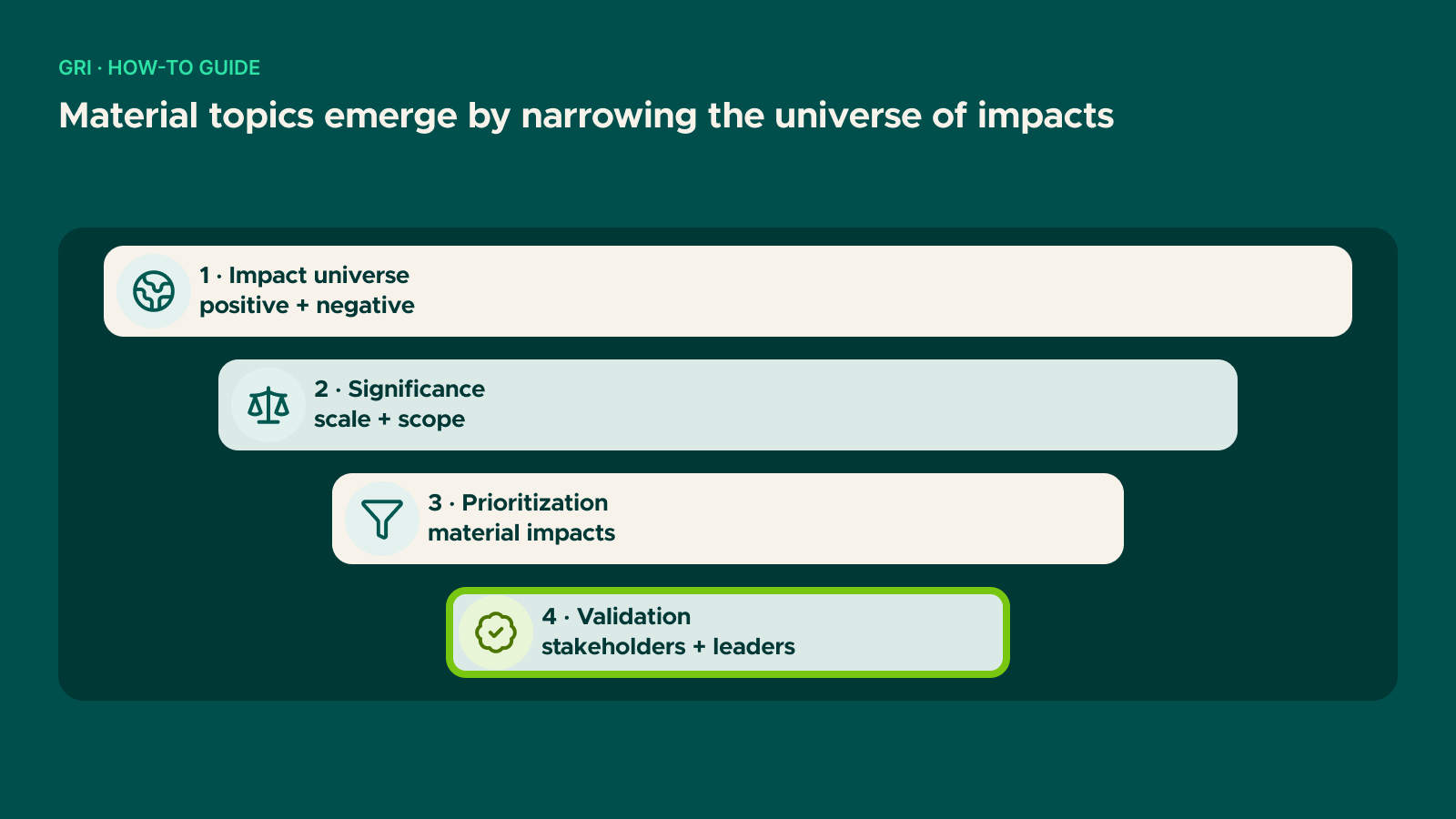
This step involves identifying the organization's actual and potential impacts on the economy, environment, and people, across the value chain mapped in Step 1. Sources for this step typically include: internal subject-matter experts, stakeholder engagement (employees, customers, suppliers, communities, investors, civil society), sector-specific guidance (including the relevant GRI Sector Standard, if one exists — see Is Your Industry Covered by a GRI Sector Standard? (2026 Update)), and external sources such as industry research and expert input.
It is worth being precise here about what GRI is asking for: impact materiality. GRI 3 focuses the organization on identifying impacts on the outside world — the economy, environment, and people — as the primary lens, which is a different starting point from a financial-materiality-only assessment. This is the same distinction discussed in GRI vs ESRS/CSRD: Which Framework Should Your Company Use?, where ESRS applies double materiality (impact and financial) by legal design. GRI 3's more recent guidance has moved closer to double-materiality-adjacent thinking, so organizations increasingly also consider whether an impact carries financial consequence for the business — but the anchor point of a GRI materiality assessment remains the organization's effect on the world, not only the world's effect on the organization's financials.
Once impacts are identified, GRI 3 requires assessing their significance. For actual negative impacts, this means assessing severity — scale, scope, and how difficult the impact is to remedy. For potential negative impacts, severity is assessed alongside likelihood. For actual and potential positive impacts, assessment focuses on scale and scope. This step typically produces a scored or ranked list of impacts rather than a simple yes/no determination.
Not every identified impact rises to the level of a material topic. GRI 3 requires prioritizing the most significant impacts for reporting — this is the step that produces the organization's final list of material topics. Prioritization thresholds should be documented and defensible, since stakeholders and assurance providers may ask how the cutoff between material and non-material was determined.
Each prioritized impact is grouped into a material topic — for example, several distinct impacts related to energy use, emissions, and resource efficiency might collectively support "Energy" as a material topic, corresponding to the relevant Topic Standard (GRI 103: Energy, in its current 2025 form). The organization then selects the specific disclosures within that Topic Standard it will report against.
GRI 3 requires organizations to disclose their process for determining material topics, not just the resulting list. This means documenting: the stakeholders engaged, the sources used to identify impacts, the significance assessment method, and the prioritization threshold applied. This documentation becomes part of the report itself and is often the first thing external assurance providers or discerning readers scrutinize.
The most frequent errors in GRI materiality assessments are: treating it as a one-time exercise rather than a periodic review (material topics can and do shift as the business and its context change); collapsing impact materiality into pure financial materiality without documenting the distinction; and skipping value-chain mapping, which causes organizations to miss impacts occurring at suppliers or through product use rather than direct operations.
Semtrio Note: Materiality assessment is one of the core services in Semtrio's sustainability reporting practice, informed by Semtrio's GRI Community Membership since 2020.
If your organization is preparing its first materiality assessment, or reviewing an existing one that may be out of date, our materiality assessment service can walk through this process end to end.
GRI does not prescribe a single fixed interval, but material topics should be reviewed periodically as the organization's operations, value chain, and stakeholder expectations change — an assessment several years old should not be assumed still accurate without review.
Internal subject-matter experts across relevant functions, plus external stakeholder input — employees, customers, suppliers, communities, investors, and civil society representatives, depending on the organization's context.
No. GRI's core approach is impact materiality; ESRS's double materiality assessment formally combines impact and financial materiality. There is overlap in underlying data and process, but the two are not interchangeable without a mapping exercise.
An impact is a specific effect the organization has (or could have) on the economy, environment, or people. A material topic is the broader subject area — such as energy, water, or labor practices — that groups related significant impacts together and maps to a GRI Topic Standard.
Get in touch
If something you've read here connects to a live project, a reporting deadline, or a decision you're weighing — we're happy to have a useful conversation.
Contact us
Regulation & Compliance
Regulation & Compliance

Regulation & Compliance
Lets talk about your sustainability goals.


