Blog
Publish: 02 Sep 26Reading Time: 5 Min
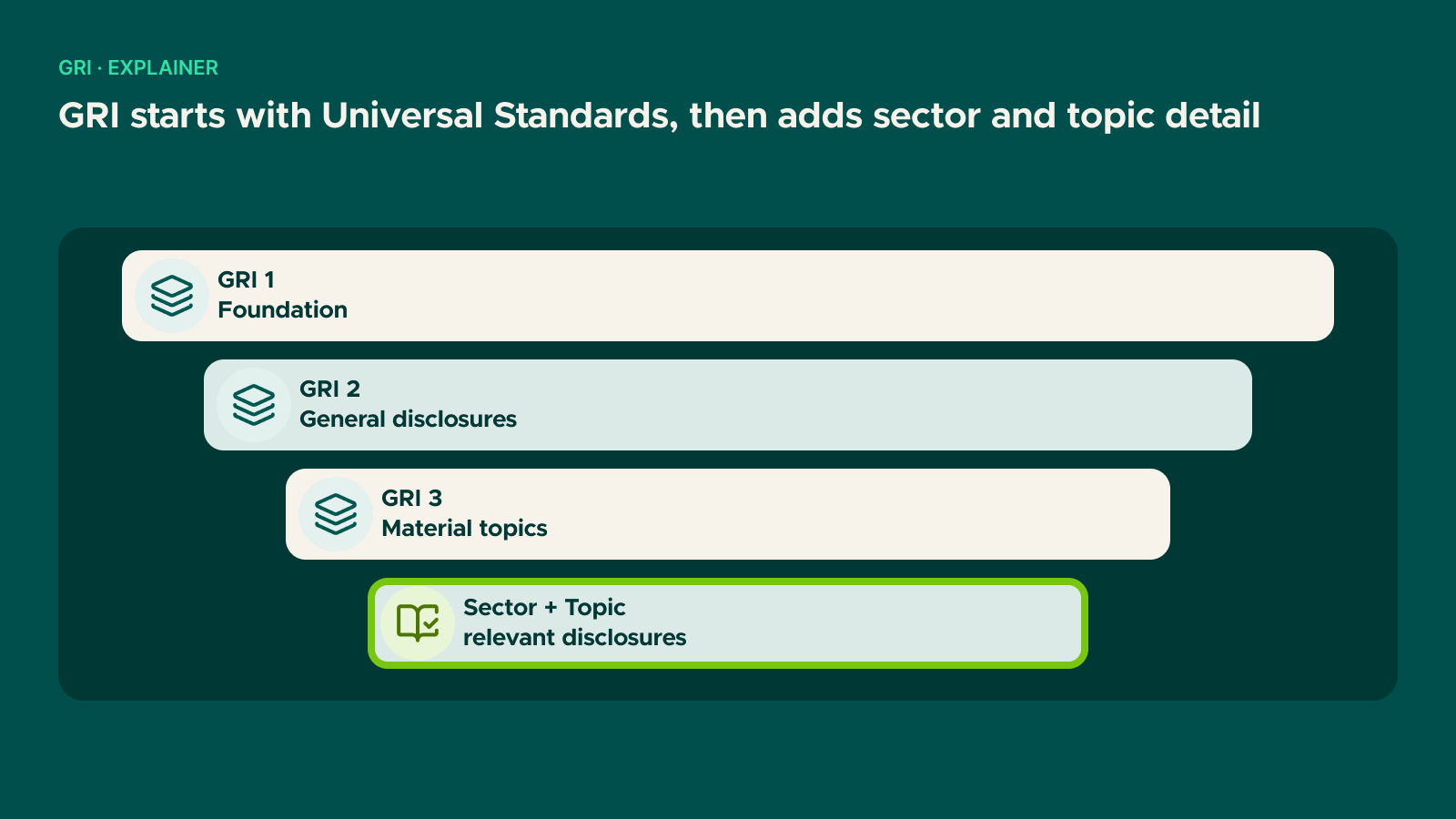
The GRI Standards are organized into three tiers: Universal Standards, which apply to every reporting organization; Sector Standards, which address the specific impacts of a given industry; and Topic Standards, which cover individual issues such as energy, water, or labor practices. Together, these three tiers determine what an organization discloses and how.
This modular structure is what allows GRI to serve organizations as different as a mining company and a regional bank without forcing either into a one-size-fits-all template. Each organization builds its own disclosure set by combining the Universal Standards with the Sector and Topic Standards relevant to its material topics.
Every organization reporting in accordance with GRI applies three Universal Standards:
These three standards are non-optional. An organization cannot report "in accordance with" GRI without applying all three.
Sector Standards translate GRI's general disclosure requirements into the specific impacts most likely to be material for a given industry. As of this writing, four Sector Standards have been published:
Additional Sector Standards are under development for banking, insurance, and capital markets, and a new standard is in progress for textiles, apparel, and footwear. GRI's Sector Program is a long-term undertaking: the stated ambition is to eventually cover roughly 40 sectors, prioritizing those with the highest economic, environmental, and social impact first. For a full breakdown of which industries are and are not yet covered, see Is Your Industry Covered by a GRI Sector Standard? (2026 Update).
When a Sector Standard exists for an organization's industry, GRI 1 requires that it be used to inform the materiality assessment — an organization cannot simply skip the applicable Sector Standard and go straight to Topic Standards.
Topic Standards cover specific sustainability subjects in depth — energy, water and effluents, waste, biodiversity, occupational health and safety, labor/management relations, anti-corruption, tax, and dozens more. An organization reports against the Topic Standards that correspond to the material topics identified through its GRI 3 assessment, not the full library.
Topic Standards are also where much of GRI's recent revision activity has concentrated. GRI 101 (Biodiversity, 2024 revision), GRI 102 (Climate Change, a new 2025 standard), and GRI 103 (Energy, 2025 revision) are now in effect, superseding the legacy numbered topic standards that previously covered these areas (formerly GRI 304 Biodiversity, GRI 305 Emissions, and GRI 302 Energy, respectively). Organizations preparing a report cycle should confirm which version of each relevant Topic Standard currently applies, since the numbering and content have changed materially.
A practical example: a mining company reporting under GRI would apply GRI 1, 2, and 3 (Universal), GRI 14 (Sector), and then whichever Topic Standards its materiality assessment identifies as significant — likely including GRI 101 Biodiversity, GRI 103 Energy, water-related topics, and occupational health and safety, among others. A retail company without an applicable Sector Standard yet would apply the Universal Standards and go directly to the relevant Topic Standards based on its material topics.
This layered structure is also what makes GRI content index preparation a genuine technical exercise rather than a formality — every disclosure needs to be correctly mapped to the right standard, tier, and version. We walk through that process in How to Build a GRI Content Index: A Step-by-Step Guide.
Semtrio Note: As a GRI Community Member since 2020, Semtrio applies this three-tier structure directly in client engagements, including determining which Sector and Topic Standard versions apply to a given reporting cycle.
If your organization is unsure which combination of Universal, Sector, and Topic Standards applies to its reporting scope, our sustainability reporting team can help map this out before the reporting cycle begins.
Only if one exists for their industry. Currently, Sector Standards exist for oil and gas, coal, agriculture/aquaculture/fishing, and mining, with more under development. Organizations outside these sectors report using the Universal Standards and relevant Topic Standards.
The organization reports using the Universal Standards and the Topic Standards relevant to its material topics, following the general GRI 1 requirements. Once a Sector Standard for that industry is published, it becomes the reference point for future materiality assessments.
Several legacy Topic Standards have been superseded by renumbered, revised versions — for example, GRI 302 Energy and GRI 305 Emissions have been superseded by the new GRI 103 (Energy, 2025) and GRI 102 (Climate Change, 2025) respectively. Reporting teams should confirm the current, in-effect version before citing a Topic Standard.
No. GRI 3 is a Universal Standard, and the materiality assessment it governs is what determines which Topic Standards are disclosed against. Skipping it is not compatible with reporting "in accordance with" GRI.
Get in touch
If something you've read here connects to a live project, a reporting deadline, or a decision you're weighing — we're happy to have a useful conversation.
Contact us
Regulation & Compliance

Regulation & Compliance
Regulation & Compliance
Lets talk about your sustainability goals.


