Blog
Publish: 10 Nov 26Reading Time: 7 Min
CDP, originally the Carbon Disclosure Project, is a global non-profit that runs an environmental disclosure system: investors and large buyers ask companies to report on climate change, water security and forests, and CDP scores the answers from A to D-. Each answer is assessed on four consecutive levels (Disclosure, Awareness, Management and Leadership), so the score reflects the evidence behind your answers, not how many questions you filled in. For 2027, request lists open in the week of 22 February and the scoring deadline falls in the week of 26 July.
Last checked: 10 November 2026.
CDP describes itself as "a global non-profit that runs the world's only independent environmental disclosure system". The organisation started as the Carbon Disclosure Project and now uses only the initials. According to CDP, over 22,100 companies disclose through it, and more than 540 capital markets signatories with over US$110 trillion in assets use its data; in 2026, those signatories asked more than 43,000 companies to disclose.
CDP is voluntary in the legal sense. What makes it hard to ignore is who is asking.
Two groups send most requests:
Requesters build their lists in the request window, which for 2027 runs from the week of 22 February to the week of 19 April. A company that is asked to disclose and does not respond is marked as "Did not disclose".
Since 2024, CDP has used one integrated corporate questionnaire in place of separate climate change, water security and forests questionnaires. Water and forests questions appear for companies that have been requested to report on them or that opt in. CDP also aligned the 2024 questionnaire with IFRS S2, the ISSB's climate standard.
The themes are still scored separately. For 2026, CDP scores Climate Change, Water Security and Forests; Plastics, Biodiversity and Ocean questions remain unscored. A company can therefore hold an A in climate change and a different score in water security.
The same emissions inventory, governance records and risk analysis feed the climate and water answers. Treating the themes as two separate projects means collecting the same data twice.
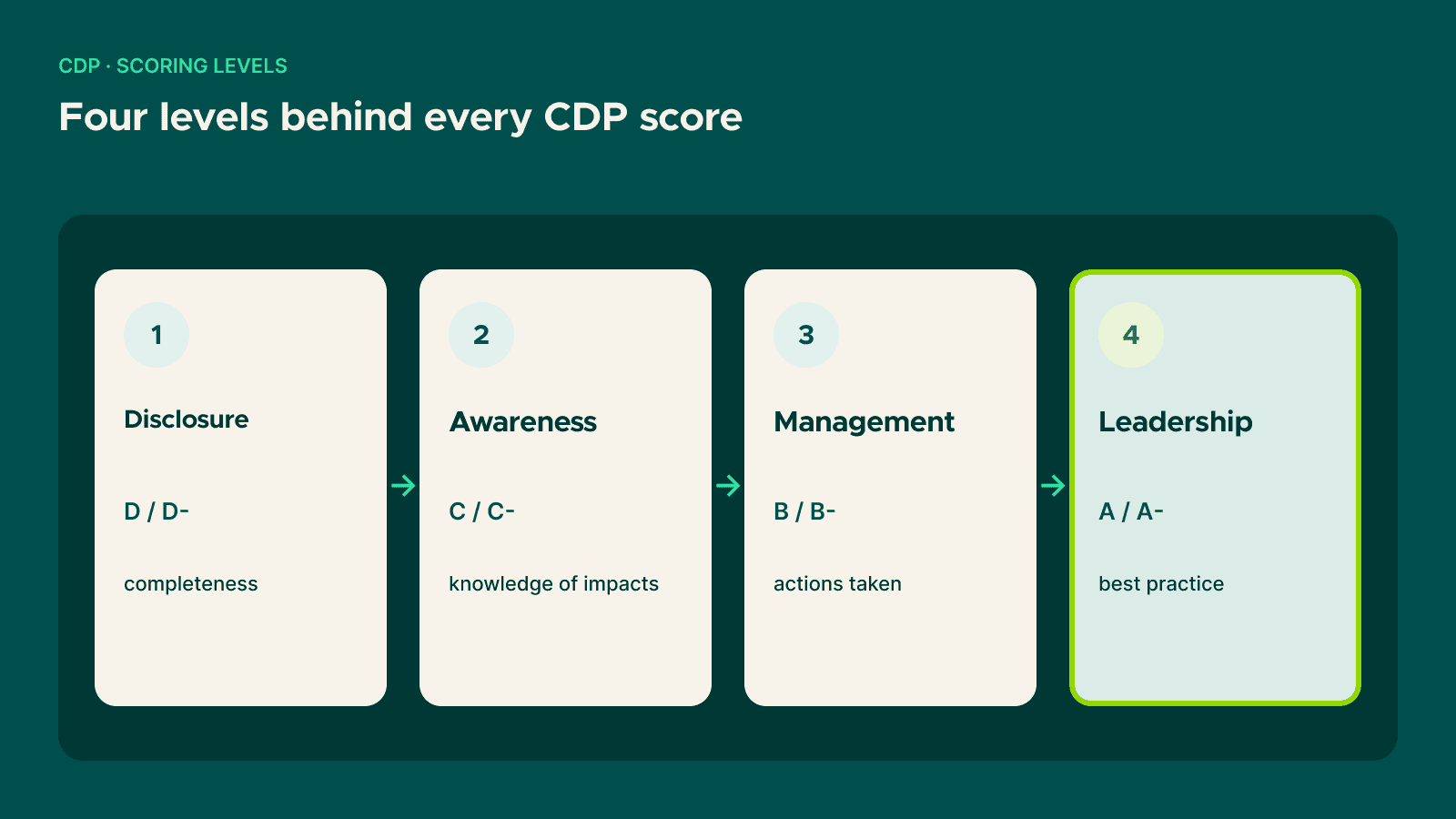
CDP assesses each answer on four consecutive levels, and each level maps to a pair of letter grades:
| Level | What it measures | Letter grade |
|---|---|---|
| Leadership | Best-practice performance and transparency on environmental issues | A / A- |
| Management | Evidence of action and processes to manage environmental issues | B / B- |
| Awareness | Understanding of how environmental issues relate to the company's activities and impacts | C / C- |
| Disclosure | Completeness of the company's reporting | D / D- |
| No response | Requested to disclose but did not respond, or gave too little information to score | Marked "Did not disclose" |
The levels are sequential. Scoring starts at Disclosure, and to move up a level a response must reach a minimum score threshold and meet all Essential Criteria for that level; otherwise the score stays at the level below, however strong other answers are. Two practical consequences follow:
The A List is the group of companies with the top score on a theme. Because Essential Criteria decide whether an answer can move up a level, check the current year's criteria in CDP's scoring methodology rather than relying on last year's.
CDP has updated the 2027 timeline since the dates it first announced in June 2026. The current dates (each is a week commencing) are:
| Milestone | 2027 date (week commencing) |
|---|---|
| Request lists open | 22 February 2027 |
| Request list deadline | 19 April 2027 |
| Response window opens | 26 April 2027 |
| Scoring deadline | 26 July 2027 |
| Final response deadline | 6 September 2027 |
| Scores delivered to disclosers | September 2027 (CDP's stated aim) |
| Public score release | November 2027 (CDP's stated aim) |
A response must be submitted by the scoring deadline to receive a score. For a company planning around a score, the date that matters is the week of 26 July, not 6 September.
The months between the release of 2026 scores and the opening of the 2027 window are the most useful preparation time. Your score report shows where points were lost; those gaps can be closed before the questionnaire opens.
Semtrio is a CDP Accredited Solutions Provider, with 100+ CDP reports prepared.
Our clients' results: in 2025, 33 of the 44 projects we supported reached the A List (75%). 100% of our clients have either improved their score or kept their A List position. Past results, not a guarantee of future scores.
The work behind those results looks different by company. For Turkcell, it started with a gap analysis of earlier responses and module-by-module data templates. At Sabancı Holding, the core task was a consistent consolidation approach across subsidiaries for a group-level response. Ford Otosan's own team led its 2025 disclosure, with Semtrio as methodological guide. At Türk Telekom, a group-wide Scope 1, 2 and 3 inventory came first, then the climate questionnaire.
No law requires it. But when an investor signatory or a customer requests your response through CDP, not responding means your company is marked as "Did not disclose".
CDP was originally the Carbon Disclosure Project. The organisation now uses only the initials, and its questionnaire covers water security and forests as well as climate change.
CDP scores environmental disclosure on climate change, water security and forests in depth. EcoVadis rates a company's management system across environment, labour and human rights, ethics and sustainable procurement. See EcoVadis vs CDP for a side-by-side comparison.
The scoring deadline is the week of 26 July 2027; a response submitted after it will not be scored. The final response deadline is the week of 6 September 2027.
None. A company that was requested to disclose and does not respond, or whose response has too little information to score, is marked as "Did not disclose". That reflects missing information, not an assessment of environmental performance.
Related reading: GRI vs CDP: reporting vs rating · Corporate GHG accounting · What is GRI?
Ahead of the 2027 window, CDP advisory starts with a question-by-question gap list from your current score report, with an owner and a date for each missing piece of evidence before the 26 July scoring deadline.
Get in touch
If something you've read here connects to a live project, a reporting deadline, or a decision you're weighing — we're happy to have a useful conversation.
Contact usLets talk about your sustainability goals.